5 Best Momentic Alternatives in 2026
Written byDominik SzahidewiczReviewed byMariusz Wójcik


Updated: September 2, 2026View as Markdown
Momentic is one of the more interesting AI-native testing platforms available today. It lets teams describe tests in natural language, stores tests as YAML in the repository, uses AI to resolve and heal interactions, and exposes an MCP server so coding agents can create, edit, run, and diagnose tests.
But its operating model is not right for every team.
Momentic is now CLI-first. For web testing, cloud authoring and cloud-hosted execution are deprecated: tests live in your repo, are created through the local editor or coding agents, and run locally or inside your CI infrastructure.
That makes the choice of a Momentic alternative less about finding "another AI testing tool" and more about deciding who should own testing and how you want it to fit into product development. It's the same question we worked through in our look at Autonoma alternatives — in the agent era, the tool decision follows the ownership decision, not the other way round.
Some teams want QA and product people to create regression tests visually. Others want complete engineering control. Some are building around coding agents, while larger QA organizations may need one platform for browser, mobile, API, and cross-device testing.
Here are the five Momentic alternatives we think are worth considering.
| Tool | Best for | Test creation | Execution model | Main trade-off |
|---|---|---|---|---|
| BugBug | QA and product teams sharing regression with engineering | Visual browser recording and editing | Local browser + managed cloud | Web-focused and Chrome-centric |
| Playwright | Engineering teams wanting maximum control | Code | Your infrastructure / CI | Highest engineering and maintenance responsibility |
| Shiplight | Teams building around AI coding agents | AI agents, natural language, YAML, visual tools | Agent-first testing built on Playwright | Best value comes when coding agents are central to development |
| mabl | Enterprise teams needing a broad low-code quality platform | Low-code + AI | Local, CI, and managed cloud | Broader and more enterprise-oriented than many web-only teams need |
| Testsigma | QA teams needing broad no-code and cross-device coverage | No-code, NLP, recorder, AI | Local + cloud/device infrastructure | Broad platform rather than a focused web regression tool |
Momentic has changed significantly. Older comparisons that describe it as a cloud-only tool or claim its tests cannot be versioned are no longer accurate. Tests now live as YAML files in your repository, and Momentic actively encourages Git- and coding-agent-based workflows.
The more relevant reasons to consider an alternative in 2026 are different.
Momentic can be used through a local editor, but its current direction is closely tied to the CLI, repository-based tests, and coding agents through MCP.
If manual QA, product managers, or support teams are responsible for building regression coverage, a recorder-first workflow may be a better organizational fit.
Momentic has deprecated cloud-hosted execution for web tests. Its web tests now run locally or in your CI environment, with results optionally uploaded to the dashboard.
Teams that want schedules, hosted runners, and regression execution without operating the testing infrastructure themselves may prefer a managed platform.
Momentic's current web documentation lists Chromium, Google Chrome, and Chrome for Testing as supported browser options.
If Firefox or WebKit coverage is important, alternatives such as Playwright or broader cloud testing platforms provide more options. Playwright, for example, supports Chromium, Firefox, and WebKit.
Momentic now covers web, iOS, and Android, with mobile execution available on local or remote emulators and simulators.
But organizations that also need API testing, real-device coverage, accessibility, performance testing, or a wider low-code testing tools may prefer a broader platform such as mabl or Testsigma.
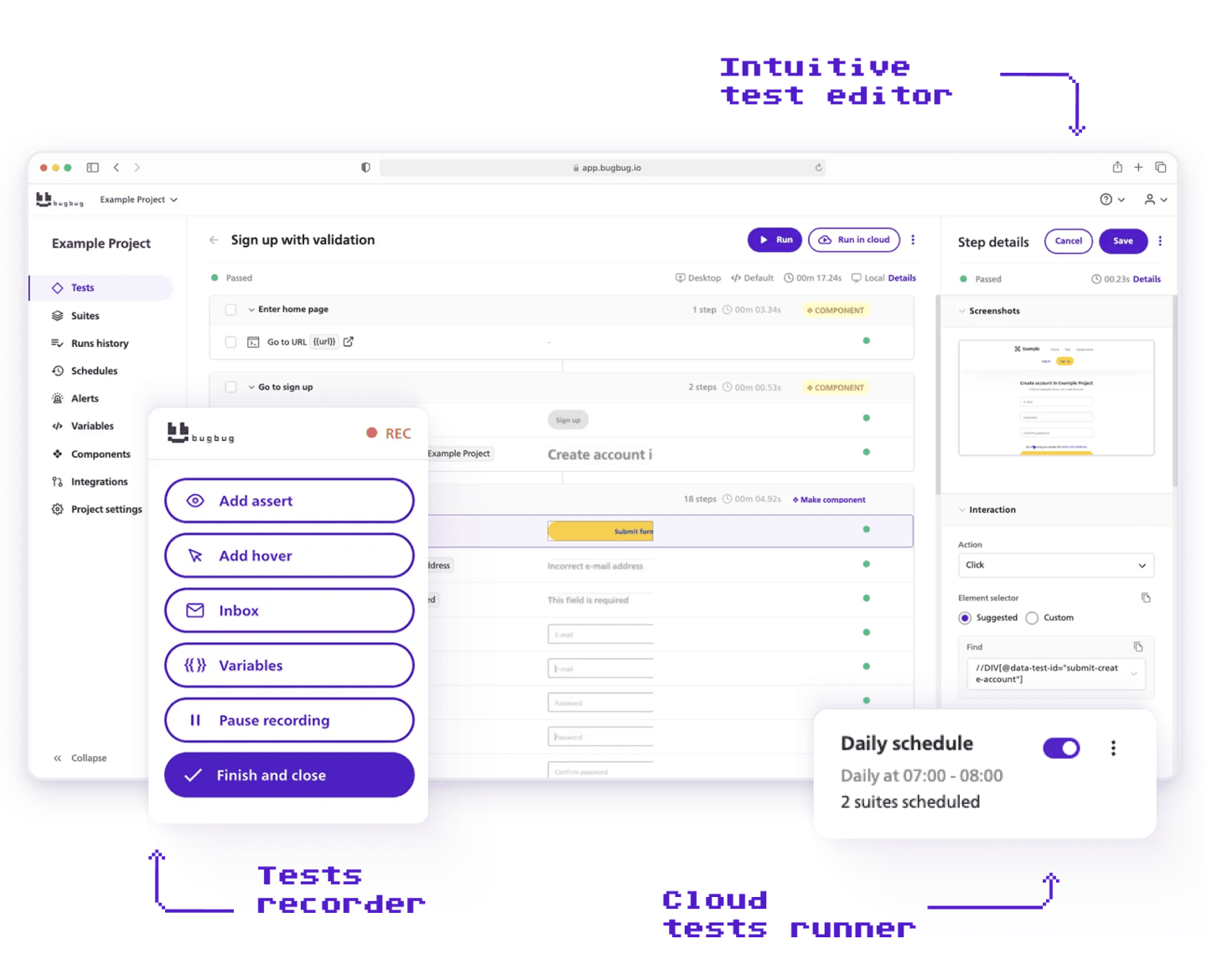
BugBug takes a different starting point from Momentic.
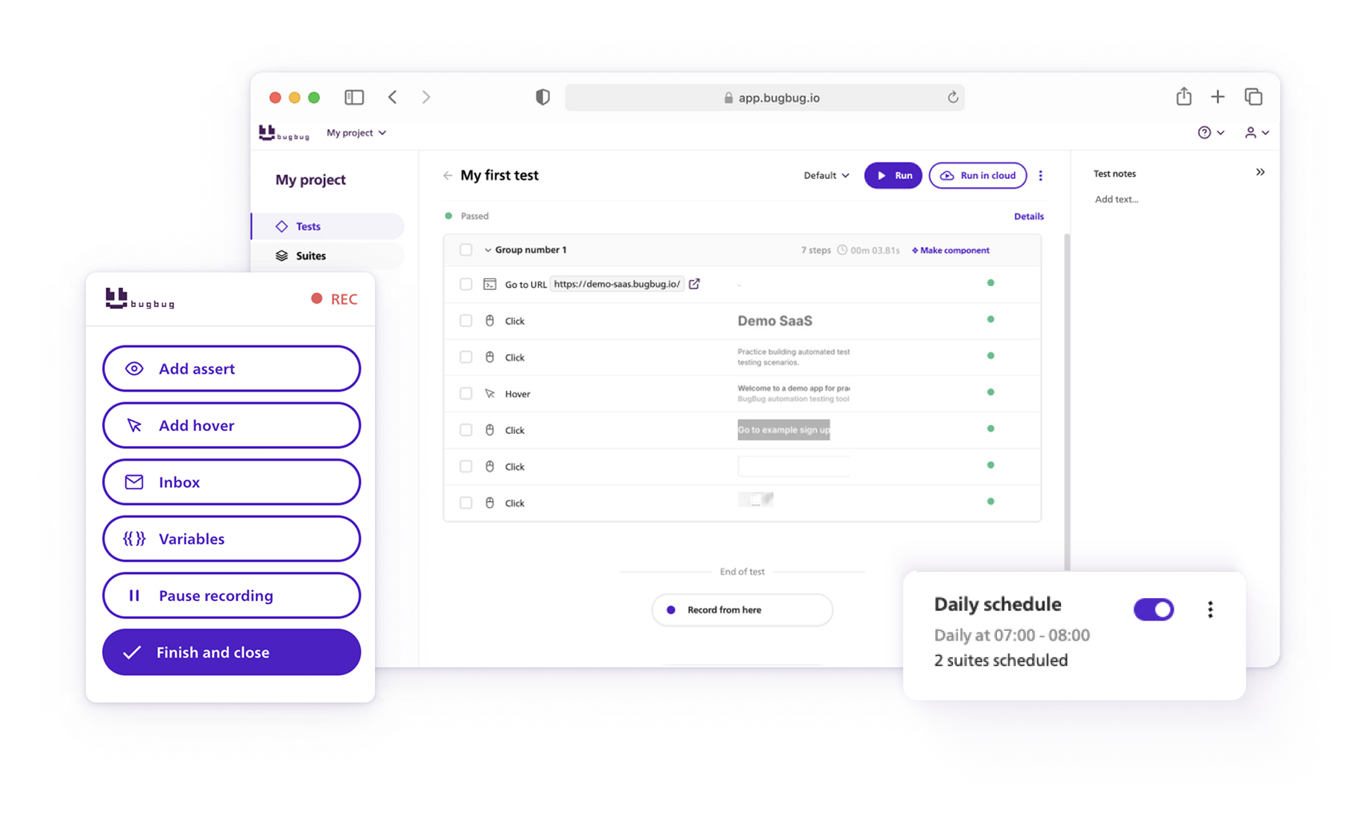
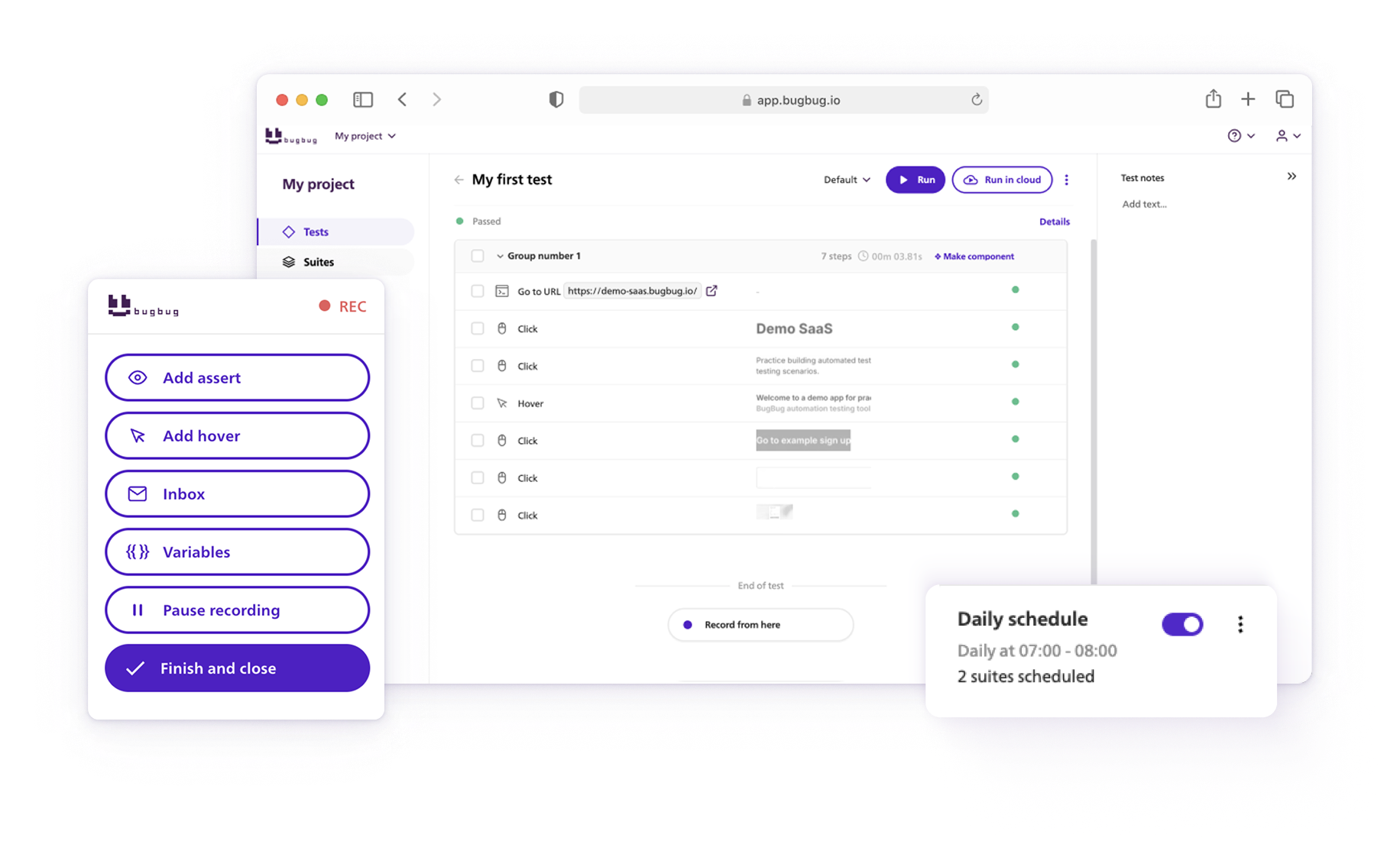
Instead of asking a developer or agent to describe a test, you can simply perform the workflow in Chrome. BugBug records clicks, typing, navigation, form interactions, assertions, hover actions, and drag-and-drop as reusable test steps. Tests can then be edited visually without writing automation code.
Behind that visual workflow, BugBug handles waiting conditions, selectors, reusable components, variables, and test execution. Tests can run directly in a local Chrome browser or on BugBug's managed cloud infrastructure. If you've never built a test this way, our automation testing tutorial walks through a first passing test end to end.
Developers are not excluded from the workflow. BugBug supports CLI and API integrations with CI/CD pipelines, and YAML import and export shipped in 2026 — available on every plan, including Free.
In Momentic, YAML is the test. It lives in your repo, the CLI runs it, and changing a step means opening the file. In BugBug, YAML is a projection of the test. You record and maintain the workflow visually, then export it as a readable definition whenever someone needs to diff a change, review it in a PR, or keep a copy in Git. Import it back and BugBug shows current and incoming definitions side by side before anything is overwritten, and every exported file references a JSON Schema you can validate in your editor or in CI.
A full project export goes further than a single test: a ZIP can carry reusable components, suites, profiles, project settings, folder structure, upload attachments, and visual regression baselines — a complete copy of what the project depends on.
One honest limitation, because it cuts both ways: BugBug YAML is a test definition, not standalone executable code. A .bugbug.yaml file doesn't run by itself — you import it and execute locally, in BugBug Cloud, or from CI. Momentic's YAML runs directly from the CLI. If your requirement is a file that executes anywhere with no platform behind it, that's a point for Momentic. If your requirement is that a product manager can still fix a broken login step in month six without touching a repo, it isn't.
QA or product people are responsible for building regression coverage. Recording a working user flow is often faster than describing or scripting it.
You don't want to operate browser-test infrastructure. BugBug provides managed cloud runs, schedules, and CI/CD execution in addition to local runs.
You want testers and developers working on the same regression process. Test creation stays visual while engineering interacts through CI, CLI, APIs, and exported YAML.
You want portability without making the repo the authoring surface. Tests export as readable YAML and full-project ZIPs on every plan, so exit cost stays near zero without moving ownership into Git.
BugBug is primarily focused on web application testing, while Momentic also supports native iOS and Android testing through simulators and emulators.
BugBug's current browser workflow is Chrome-centric, so it is not the choice for teams that need broad Firefox/WebKit coverage today.
Momentic's YAML executes from the CLI without the platform in the loop; BugBug's YAML is a definition you import back in order to run.
Choose BugBug when regression testing needs to remain accessible to QA and product teams without creating a separate testing world for engineering.
Momentic is stronger today for an engineering- and agent-first workflow. BugBug is the better fit when humans still need a fast visual way to create and govern regression coverage while engineering plugs into the same testing process — and, since the 2026 YAML release, without giving up structured, reviewable, portable test definitions.

Playwright is the obvious alternative if your reaction to Momentic is:
"We don't need another testing platform. We want to own the automation ourselves."
Playwright gives developers direct programmatic control over browser automation. It supports Chromium, Firefox, and WebKit, automatically waits for elements to become actionable, and includes Trace Viewer for debugging failed tests with DOM snapshots, screenshots, network activity, and console information.
There is no visual abstraction between your team and the test implementation. Your test code, fixtures, configuration, CI setup, browser installation, reporting, and maintenance strategy are yours.
For some engineering organizations, that is exactly the point. For a fuller picture of what you take on, see our roundup of Playwright alternatives and the Playwright cheat sheet.
The flexibility comes with responsibility.
Someone has to design the test architecture, maintain the suite, keep browser dependencies current, debug failures, and operate it in CI. Playwright provides strong primitives such as auto-waiting and Trace Viewer, but it does not remove the need to own the automation engineering itself. That trade-off — free framework, expensive ownership — is the same one we walk through for every open-source testing tool.
Momentic's value proposition is almost the opposite: describe intent and let its AI layer handle more of the element resolution and maintenance. Its step cache can replay resolved actions and invoke AI again when something changes.
Choose Playwright when control matters more than reducing automation engineering.
It is arguably the strongest option on this list for engineering teams that actively want to own their testing stack. It is a weaker answer when the reason you're looking beyond Momentic is that too much testing already depends on developers.
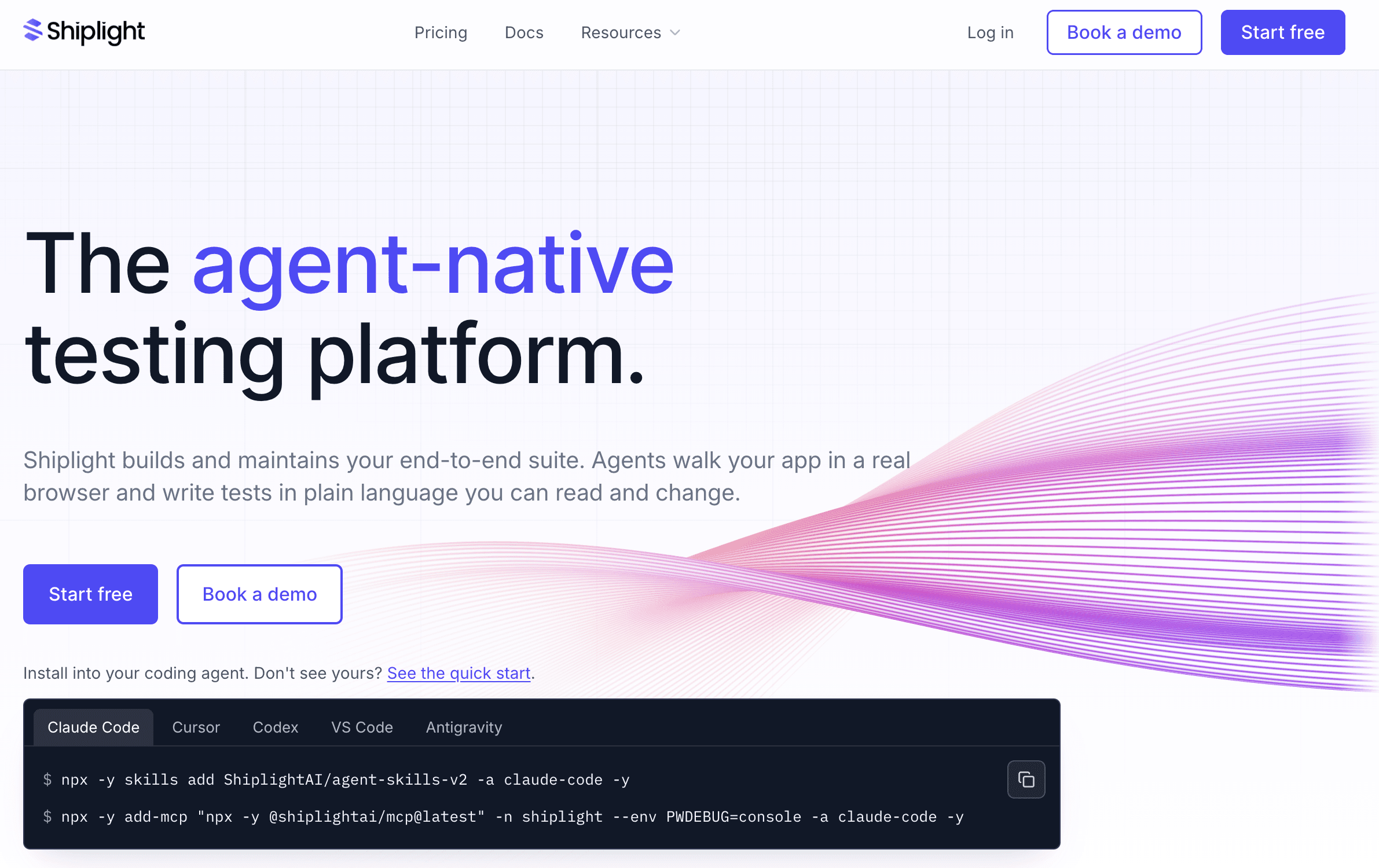
Shiplight is probably the closest alternative to Momentic in terms of where software development is heading.
Its core proposition is not traditional no-code automation. Shiplight connects directly to coding agents such as Claude Code, Cursor, Codex, and GitHub Copilot through MCP and Skills. The agent can open a real browser, verify a change, generate regression tests, and run existing coverage without leaving the development workflow.
Shiplight's current product also includes natural-language testing, a visual editor, self-healing behavior, and YAML authoring. Tests are YAML that transpiles to Playwright at run time, so they run alongside an existing Playwright suite rather than replacing it. Local MCP browser automation and test authoring are free with no account required.
Shiplight is most compelling when your coding agent is becoming an active participant in your development process.
Instead of treating QA as something that happens after implementation, Shiplight's agent-first model aims to let the same coding workflow verify UI changes and create regression coverage as code is being built.
Consider it when:
This is less a feature gap than a workflow question.
Momentic now also has MCP, YAML tests in the repository, natural-language authoring, and agent-driven browser interaction. The choice between them is therefore much closer than older comparisons suggest.
If AI coding agents are not central to how your team ships software, Shiplight's strongest differentiation may simply not matter enough. Teams primarily looking for conventional QA-led recording and regression management should evaluate a recorder-first platform separately.
Choose Shiplight when testing should happen inside the AI coding loop, not as a separate QA workflow.
Among the alternatives here, it is the most direct competitor to Momentic's increasingly agent-first direction.

mabl is less of a direct Momentic replacement and more of a broader quality engineering platform.
It combines low-code test creation with AI capabilities across browser, mobile, and API testing. QA and business users can create workflows visually or from natural-language intent, while developers can extend tests with code and integrate testing into their delivery pipelines.
Its platform also covers visual assertions, accessibility and performance testing, cloud execution, CI integration, and enterprise support.
mabl is a bigger platform.
That breadth is useful when you need it, but it can also be more than a small web team requires. Pricing is customized rather than presented as a simple self-service tier, which also reflects its more enterprise-oriented buying motion. If the price or the scope is what's giving you pause, we compare the field in our guide to mabl alternatives.
Momentic has a clearer proposition for teams whose workflow revolves around repo-based YAML, CLI execution, and coding agents through MCP.
Choose mabl when you're solving an organization-wide quality engineering problem rather than only replacing your web E2E framework.
For a small engineering team, it may be too much platform. For a larger QA organization covering multiple application layers, that breadth becomes the reason to buy it.
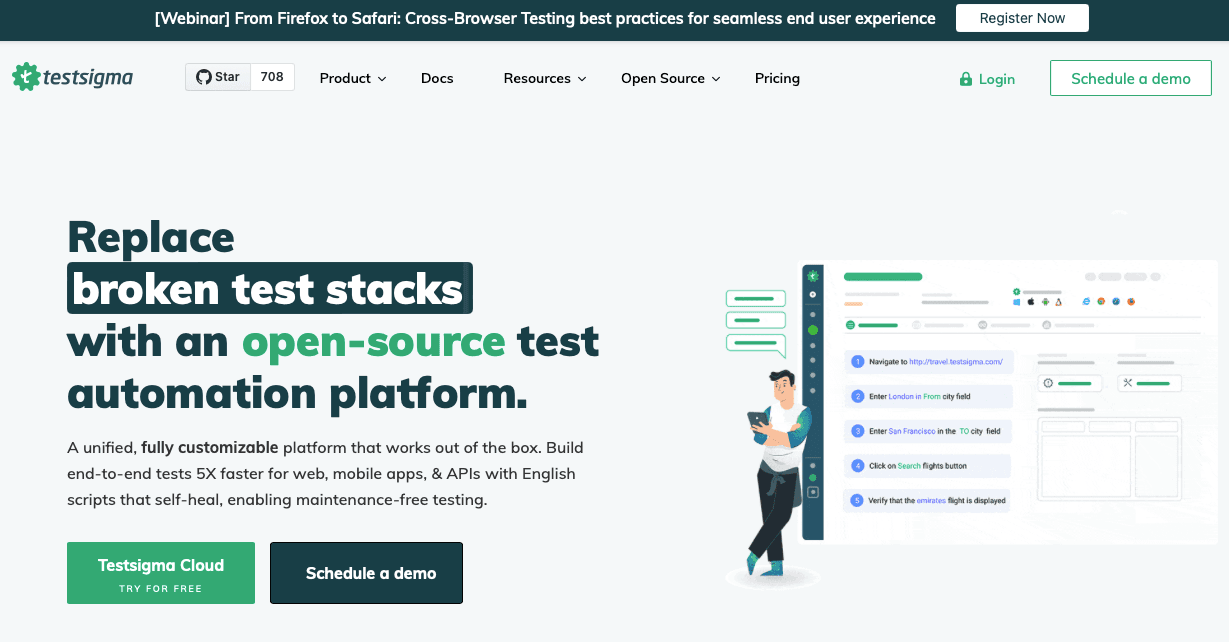
Testsigma goes even broader on test coverage.
The platform supports web, native mobile, mobile web, desktop, Salesforce, and REST API testing. Tests can be created through plain English, AI-generated scenarios, or recording rather than traditional test code.
Its cross-device platform supports execution across browsers, operating systems, devices, cloud infrastructure, and local environments.
Testsigma also increasingly uses AI agents to generate tests from sources such as Jira requirements, Figma designs, files, images, and videos.
Breadth comes with a different product philosophy.
If your ideal workflow is:
test files in the repository → coding agent through MCP → run from CLI in CI
Momentic is much closer to that architecture.
Testsigma makes more sense when the QA platform itself is where much of the testing process is coordinated. Pricing is the other common objection — see Testsigma alternatives for cheaper options with similar authoring models.
Choose Testsigma when coverage breadth matters more than having a narrowly engineering-native testing workflow.
It is particularly attractive when "E2E testing" means more than browser automation.
There isn't one universal winner.
The right choice depends mostly on who owns regression testing and how much of the testing stack you want to operate yourself.
| Your priority | Best fit |
|---|---|
| QA and product teams creating browser regression tests | BugBug |
| Maximum code and infrastructure control | Playwright |
| Testing inside AI coding-agent workflows | Shiplight |
| Enterprise low-code quality engineering | mabl |
| Broad no-code web, mobile, desktop, and API testing | Testsigma |
| Repo-native YAML + MCP + AI-maintained tests | Momentic |
If you're already happy with Momentic's CLI-first model, its Chrome-family browser support is sufficient, and your engineers or coding agents are comfortable owning the workflow, you may not need to switch at all.
An alternative becomes more interesting when the operating model — not simply a missing feature — is the problem. Our broader comparison of automation testing tools covers how that decision plays out across categories.
BugBug and Momentic are converging on some of the same ideas, but they approach test automation from opposite directions.
| BugBug | Momentic | |
|---|---|---|
| Primary starting point | Record a real browser workflow visually | Describe behavior through local editor, YAML/MCP workflow |
| Source of truth | Visual test in the platform | .yml file in your repo |
| Role of YAML | Export/import for review, diff, Git, and backup | Mandatory — it is the test |
| Editing a step | In the visual editor; file optional | Open the file |
| Does the YAML execute directly? | No — it's a definition you import, then run | Yes, via CLI |
| Best suited to | QA, product teams, developers | Developers and AI-agent-driven teams |
| Local execution | Yes, in Chrome | Yes, through CLI |
| Managed web cloud execution | Yes | Deprecated |
| CI/CD | CLI/API integrations with BugBug execution | CLI running in your CI |
| Project-level backup | Full project ZIP: components, suites, profiles, settings, attachments, visual baselines | Repo is the backup |
| AI-agent access | [VERIFY MCP STATUS] | MCP today |
| Native mobile testing | No | iOS + Android simulators/emulators |
| Web browsers | Chrome-centric | Chromium/Chrome family |
BugBug's strongest advantage is accessibility without isolating QA from engineering.
A manual tester can record a critical customer workflow and turn it into repeatable regression coverage without setting up a framework. Developers can integrate those tests into CI/CD through the CLI and API, and review the same tests as exported YAML in a pull request. BugBug also provides the managed cloud execution layer, so the team does not need to build browser-runner infrastructure just to automate regression.
Momentic takes the more engineering-native route. Tests already live as YAML beside the code, execution happens locally or in CI, and coding agents can manipulate the suite through MCP.
Our verdict: choose Momentic when developers and AI agents are becoming the primary operators of your E2E suite. Choose BugBug when QA and product teams still need to create and govern regression tests themselves, but you don't want those tests disconnected from engineering.
The 2026 YAML import/export release is what makes that bridge real rather than aspirational: visual for the people who create tests, structured and reviewable for engineering, and portable enough that nothing is trapped in the platform.
Your next release. Properly tested.
Join 1,200+ QA teams that automated their regression coverage with BugBug.

Dominik Szahidewicz is a Software Quality Evangelist specialising in quality assurance, test automation, and modern software testing practices. He creates practical, research-driven content that helps QA professionals, developers, and product teams improve test coverage, automate repetitive testing, and release more reliable web applications.
Drawing on his experience in technical writing, data analysis, and application consulting, Dominik translates complex testing concepts into clear, actionable guidance. His areas of interest include end-to-end testing, no-code test automation, regression testing, and the use of AI in software quality assurance.

Senior software engineer at BugBug, where he's spent 6 years helping shape the product. He's a T-shaped developer skilled in frontend with React and TypeScript, browser extensions, backend work, and building AI agents and tooling. His strengths also include UX instincts, a product-minded approach, and process automation.
Join thousands of QA experts. Subscribe to our newsletter.
Get more testing tips and product related content. Zero spam.
Discover essential business tools for startups. Read the article to find the right tools for your success.
Learn how to automate regression testing without devs or QA. Discover a risk-based strategy and practical workflows.
Discover the essential QA tester skills for 2026! Learn the technical and soft skills required to excel as a QA Tester.
Build a CI/CD testing pipeline in 30 minutes with BugBug. Learn how to run reliable E2E smoke tests on every PR, block bad merges, and scale safely.
Discover how to calculate ROI for test automation with easy formulas and practical examples. Learn to evaluate costs and track results effectively.
Compare the best SaaS testing tools for startups, QA, and dev teams. See use cases, pricing, and key SaaS flows to automate.
Discover essential accessibility testing tools and software in our guide. Learn how to make your applications accessible for everyone.
Discover the best API integration tools for 2026. We explore top platforms like IBM API Connect and Microsoft Azure.
In this guide, we’ll explore the best beta testing tools available in 2026, compare their key features.