Automated Regression Testing
Automated regression testing for fast-moving SaaS teams
BugBug turns critical web app flows into automated regression tests - recorded in the browser, run in the cloud or CI/CD, and maintained without a heavy framework.












See it in action
See a checkout regression run before release
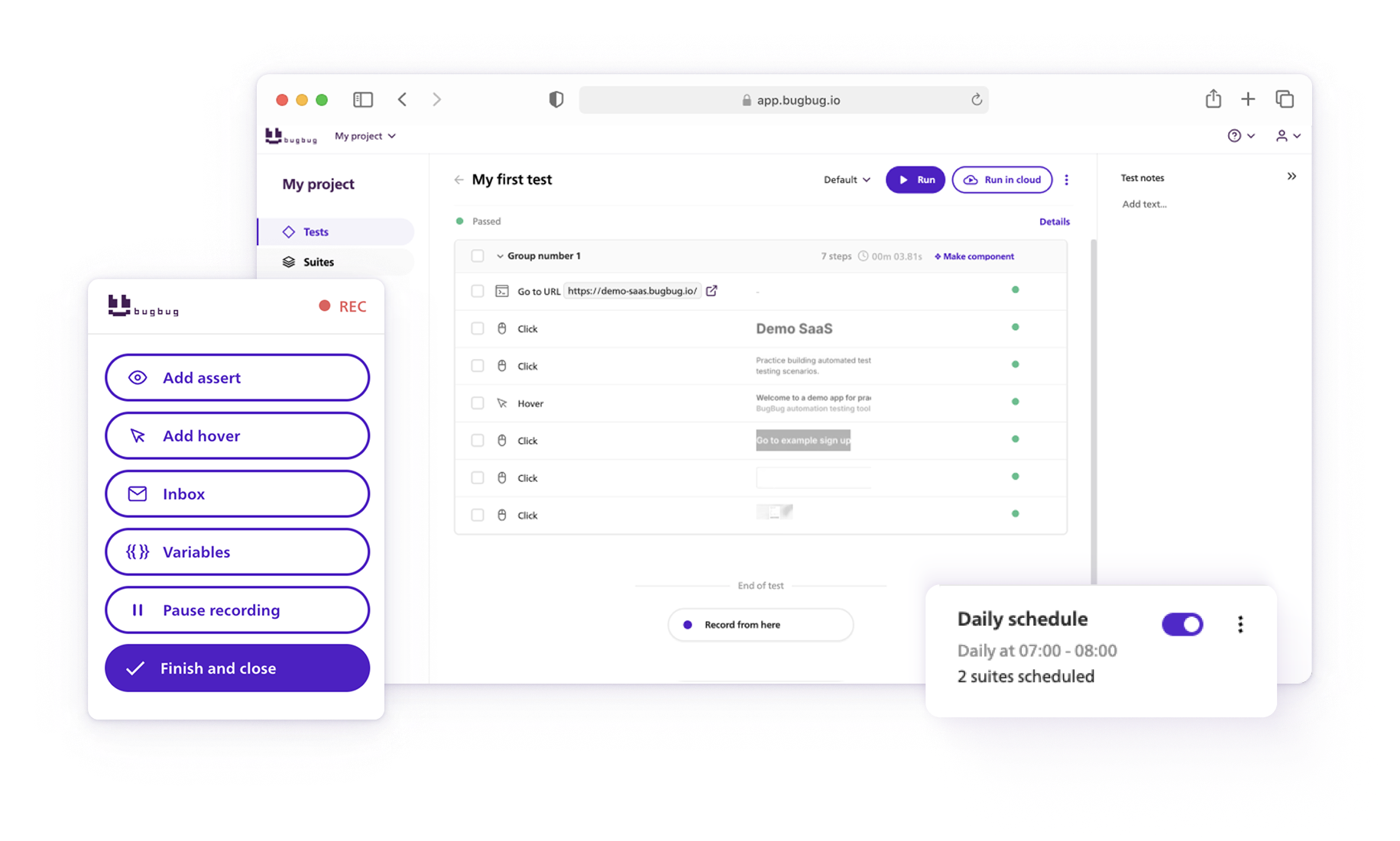
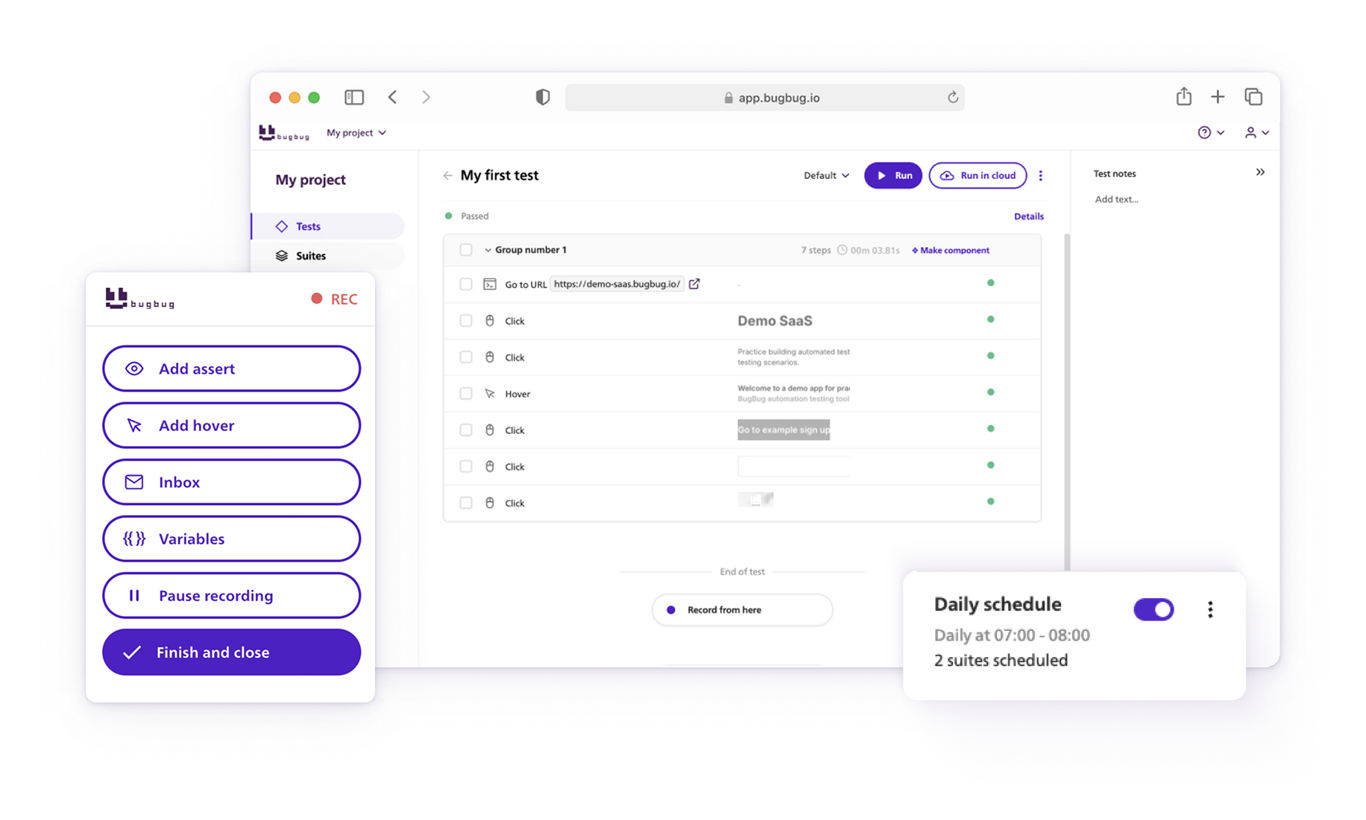
BugBug records real browser actions and turns them into repeatable regression tests. Run them on demand, on a schedule, or before deployment, then inspect screenshots, logs, and failed steps when something breaks.
The problem
Regression testing breaks when teams ship faster than QA can keep up
Manual regression does not scale
Every release adds more flows to check: login, signup, billing, permissions, checkout, settings, onboarding, and password reset. A small QA team cannot manually retest everything before every deploy.
Framework maintenance steals engineering time
Playwright and Selenium are powerful, but someone still has to write tests, maintain selectors, debug flaky runs, configure CI, and keep the suite usable as the product changes.
AI-generated code increases release pressure
AI coding tools help teams ship more changes faster. Without an automated regression gate, untested changes reach production faster too.
Coverage gaps become production bugs
Teams usually test the obvious paths. Regressions often happen in secondary flows: billing edge cases, account settings, invitations, onboarding, and forgotten user journeys.
How it works
From manual checklist to automated regression suite
- 1
Record the flow
Click through your app in Chrome: login, signup, checkout, billing, onboarding, password reset, or any critical SaaS workflow.
- 2
Add assertions
Verify text, URLs, buttons, emails, page states, and expected outcomes.
- 3
Group tests into suites
Create smoke, regression, checkout, onboarding, billing, or release-gate suites.
- 4
Run automatically
Schedule tests in the cloud or trigger them from CI/CD before deployment.
- 5
Debug and maintain
Use screenshots, logs, failed-step context, and Edit & Rewind to fix the exact step that broke.
Where to start
Regression tests SaaS teams should automate first
Start with the flows that would hurt the business most if they broke silently after a release.
Flow
Login
What BugBug can verify
Users can sign in and reach the dashboard
Flow
Signup
What BugBug can verify
New users can create an account and verify email
Flow
Checkout
What BugBug can verify
Payments, totals, discounts, confirmations, and redirects work
Flow
Subscription management
What BugBug can verify
Plan changes, cancellations, and billing states work
Flow
Password reset
What BugBug can verify
Reset emails arrive and links work correctly
Flow
Team invitations
What BugBug can verify
New team members can be invited and onboarded
Flow
Account settings
What BugBug can verify
Profile, permissions, and notification settings still work
Flow
Critical dashboard action
What BugBug can verify
The core product workflow works after every release
| Flow | What BugBug can verify |
|---|---|
| Login | Users can sign in and reach the dashboard |
| Signup | New users can create an account and verify email |
| Checkout | Payments, totals, discounts, confirmations, and redirects work |
| Subscription management | Plan changes, cancellations, and billing states work |
| Password reset | Reset emails arrive and links work correctly |
| Team invitations | New team members can be invited and onboarded |
| Account settings | Profile, permissions, and notification settings still work |
| Critical dashboard action | The core product workflow works after every release |
Why BugBug
Why SaaS teams use BugBug for automated regression testing
AI-assisted test recorder
Record critical browser flows by using your product like a real user. BugBug captures clicks, inputs, assertions, tabs, iframes, and dynamic UI behavior without manual XPath or CSS setup.
More stable web regression suites
Adaptive locators, smart waiting, and smart click-and-scroll help reduce flaky failures caused by dynamic interfaces.
Scheduled cloud runs and CI/CD gates
Run regression tests every few minutes, nightly, after deploys, or inside your CI/CD pipeline when your team is ready to make tests part of the release process.
Faster debugging and maintenance
Use screenshots, console logs, failed-step details, and Edit & Rewind to update tests without re-recording the full scenario.
Compare
BugBug vs other ways to automate regression testing
A quick side-by-side of common approaches and where BugBug fits in the mix.
Manual regression testing
- Strength
- Flexible, no setup
- Main limitation
- Slow, repetitive, hard to scale before every release
- Where BugBug fits
- Automates repeatable checks so QA can focus on exploratory work
Playwright / Selenium
- Strength
- Powerful and fully flexible
- Main limitation
- Requires coding, CI setup, selector maintenance, and developer ownership
- Where BugBug fits
- Better when QA/PMs also need to contribute without maintaining a full framework
Cypress
- Strength
- Developer-friendly web testing
- Main limitation
- Still code-heavy and requires ongoing maintenance
- Where BugBug fits
- Easier for cross-functional SaaS regression coverage
DIY AI + Playwright
- Strength
- Fast first test generation
- Main limitation
- Still needs infrastructure, review, storage, reporting, scheduling, and maintenance
- Where BugBug fits
- BugBug gives managed execution, UI review, schedules, reports, and team workflows
Autify / Aximo
- Strength
- Autonomous AI regression across multiple platforms
- Main limitation
- Broader than many web-first SaaS teams need
- Where BugBug fits
- BugBug is simpler and more focused for Chromium-based web app regression
QA Wolf
- Strength
- Fully managed QA
- Main limitation
- Higher cost and less internal ownership
- Where BugBug fits
- BugBug is better when the team wants to own and maintain its own suite
BugBug
- Strength
- Fast web regression automation for SaaS teams
- Main limitation
- Not for native mobile, desktop, or full cross-browser testing
- Where BugBug fits
- Best fit for web-first teams that need maintainable regression coverage quickly
| Approach | Strength | Main limitation | Where BugBug fits |
|---|---|---|---|
| Manual regression testing | Flexible, no setup | Slow, repetitive, hard to scale before every release | Automates repeatable checks so QA can focus on exploratory work |
| Playwright / Selenium | Powerful and fully flexible | Requires coding, CI setup, selector maintenance, and developer ownership | Better when QA/PMs also need to contribute without maintaining a full framework |
| Cypress | Developer-friendly web testing | Still code-heavy and requires ongoing maintenance | Easier for cross-functional SaaS regression coverage |
| DIY AI + Playwright | Fast first test generation | Still needs infrastructure, review, storage, reporting, scheduling, and maintenance | BugBug gives managed execution, UI review, schedules, reports, and team workflows |
| Autify / Aximo | Autonomous AI regression across multiple platforms | Broader than many web-first SaaS teams need | BugBug is simpler and more focused for Chromium-based web app regression |
| QA Wolf | Fully managed QA | Higher cost and less internal ownership | BugBug is better when the team wants to own and maintain its own suite |
| BugBug | Fast web regression automation for SaaS teams | Not for native mobile, desktop, or full cross-browser testing | Best fit for web-first teams that need maintainable regression coverage quickly |
Who it's for
Built for SaaS teams where QA, product, and engineering share quality
For QA engineers
Automate repetitive regression checks, maintain tests faster, and stop being the bottleneck before every release.
For engineering leaders
Add a regression gate without hiring a bigger QA team or assigning developers to maintain a full testing framework.
For developers
Run regression suites from CI/CD, inspect failed runs, and extend flows with JavaScript or CLI when needed.
For product managers
Record business-critical flows and get visibility into what is tested without waiting for engineering to write every test.
Pricing fit
Which BugBug plan fits automated regression testing?
Most SaaS teams start with Core when they need scheduled regression monitoring, then move to Pro when regression testing becomes part of the deployment pipeline.
Record and run tests locally
FreeSchedule cloud regression checks for critical flows
CoreRun regression suites in CI/CD before deployment
ProAdd REST API, Jira, access control, advanced reports, and governance
Business| Need | Best fit |
|---|---|
| Record and run tests locally | Free |
| Schedule cloud regression checks for critical flows | Core |
| Run regression suites in CI/CD before deployment | Pro |
| Add REST API, Jira, access control, advanced reports, and governance | Business |
Honest scope
When BugBug is not the right regression testing tool
BugBug is focused on automated regression testing for Chromium-based web applications and SaaS products. It is not the best fit if you need:
- Native iOS or Android app regression testing
- Desktop application testing
- Full Safari / Firefox / cross-browser coverage
- Load, performance, or accessibility testing as the main use case
- A fully outsourced QA team that writes and maintains tests for you
Real results
Real ROI from real QA teams
Teams shipping web software use BugBug to accelerate releases, reduce escaped bugs, and stop paying the maintenance tax that comes with scripted frameworks.
"We saved 250 hours per year on manual testing. BugBug allowed our team to focus on new features instead of fixing old regressions."

"BugBug saves us 3+ hours every single deployment. It's the most reliable part of our CI/CD pipeline."

"Since implementing BugBug, we've seen 60% fewer customer-reported issues. The visual regression catches everything."

"Setup took 15 minutes. Our non-technical product managers can now record tests, freeing up our engineers."

FAQ
Frequently asked questions
Automated regression testing with BugBug: short answer
BugBug is an AI-assisted low-code automated regression testing tool for Chromium-based web applications. It helps SaaS teams record critical user flows, run them as scheduled cloud regression suites or CI/CD checks, and maintain test coverage without building a full Playwright, Selenium, or Cypress framework. BugBug is best for small QA teams, product teams, and SaaS engineering teams that need fast web regression coverage. It is not designed for native mobile, desktop apps, or full cross-browser testing.
Your next release. Properly tested.
Join 1,200+ QA teams that automated their
regression coverage with BugBug.

- Free plan
- No credit card
- 14-days trial