Autonoma Alternatives: Compared by Who Owns Regression
Written byDominik SzahidewiczReviewed byPaweł Bylina


Updated: August 13, 2026View as Markdown
Autonoma makes one of the clearest bets in AI testing: stop writing and maintaining tests yourself and let AI agents take over more of the regression lifecycle.
Its agents can analyze a codebase, generate natural-language test coverage, execute workflows in real browsers, classify failures and update tests as the application changes. For an engineering-led SaaS company that already works around GitHub pull requests and wants AI to take testing work off the team's plate, that's a compelling model.
But not every team wants the same operating model.
Some want developers to own tests as code. Some want AI agents to own as much as possible. Others want QA, product or support teams to remain responsible for what the product should do, while automation handles execution and AI helps around that human-defined intent.
That makes the real question behind Autonoma alternatives less about which vendor has the smartest AI.
It's:
Who should own your regression coverage?
Stay with Autonoma if: your workflow is GitHub- and PR-centric, you're comfortable connecting your codebase, you want AI agents to generate and maintain coverage, and reducing human test ownership is part of the goal.
Choose BugBug if: the people who know your critical customer workflows should continue to own them, but you don't want them building and maintaining a Playwright infrastructure. Tests are created and governed visually, while engineering can integrate the same regression system through CLI and API. YAML import/export and BugBug MCP are coming soon, extending those same tests to engineering workflows and approved AI agents.
Choose Playwright + AI agents if: developers want full ownership of the test framework, code, infrastructure and CI workflow.
Choose Momentic if: you want AI-native authoring and maintenance but also want test definitions stored as YAML alongside your codebase.
The alternatives at a glance:
| Tool | Regression model | Public pricing | Best fit |
|---|---|---|---|
| BugBug | Team-owned regression; agent-ready roadmap | Free; Core $99/mo; Pro $189/mo annually | Product/QA-owned Chromium web regression |
| Playwright + AI agents | Developer-owned tests as code | Open source | Engineering-led teams wanting full control |
| Momentic | AI/engineering-owned YAML tests | Free; paid from $125/mo + usage | Teams wanting AI authoring with repo-owned tests |
| mabl | Enterprise agentic testing platform | Custom | Larger teams needing broad integrated coverage |
| QA Wolf | AI platform + managed-service option | Usage-based platform pricing | Teams wanting high automation or outsourced ownership |
| Rainforest QA | AI-assisted no-code regression | Custom | SaaS teams wanting AI generation with human control |
| Testsigma | Agentic multi-surface QA platform | Trial + paid plans | Teams covering web, mobile, API and enterprise apps |
| Katalon | Broad AI quality platform | From $59/seat/mo annually | QA organizations with mixed application types |
Autonoma isn't simply a recorder with AI added to it.
Its architecture starts from the codebase.
You connect a repository through its GitHub integration. Autonoma can create or connect preview environments for pull requests. Its Planner CLI reads the codebase and generates a natural-language E2E test suite. For deeper coverage, an Environment Factory can create isolated test data using your application's own business logic.
The important correction is that you do not need to implement the Environment Factory before Autonoma can start reviewing pull requests. Autonoma's current documentation describes the Planner and Environment Factory as later steps for deepening coverage after the initial preview-environment workflow is live.
From there, agents handle much of the lifecycle: planning coverage, executing it against the application, reviewing failures and adapting tests when the product changes.
That architecture explains both Autonoma's strengths and why some teams will prefer a different approach.
Generating another Playwright test is rapidly becoming cheap.
Playwright itself now ships planner, generator and healer agents that can plan coverage, generate tests and repair failures.
The harder problem is what happens three months later when the application has changed 40 times.
Autonoma is built around reducing that maintenance burden by letting agents continuously reinterpret and update coverage as the product evolves.
Autonoma's unit of operation is close to the developer workflow: code changes, preview environment, agent review, pull-request result.
If that's already how your company ships software, testing becomes part of the same loop rather than a separate QA workflow.
The Environment Factory is more engineering work than most visual testing platforms require, but that's partly because Autonoma doesn't pretend test data will solve itself.
Its SDK lets applications create isolated data using their own business rules rather than relying on a permanently polluted staging database.
Autonoma offers a free self-hosted version alongside its managed cloud. Its current cloud pricing starts with 100,000 credits free and then charges $100 per additional 150,000 credits.
For organizations that want greater control over testing infrastructure or application data, that is a real advantage.
The strongest reasons aren't missing features.
They're differences in how a company wants testing to operate.
Autonoma deliberately moves toward autonomous QA. Its own FAQ explicitly says replacing a QA team is part of the proposition.
Some organizations want exactly that.
Others don't.
A manual tester, product manager, implementation specialist or support lead often knows details about a business-critical workflow that don't exist cleanly in source code:
AI can help discover and automate coverage.
But test intent is still an organizational decision.
For teams that want humans to remain accountable for that intent, a system where the test is explicitly understandable and editable can be preferable to one where an agent decides more of the execution at runtime.
Autonoma's primary workflow starts by connecting your repository to GitHub.
That's natural for a product your engineering team owns.
It is less natural when:
A browser-first testing system works from the application outward rather than the repository inward.
Agentic execution has an advantage: it can adapt.
Deterministic execution has a different advantage: you know exactly what was supposed to happen.
That becomes valuable when you need to answer:
Neither model is universally better.
They're different trust models.
Autonoma's hosted model is usage-based. Its current pricing gives you 100,000 free credits and then charges by additional credit bundles.
That aligns cost with use.
But some teams prefer to know that adding another scheduled regression run or running the full suite after every deployment doesn't increase the execution bill.
For them, a fixed-price model with unlimited runs can be easier to budget.
This isn't the old argument that developers can't create automation.
AI coding tools have made that increasingly unconvincing.
The question is whether developers should be the long-term owners of every business-critical regression workflow.
If a support team understands the ten workflows that repeatedly break for customers, or a product owner knows which onboarding state is commercially critical, routing that knowledge through engineering every time the regression suite changes creates an unnecessary dependency.
There is a meaningful difference between:
replace the QA process with an autonomous testing agent
and:
give the people who understand quality better automation and let AI help them.
That distinction is where several Autonoma alternatives become much more interesting.
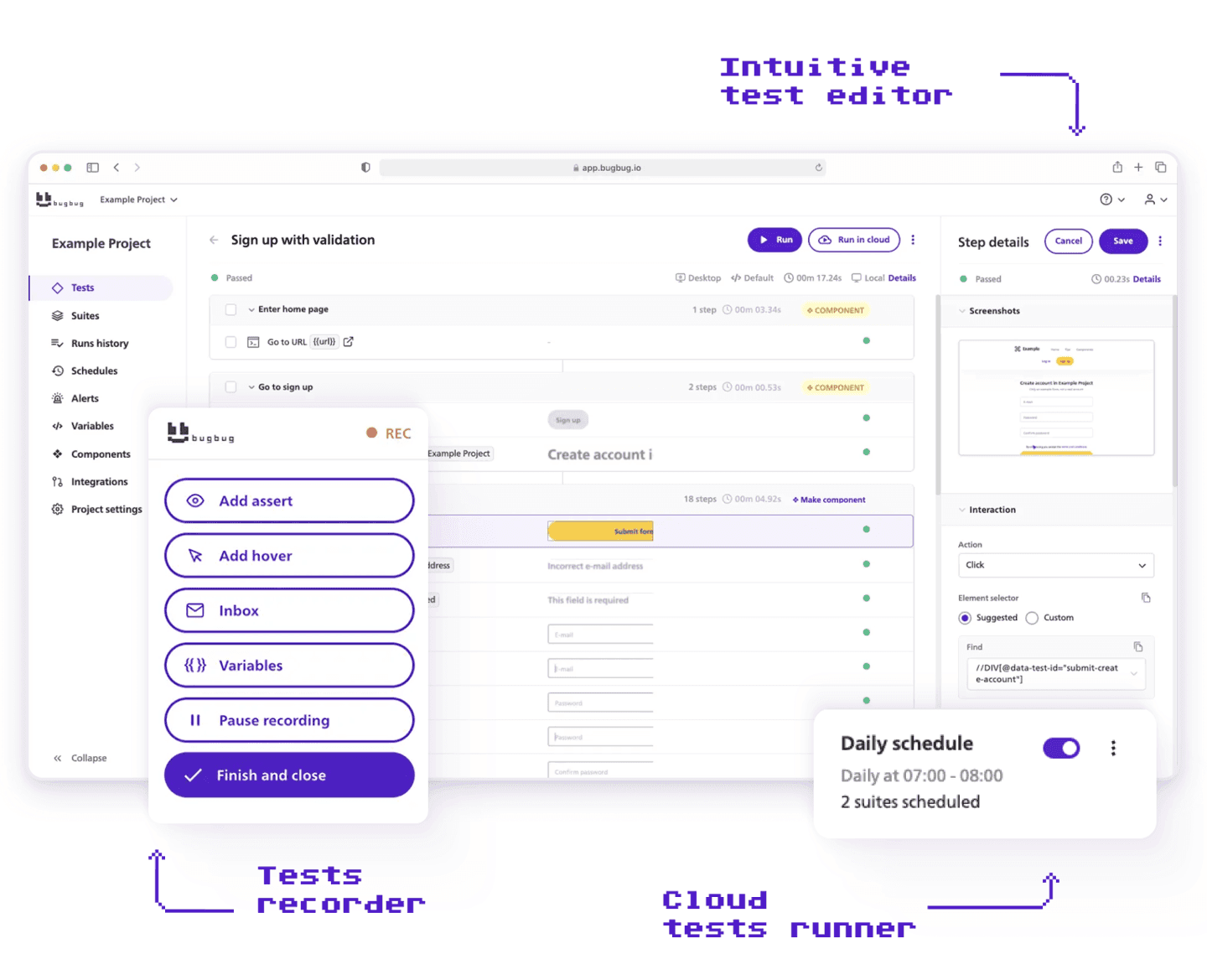
BugBug makes a different architectural bet from Autonoma.
The people who understand the business workflow remain the practical owners of the regression suite.
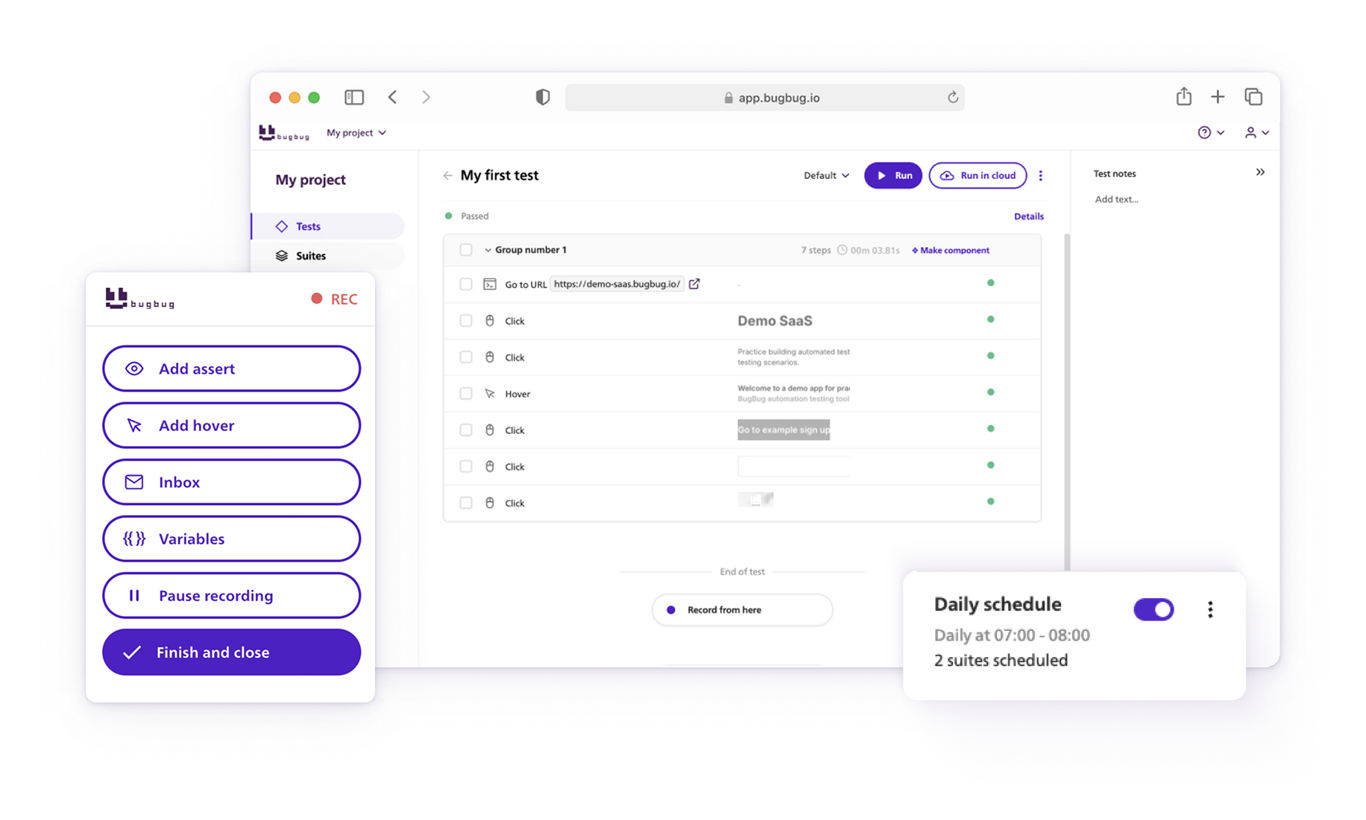
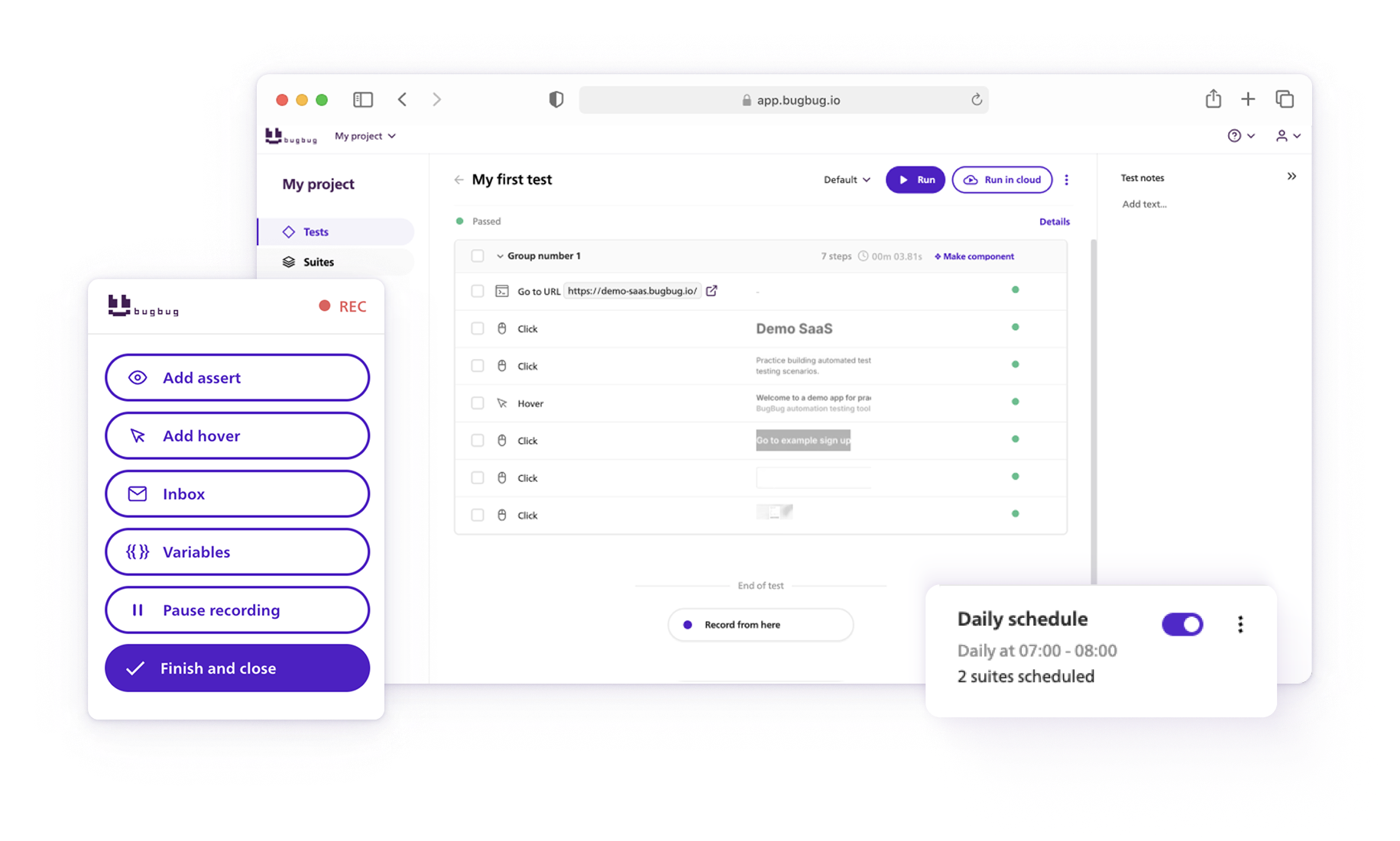
A manual tester, product person or support specialist records the real workflow in a Chromium browser. BugBug converts those interactions into readable, editable steps and handles much of the mechanical browser automation underneath them: selector selection, waiting, scrolling and dynamic interactions.
That means the test doesn't begin with the codebase or with an agent deciding what to do.
It begins with human-defined test intent.
The advantage isn't simply that BugBug is "no-code."
It's that the same business-critical workflow can become a managed regression asset without first becoming an internal framework project.
Tests can run locally or on BugBug's cloud infrastructure. Developers can trigger and manage tests through the CLI and public API, so product-team ownership doesn't mean separating regression from engineering or CI/CD.
BugBug isn't trying to win by arguing that humans should do everything manually while autonomous testing happens elsewhere.
The longer-term model is shared regression testing for humans and AI agents.
Today, people create and maintain tests visually while engineering can integrate the same regression system through API and CLI.
Two additional interfaces are currently marked as coming soon:
That's an important distinction from simply giving an AI agent browser control.
Playwright already has MCP. Momentic already supports MCP. Browser control itself is becoming commodity infrastructure.
The more interesting question is:
What regression system does the agent get access to?
BugBug's direction is to let approved agents work with the same managed test assets the team already owns rather than creating a second, disconnected automation layer.
The difference is clearer when you compare the ownership model:
Autonoma
Codebase → AI plans coverage → AI executes → AI maintains
BugBug
Product knowledge → human defines workflow visually → BugBug executes → engineering and, increasingly, approved AI agents work with the same regression assets
Autonoma minimizes human test authorship.
BugBug keeps humans responsible for test intent while reducing the infrastructure and automation work around it.
Neither philosophy is universally better.
Choose Autonoma if you want the agent to own more of QA. Choose BugBug if you want the product team to own regression while agents and engineering contribute to the same system.
Pricing is currently Free, Core at $99/month annually and Pro at $189/month annually. Core includes unlimited cloud test runs with defined limits on users, projects and tests; Pro removes those limits.
Trade-offs: BugBug is focused on Chromium-based web applications. It doesn't provide Firefox, Safari or native mobile testing. YAML import/export and the official BugBug MCP integration are still coming soon, so teams buying specifically for those capabilities should evaluate them when released. And if your goal is fully autonomous coverage generation with minimal human authorship, Autonoma or Momentic is currently closer to that model.

Playwright is no longer simply the "write every test manually" alternative.
Its current agent tooling includes a Planner that explores the application and creates a test plan, a Generator that converts that plan into Playwright tests, and a Healer that runs and repairs them. It also provides both Playwright MCP and a CLI designed specifically for coding agents.
That weakens one of the traditional arguments for commercial low-code tools: generating coded tests is becoming much easier.
The trade-off is ownership.
Your team still owns:
That's an excellent trade if engineering wants to own it.
Best when: developers see E2E testing as part of their engineering platform.
Worst when: everyone can technically edit the tests, but nobody is organizationally responsible for keeping regression healthy.
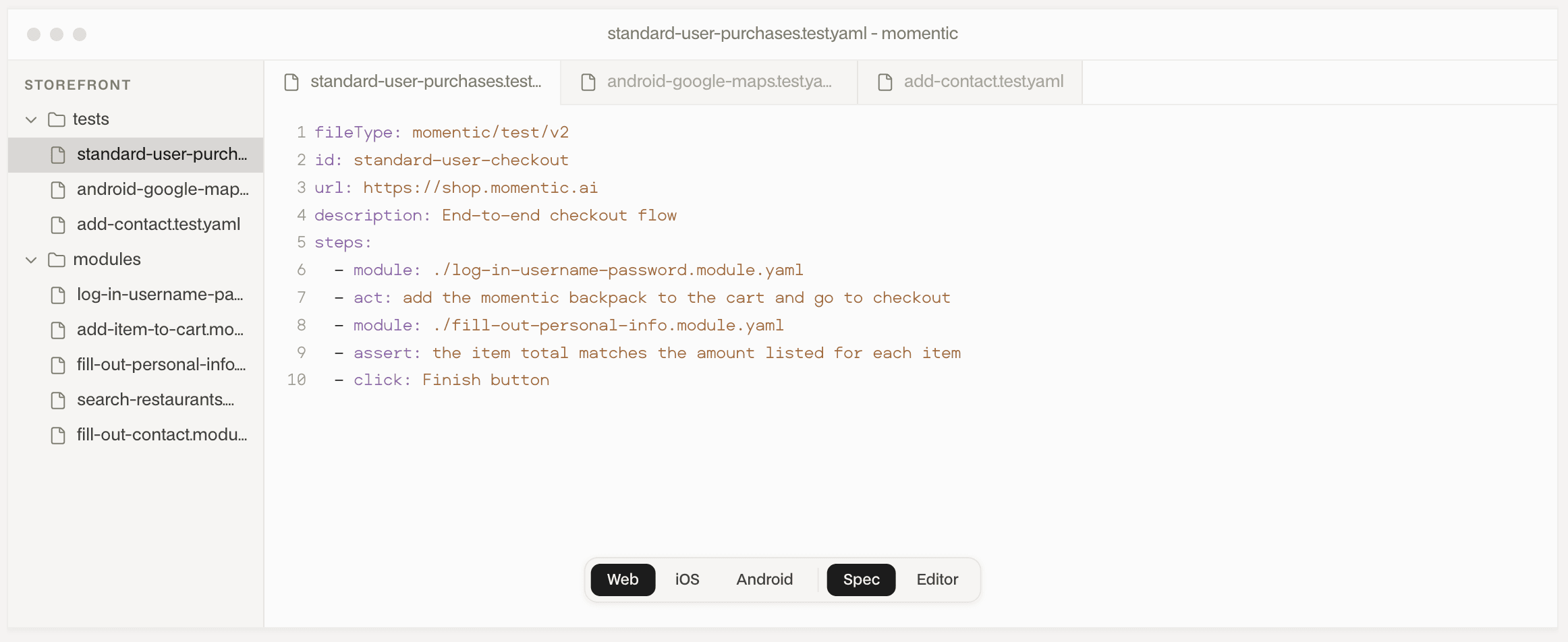
Momentic has moved strongly toward an engineering- and agent-oriented model.
Its tests live as human-readable YAML files in your repository. Teams can author them with natural language, work with them through a local editor or coding agent, run them locally or in CI and use MCP to let agents author and execute tests.
That makes Momentic particularly interesting for teams that want AI-native testing without giving up ownership of the underlying test files.
Its current pricing includes a free tier and a pay-as-you-go plan starting at $125/month plus usage.
Momentic is therefore closer to Autonoma than BugBug philosophically: AI and engineering play a larger authoring role, and test assets live with the code.
Best when: developers and AI agents should actively author and maintain regression, but you want readable YAML rather than conventional Playwright scripts.
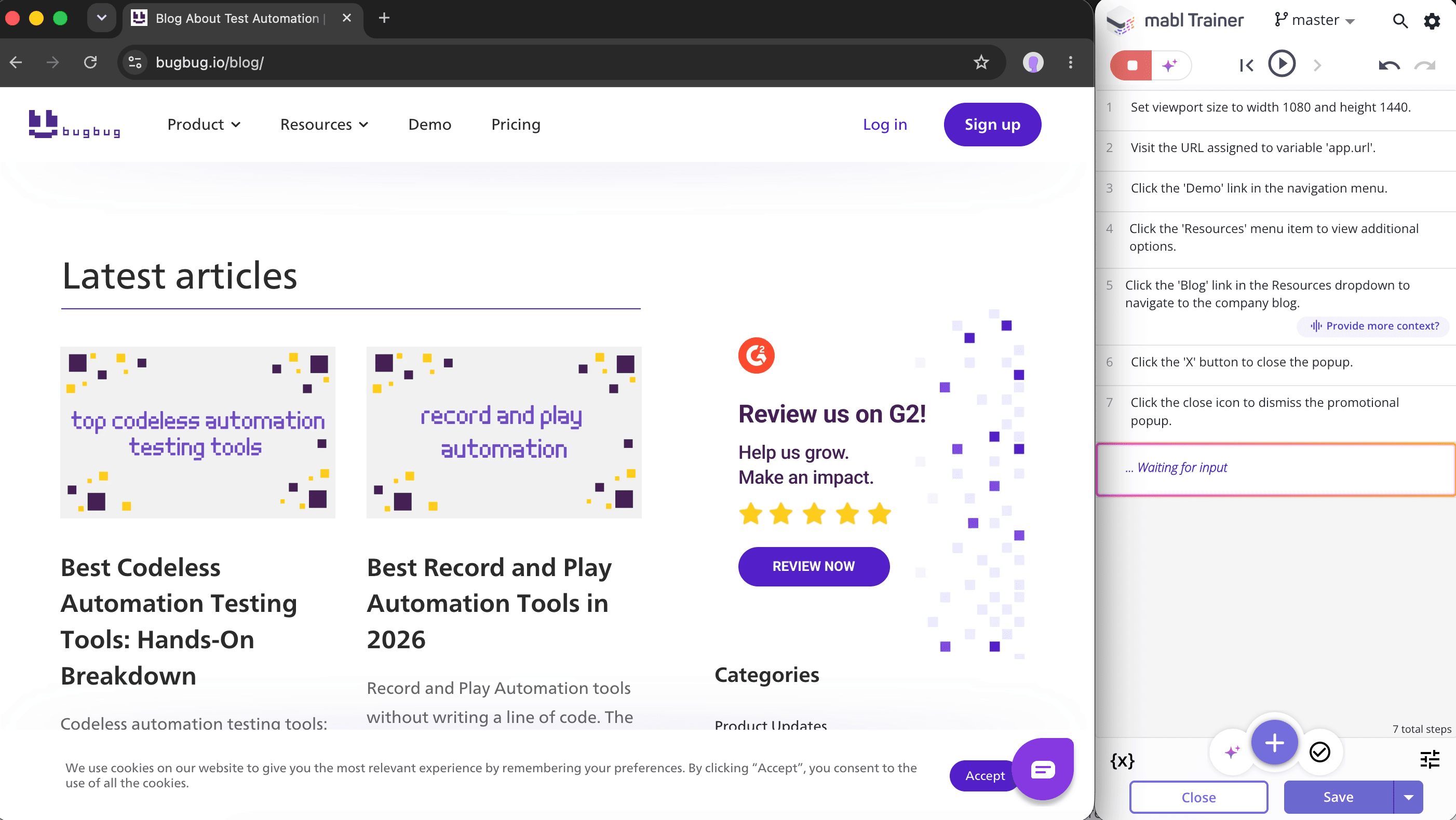
Mabl has moved beyond its older "low-code recorder with self-healing" positioning.
It now positions itself as an agentic testing platform spanning web, mobile, API and AI application testing, with AI helping maintain and expand coverage.
That breadth is the advantage.
Instead of assembling multiple specialized tools, a larger QA organization can manage several test surfaces inside one platform.
Pricing is customized rather than published as a standard self-service rate.
Best when: you're a mid-market or enterprise organization that values integrated coverage, governance and vendor support more than lightweight tooling.
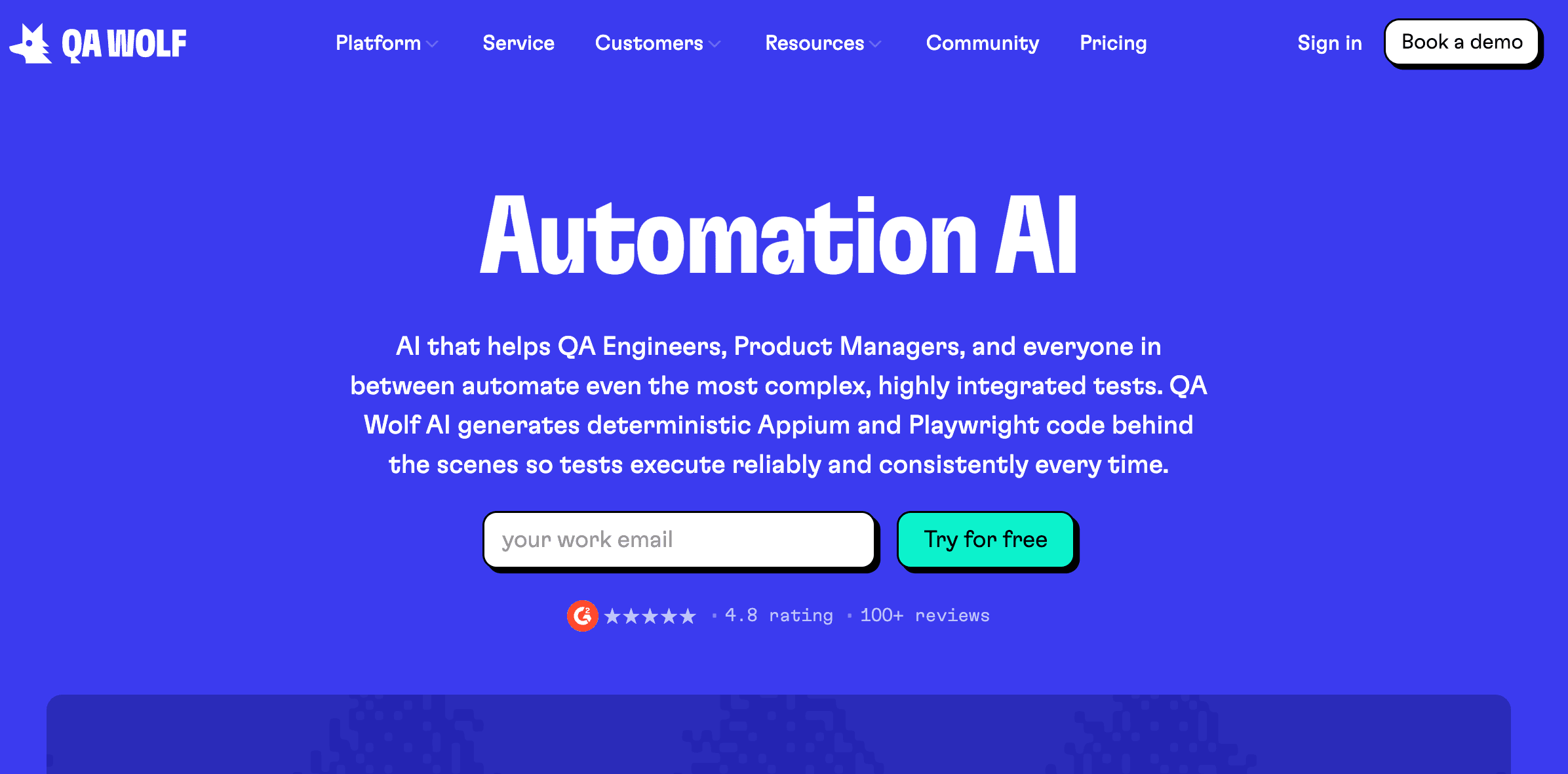
QA Wolf now offers more than its original QA-as-a-service model.
Its platform includes AI-assisted workflow mapping, test automation, maintenance, parallel execution and CI integration. Current public platform pricing is usage based, including AI credits and runner minutes. QA Wolf also continues to offer a white-glove service for teams that want QA taken largely off their plate.
That makes the decision less binary than before.
You can use the platform and own automation yourself, or buy more of the managed outcome.
Best when: your real constraint is ownership capacity and you're willing to pay to reduce it substantially.
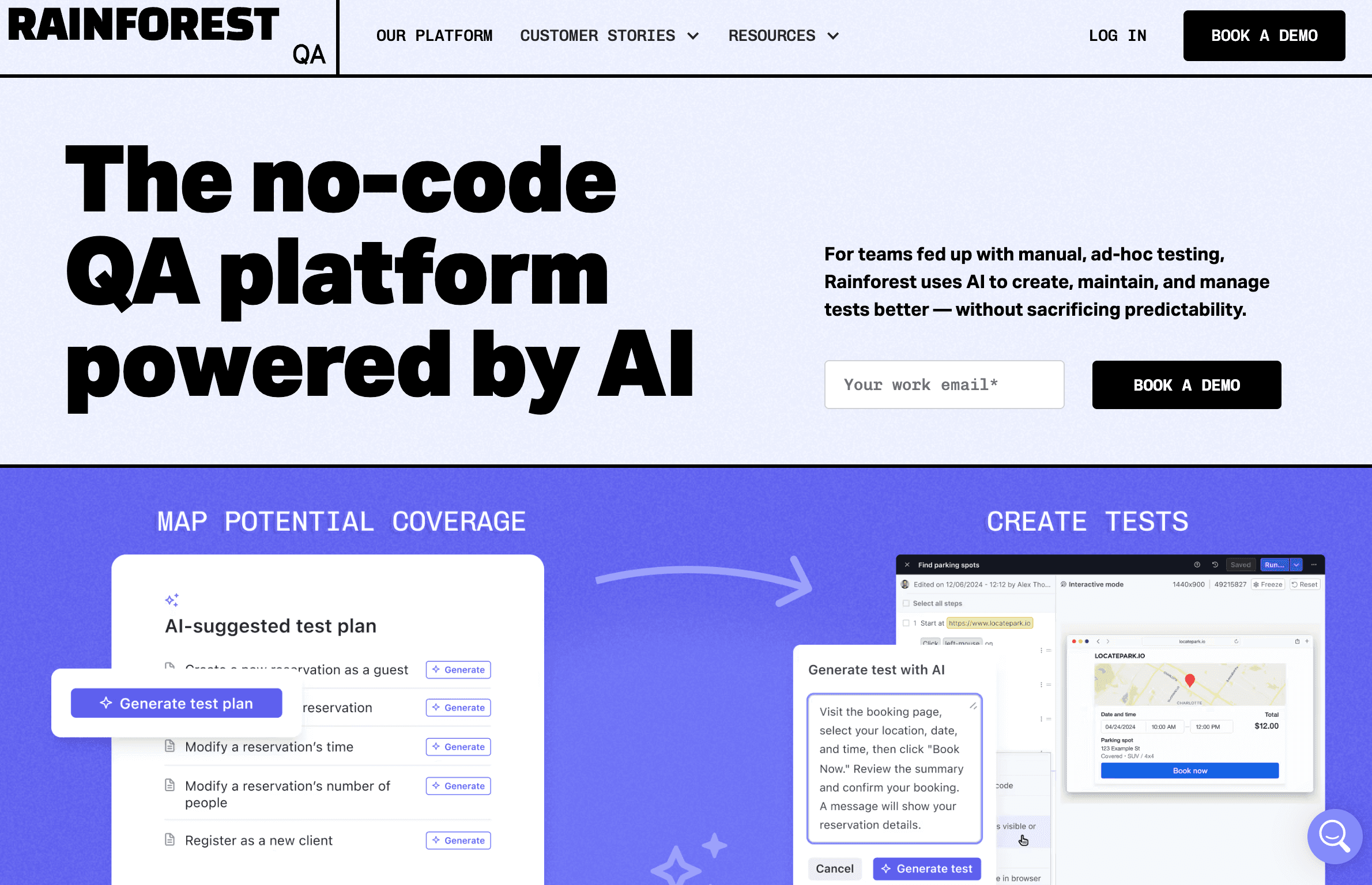
Rainforest has also changed significantly from the "crowdsourced humans execute your tests" category it was once known for.
Its current platform emphasizes AI-assisted test planning, generation, assertions and recovery while keeping humans responsible for determining what matters and setting priorities.
That's a useful middle ground for organizations that want AI to accelerate QA but don't want testing to become primarily a developer-owned codebase workflow.
Pricing is sales-led rather than openly listed as a simple self-service plan.
Best when: you want no-code test ownership with more AI generation than a traditional recorder provides.
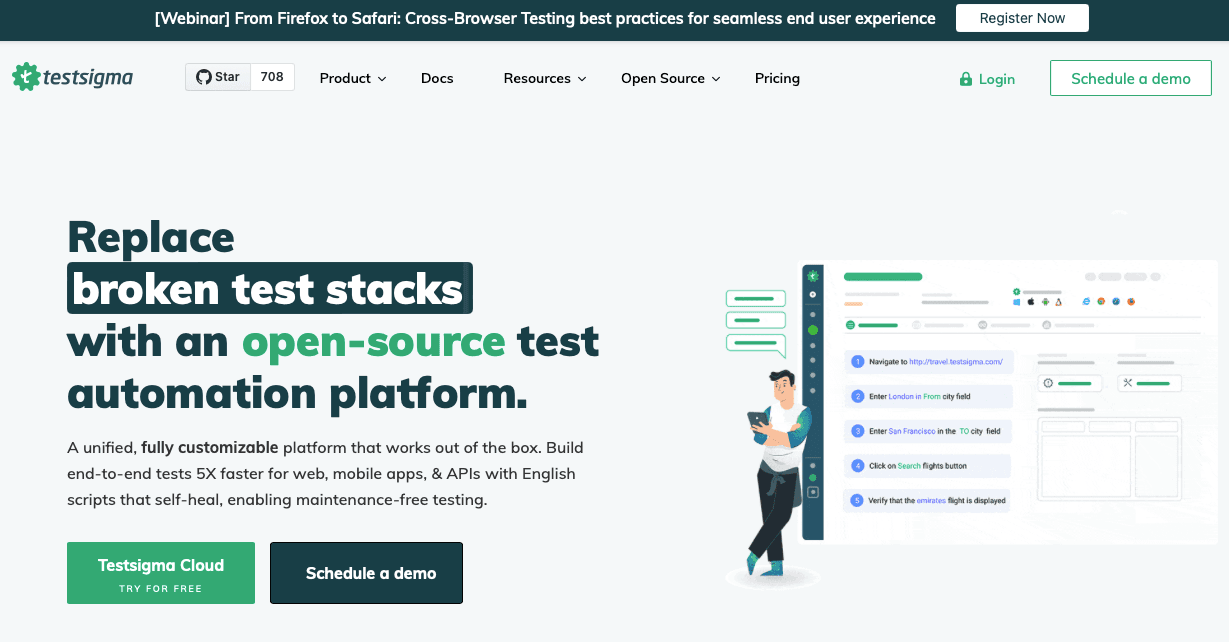
Testsigma is targeting a broader QA surface than either Autonoma or BugBug.
Its agentic platform covers web, mobile, API, desktop, Salesforce and SAP, with AI used for test generation, self-healing, analysis and reporting.
That makes it attractive when the problem isn't simply protecting a SaaS web application.
The additional breadth also means you're buying into a much larger QA platform.
Best when: one QA organization needs to automate several application types and wants a common AI-assisted environment.

Katalon remains one of the broadest options in the category, with web, mobile, API and desktop testing plus no-code, low-code, full-code and AI-assisted authoring paths.
Its current packaging starts at $59/seat/month annually for True Platform and $167/seat/month annually for True Automation.
Katalon's strength is less about replacing the QA function and more about giving an established testing organization a large integrated toolkit.
Best when: there is already a QA owner, application coverage is broad and per-seat enterprise tooling fits the organization's operating model.
Most of these products can now claim some combination of:
Those feature lists are converging.
The more durable differences are organizational.
Start with Autonoma or Momentic.
The goal is to move test generation and maintenance away from humans and toward agents.
Use Playwright + coding agents.
Modern Playwright already gives developers excellent browser automation plus increasingly capable AI tooling.
Look at BugBug.
The team records and maintains critical workflows visually while execution infrastructure, reporting and integrations are managed around those tests. Engineering can consume the same regression system through API and CLI, with YAML and MCP expanding that model further as they ship.
Look at mabl, Testsigma or Katalon.
They're better suited to organizations where testing spans multiple surfaces and a broader QA platform is justified.
Evaluate QA Wolf's managed service.
That's an organizational decision before it's a technology decision.
If an AI-generated test changes, who decides whether it still verifies the correct business outcome?
That person or team is your real regression owner.
Is it:
The answer affects reviewability, portability and who can participate.
"Run checkout regression after every production deployment" is a deterministic workflow.
"Investigate why checkout has been flaky this week" is an exploratory one.
Those jobs shouldn't necessarily use the same interface.
For a deeper treatment of that distinction, see MCP vs API: What Actually Changes When an AI Agent Touches Your Test Suite.
Running a test and rewriting a test are very different privileges.
As agents move deeper into regression workflows, permissions, history and review become more important than the simple fact that the tool has an MCP server.
A broken test is visible.
A test that an agent "fixed" so it passes while no longer validating the original business outcome is more dangerous.
Ask every vendor how human intent survives generation, healing and refactoring.
It depends on who should own regression.
Choose BugBug when product or QA should own business-critical web regression visually. Choose Playwright + AI agents when developers want full framework ownership. Choose Momentic when engineering wants AI-native YAML-based tests. Choose broader platforms such as mabl, Testsigma or Katalon when you need multiple testing surfaces.
Autonoma removes the need to manually write conventional E2E scripts, but its architecture remains strongly connected to engineering workflows: repositories, preview environments and—in deeper setups—application-integrated test-data factories.
So "no-code" doesn't fully describe the organizational model.
A better description is agent-owned testing integrated into the development workflow.
Not to start PR reviews.
Autonoma's current documentation says you can get preview environments and automated PR reviews running first. The Planner and Environment Factory deepen test-suite coverage afterward.
Yes.
Tools such as BugBug deliberately make business workflows understandable and maintainable through a visual interface rather than requiring Git or a code-based framework.
The more important question is whether your organization wants regression owned by product/QA, developers or AI agents.
For framework-level technical control, Playwright.
For repo-owned AI-assisted tests, Momentic.
For human-owned visual test intent with managed execution, BugBug.
Those are three different forms of control.
BugBug MCP is currently listed as coming soon. The planned integration will connect AI tools so they can generate, modify, refactor and analyze tests through natural-language prompts.
YAML import/export is also currently marked as coming soon.
The REST API and CLI are already available for programmatic and CI/CD workflows.
Autonoma is compelling because it pushes the category toward a clear end state: AI agents do more of the testing work.
For some organizations, that's exactly where QA should go.
But AI making test generation cheaper doesn't make ownership irrelevant.
It makes ownership more important.
Someone still needs to determine which customer journeys matter, what a passing result actually means, what an agent is allowed to change and whether the regression system still represents the product your customers depend on.
That creates three increasingly distinct models:
Agent-owned regression: Autonoma and other autonomous testing systems do more of the planning, execution and maintenance.
Developer-owned regression: Playwright and coding agents give engineering maximum control.
Team-owned regression: BugBug keeps test intent with the people who understand the product, while managed execution, engineering interfaces and—soon—AI-agent access let the rest of the organization work with the same test assets.
The best Autonoma alternative isn't therefore the tool with the longest AI feature list.
It's the system whose ownership model matches how your team actually wants to build and protect software.
Your next release. Properly tested.
Join 1,200+ QA teams that automated their
regression coverage with BugBug.

Dominik Szahidewicz is a Software Quality Evangelist specialising in quality assurance, test automation, and modern software testing practices. He creates practical, research-driven content that helps QA professionals, developers, and product teams improve test coverage, automate repetitive testing, and release more reliable web applications.
Drawing on his experience in technical writing, data analysis, and application consulting, Dominik translates complex testing concepts into clear, actionable guidance. His areas of interest include end-to-end testing, no-code test automation, regression testing, and the use of AI in software quality assurance.

Paweł Bylina is a software engineer, test automation product leader, and founder and CEO of BugBug, a no-code end-to-end testing platform used by teams in more than 50 countries. He has over 15 years of experience building software and leading engineering teams as a developer, engineering manager, CTO, and SaaS founder.
Paweł created BugBug after repeatedly seeing teams struggle with test automation that was costly to implement and difficult to maintain. He now works closely with QA engineers, developers, and engineering leaders to improve how software teams create and maintain reliable automated test coverage.
His expertise includes end-to-end testing, regression testing, browser automation, no-code test automation, QA strategy, and software quality. He shares practical insights drawn from building BugBug and working with software teams worldwide.
Join thousands of QA experts. Subscribe to our newsletter.
Get more testing tips and product related content. Zero spam.
Compare the best SaaS testing tools for startups, QA, and dev teams. See use cases, pricing, and key SaaS flows to automate.
Discover the essential QA tester skills for 2026! Learn the technical and soft skills required to excel as a QA Tester.
Learn how to automate regression testing without devs or QA. Discover a risk-based strategy and practical workflows.
Learn exactly when to run regression tests—after features, fixes, updates, and on a schedule—plus tips to automate smoothly with minimal churn.
Discover essential business tools for startups. Read the article to find the right tools for your success.
Are AI Testing Tools Worth the Hype? The integration of AI into software testing is transforming how we approach quality assurance.
Automation Testing Tools Comparison: Cypress, Selenium, BugBug and more — compared honestly by team type, cost, and required expertise.
This guide covers the best automated testing tools for startups in 2026 — for development teams of 3 to 30 who move fast and protect what matters.
Discover essential accessibility testing tools and software in our guide. Learn how to make your applications accessible for everyone.