How to Create Stable E2E Tests Without Playwright
Written byDominik SzahidewiczReviewed byMariusz Wójcik


Updated: September 28, 2026View as Markdown
Your test passes on your laptop. It fails in CI at 2am, blocks the deploy, and nobody knows why. You rerun it and it goes green. You shrug and move on.
That test is now training your team to ignore red builds. And when someone finally opens it to fix it, they find a wall of selectors and waits. If they can't read it, they can't own it.
If you're avoiding Playwright, or leaving it, don't assume the tool was the problem. Stable E2E tests come from a handful of habits, and most of them work in any tool. This guide covers those habits, your realistic options, and when you should stay on Playwright.
Playwright is excellent. It records interactions into code, has a UI mode with time-travel debugging, and ships agents that plan, generate and repair tests. Pair it with an AI coding assistant and writing tests gets cheaper every month.
So "Playwright requires coding" is no longer a strong reason to skip it. Skip it for different reasons: nobody on your team wants to own a framework, or the people who know what to test can't read the code.
Setup still costs something, too. Teams that wire up Playwright's MCP server for AI agents report failures from outdated Node versions, missing browser binaries, and version mismatches after an unpinned @latest install. Agent-driven clicks can also get blocked by cookie banners and modals. None of that is a flaw in Playwright. It's the tax on any stack you assemble yourself.
Flaky tests have the same causes everywhere: fragile selectors, timing assumptions, shared data, and unclear ownership. Fix those and any tool gets more stable. Ignore them and the best tool won't help.
Selecting elements by CSS chains is the most common source of breakage. A designer moves a button into a new wrapper and a dozen tests fail. None of them found a bug.
Use identifiers that exist for testing: data-test-id attributes, accessible roles, and visible labels. Avoid position-based selectors and auto-generated class names.
One SaaS team we talk to takes this to its logical end. Their selectors are exclusively data-test-id. If an element doesn't have one, their tooling refuses to write the test and files a ticket against their own frontend instead. The missing ID gets treated as a product defect, not a testing inconvenience.
You don't need that level of strictness on day one. Adopt the rule for new features and fix old ones when they break.
A fixed sleep(3000) is a bet that your app is never slower than three seconds. On the day the CI runner is busy, you lose.
Wait for a condition instead: the element is visible, the request has finished, the button is enabled. Good tools do this by default. Datadog's browser tests, for example, keep checking whether the page is ready before each step and time out after 60 seconds unless you change it. Hard-coded waits, they note, tend to make tests less reliable, not more.
If your tool makes you write waits by hand, that's a warning sign, not a skill to be proud of.
Tests that depend on the leftovers of other tests fail in ways nobody can reproduce. Test order changes, one test crashes halfway, and the next one starts from a broken state.
Each test should create what it needs and leave things as it found them. A checkout test that adds items to a cart should empty the cart afterward. Use dedicated test accounts and environments, not real customer data.
Splitting data into two pools helps at scale. The team above keeps a "stable" data set that tests only read from, and a "mutable" set for tests that change things. A read-only test can't be broken by someone else's write. They also watch for fixture drift: a database that changed while a test still hardcodes the old values.
The instinct is to cover every page. Resist it. Chasing 100% coverage produces a suite too big to maintain, and every extra test is another thing that can go flaky.
Start with 5 to 10 journeys that would hurt most if they broke: signup, login, checkout, the core action your product exists for. Add rare but critical flows too, like password reset. Nobody notices those are broken until a customer complains.
Keep each test focused on one workflow. A checkout test shouldn't create an account first. If it fails, you don't want to spend an hour figuring out which half broke. Pull repeated steps, like login, into a shared component so a change is made once.
Shared components cut both ways. Edit one to fix a single test and you've changed every test that uses it. Keep your shared library small: only sequences that are truly identical everywhere.
Two more rules:
There's a live debate on how many E2E tests you should have. Some vendors argue that fast, AI-assisted tooling has made the old "keep E2E tests few" advice obsolete. Datadog's guidance points the other way: cover what users do most, and skip the rest. Our view is that speed doesn't fix a suite nobody can maintain. Start small and grow only what you can keep green.
Tests without an owner rot. It follows the usual pattern: something breaks in production, the team writes a pile of tests, and a month later a few fail and nobody fixes them. Six months on, the suite is decoration.
Name an owner for every test or suite, and tag it so a failure reaches the right person. Then check that the owner can actually read the failure.
That second check gets skipped. If understanding a red test requires reading a page of code, only developers can own it. And developers are busy shipping features.
One triage rule saves time: if every test in a suite fails with the same error at once, suspect the environment before the app. A shared outage looks nothing like ten separate regressions.
Every approach below can produce stable tests if you follow the five habits. They differ in who writes the tests, who maintains them, and what you have to run yourself.
| Cypress | Selenium | Low-code recorder (e.g. BugBug) | AI-agent tools | |
|---|---|---|---|---|
| Who writes tests | Developers, in JavaScript | Developers, in many languages | Anyone, by recording clicks | An agent generates them |
| Setup effort | Moderate | Highest (drivers, grid) | Lowest (browser extension) | Varies by vendor |
| Cross-browser | Yes, with limits | Yes | Chromium only | Varies |
| Who reads a failure | Developers | Developers | Anyone on the team | Depends on the artifact |
| Watch out for | Best for JS-heavy apps | Most maintenance | Web-only, no mobile | Tests may live inside the vendor's platform |
Check pricing pages before you decide. They change often, and several vendors in this space hide prices behind a sales call.
Cypress. Best for developer-led teams with JavaScript-heavy apps. Avoid it if nobody on the team wants to maintain test code.
Selenium. Best when you need maximum flexibility and language choice. Avoid it if you have no capacity to run and maintain drivers and infrastructure.
Low-code recorders. Best for web-only teams that want a first test running quickly and want non-developers to contribute. Avoid them if you need Firefox, Safari, mobile, or heavy data-driven scripting.
AI-agent tools. These split into two camps. Some automate only running tests. Others also automate writing them, reading your code and generating coverage on every pull request. Best for teams shipping a lot of AI-generated code without a QA function. Avoid them if you can't inspect what the agent produced. Also be wary of tests that pass but assert nothing. Ask any vendor what the artifact is, where it lives, and whether a person can read and edit it.
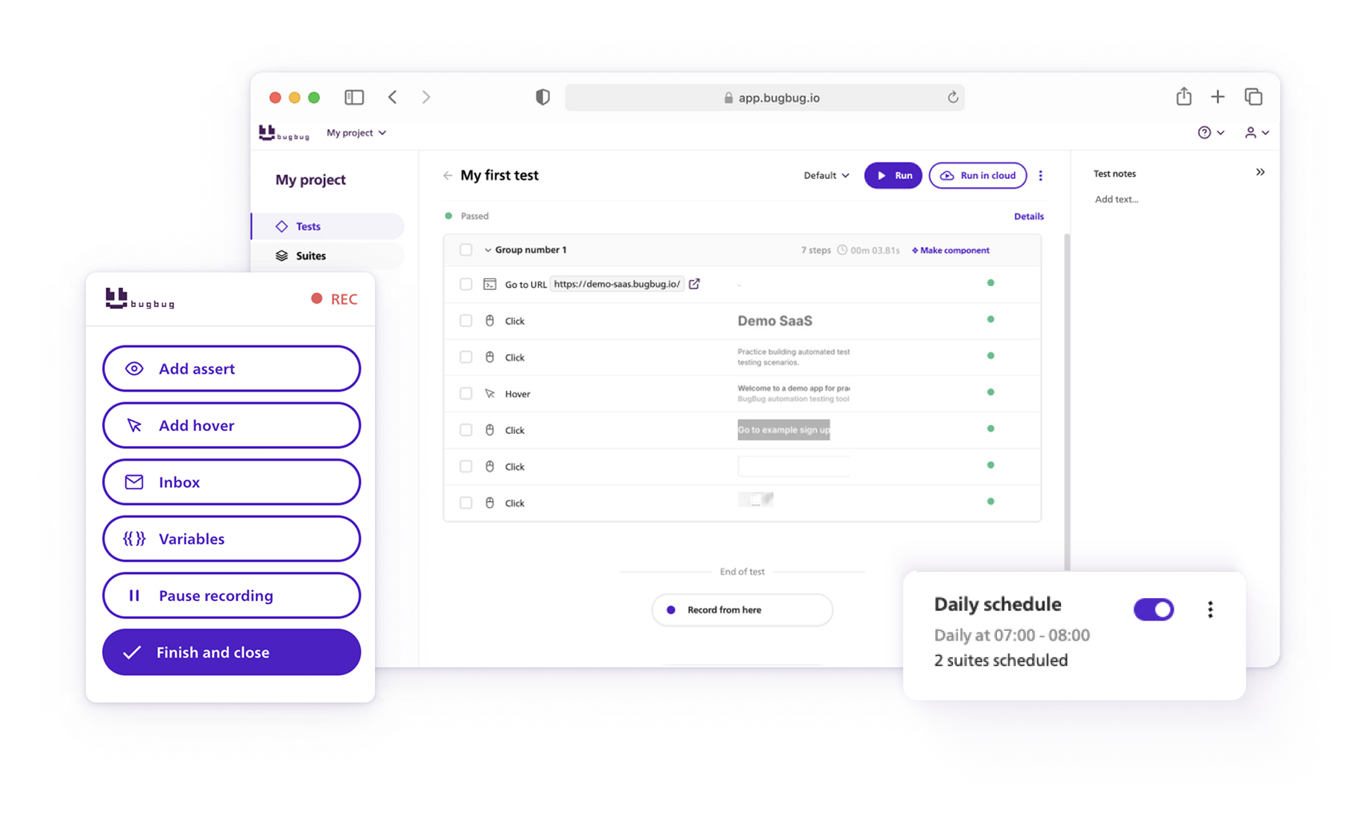
BugBug is a low-code option. You install a Chrome extension, click through your app, and it records each click and keystroke as a step. There's no Selenium grid, no Docker and no VMs. You edit steps in a visual editor, and Edit & Rewind lets you fix a step and rerun from that point without re-recording the whole flow.
A typical first test looks like this:
For anything the recorder can't do, you can add a custom JavaScript step.
Here's a real-world example of why this matters. A SaaS team with a single manual tester needed automation without pulling developers away from product work. Their developers later suggested moving to a code framework, since that would be more convenient for them. The team declined. Their reasoning was that once tests live in code, ownership quietly shifts to developers, and the people responsible for quality can no longer touch their own work.
They now have an AI agent write their tests through BugBug's API. When a test fails, the tester opens the BugBug UI, sees why, and fixes or reruns it herself. The writing is automated, but the tests aren't a black box. Their suite runs around 250 tests, and their selectors are exclusively test IDs.
That's the setup BugBug fits best: a web-only team where the people who understand the product need to own the tests.
The limits are real. BugBug runs on Chromium and Chrome only, with no Firefox or Safari and no mobile app testing. It doesn't test desktop applications. It's also less flexible than a code framework, so it's a weaker fit if you need deep customization or heavy data-driven scripting.
Stay on Playwright if any of these describe you:
The same goes for Cypress. Neither is a mistake. They're the right answer for a different kind of team.
Match your situation to a profile:
Whichever tool you choose, start with five journeys, use stable IDs, wait for state, isolate your data, and name an owner. That will do more for stability than any tool.
Happy (automated) testing!
Yes, if the tool gives them stable selectors, automatic waiting, and readable failures. Stability comes from test design, so the same habits apply. A recorder makes creation accessible, but someone still needs to decide what to test and own the results.
No. They're common choices for teams that write tests in code, but low-code recorders and AI-agent tools can also run real browser tests. Pick based on who writes and maintains the tests, and which browsers you must cover.
There's no universal number. Start with 5 to 10 critical journeys and grow from there. A small suite you trust beats a large one you rerun until it passes.
Usually timing, data or environment: a slower runner, leftover state from another test, or a different configuration. Wait for conditions instead of fixed delays, give each test its own data, and check whether an entire suite fails identically, which points to the environment.
Your next release. Properly tested.
Join 1,200+ QA teams that automated their regression coverage with BugBug.

Dominik Szahidewicz is a Software Quality Evangelist specialising in quality assurance, test automation, and modern software testing practices. He creates practical, research-driven content that helps QA professionals, developers, and product teams improve test coverage, automate repetitive testing, and release more reliable web applications.
Drawing on his experience in technical writing, data analysis, and application consulting, Dominik translates complex testing concepts into clear, actionable guidance. His areas of interest include end-to-end testing, no-code test automation, regression testing, and the use of AI in software quality assurance.

Senior software engineer at BugBug, where he's spent 6 years helping shape the product. He's a T-shaped developer skilled in frontend with React and TypeScript, browser extensions, backend work, and building AI agents and tooling. His strengths also include UX instincts, a product-minded approach, and process automation.
Join thousands of QA experts. Subscribe to our newsletter.
Get more testing tips and product related content. Zero spam.
Discover essential business tools for startups. Read the article to find the right tools for your success.
How to find bugs in your code? They live to damage your code, to make you lose time and effort and money.
Comprehensive guide to testing search functionality with 100+ test cases, real-world examples, and tips for automating search tests using BugBug.
Momentic is now CLI-first with cloud web execution deprecated. Compare 5 alternatives - BugBug, Playwright, Shiplight, mabl, Testsigma.
Discover essential accessibility testing tools and software in our guide. Learn how to make your applications accessible for everyone.
What does AI for QA actually look like on a team without dedicated QA? Check our curated list of 10 best ai tools for testing in 2026.