10 AI Tools for Testing in 2026: Real-World Guide
Written byDominik SzahidewiczReviewed byMariusz Wójcik


Updated: September 8, 2026View as Markdown
AI testing tools use artificial intelligence to create, stabilize, execute, or maintain software tests, but they do not all solve the same problem. Some write tests autonomously, some record and maintain browser-based flows for small teams, and some pair AI with code-first frameworks for developer-led QA. If you're shipping faster than your tests can keep up—especially now that AI is writing a growing share of your code—that distinction matters more than the marketing.
Every vendor selling AI tools for software testing now claims the same three things: AI writes your tests, heals your tests, and replaces your QA team. From the pricing pages alone, you can't tell a $250/month recorder from a $90,000/year managed service. They use identical words.
For small to mid-sized SaaS and web teams with limited QA resources, as well as product managers or non-technical teammates who want to automate web test flows without coding, picking the wrong category is an expensive way to add more QA work instead of less.
Buying the right tool in the wrong category is how teams lose a quarter. So the ten AI testing tools below aren't ranked 1 to 10—a ranking would be a lie.
An autonomous agent priced for a 50-person QA org and a test recorder built for a team with zero QA aren't competing for the same job. Instead, this guide breaks the market into the three categories AI test automation has actually split into, compares tools and pricing, shows who each type is for, calls out where vendor claims outrun current AI testing reality, and helps you choose the right fit for your team so you can catch bugs earlier, cut regression effort, and ship faster with confidence.
We build a tool in this category, so read our take on BugBug with the same skepticism you'd apply to any vendor's list—we've placed it where it belongs, not at #1.
What we bring that a neutral roundup can't: we run demo calls every week with teams choosing between these exact tools. Vast majority of development teams now use AI in testing workflows. When we surveyed our own users this year, AI assistance was the single most-requested capability - named by 36.8% of respondents who wanted more from us, ahead of every other feature.
And we lose deals to one of the options on this list (Playwright paired with an AI coding agent), so we know that workflow from the losing side. Losing teaches you things marketing pages don't.
We just shipped our own AI - an agent integration built on exactly the human-in-the-loop principles this article argues for. We'll describe precisely what it does and doesn't do, the same standard we hold every other tool to.
Strip away the landing-page language and AI test automation tools have split into three architectures. Which one fits you depends less on the feature list and more on one question: who at your company will own the tests?
Momentic, KaneAI (TestMu), QA Wolf, Octomind, Checksum. You describe what to test from requirements or user stories—or the agent observes your app—and AI plans, writes, handles test execution, and can run tests with minimal manual work. Many of these platforms also promise autonomous test generation, but coverage still needs review.
The capability is real.
So is the money: this tier of AI-driven test automation is priced for companies where testing is a funded function. QA Wolf isn't even software in the usual sense - it's a managed service where their engineers own your Playwright suite, and a 200-test suite runs roughly $96K a year at their published per-test pricing. Momentic starts at $250/month self-serve, then goes quote-based. Most of the rest don't publish numbers at all.
Choose this tier if you have budget authority, a QA org (or a deliberate decision not to build one), and a product complex enough to justify the spend. Skip it if "contact sales" makes you close the tab—at your size, that instinct is correct.
Playwright plus Claude Code, Cursor, or Copilot - with Healenium as the self-healing bolt-on for legacy Selenium suites. This is the workflow most vendor lists quietly omit, and it's the strongest option on this page for one specific team: developer-led, Playwright-literate, with an engineer who will genuinely own the suite. The tests are real code in your repo. Zero lock-in, near-zero licensing cost, maximum control - the open-source answer to AI testing.
The catch is the ownership question. The AI writes test code fast; it doesn't triage Monday morning's failures, decide what's worth covering, or keep the suite honest as the product changes. That's a person. If that person is your busiest engineer - the one who got paged Saturday night—the "free" AI testing framework has a salary attached.
Choose this tier if an engineer wants to own testing and your team lives in code. Skip it if nobody has recurring hours to be the test suite's parent.
BugBug, Mabl, Testim, testRigor, Reflect. Here the AI doesn't invent your test plan - it works on the two things that make recorded tests historically fragile: selectors and timing.
A human records the flow, though some tools in this tier also support natural language prompts so AI tools can generate tests from plain-English descriptions; artificial intelligence picks stable locators, waits intelligently, and handles dynamic UIs.
Many codeless test automation products also use visual recognition alongside selectors to keep recorded flows stable. This is the fastest route to regression coverage for teams where nobody owns testing full-time—which, at 20–150-person SaaS companies, is most teams.
This tier's honest problem is lock-in and pricing opacity: several incumbents keep your tests inside their platform and their prices behind a sales call. Mabl and Testim both start around $450–500/month with quote-based tiers above, and they charge per-seat—meaning adding team members doubles your cost. We flag the export question tool by tool below, because it matters.
Choose this tier if you need coverage this sprint and your testers or non-technical team members aren't engineers. Skip it if you need deep framework customization, coverage beyond the web, or if test portability matters to you.
👉 Check our guide on AI-assisted test automation: How to use AI with BugBug?
Most lists of the best AI automation testing tools skip the two columns that decide the purchase: what it really costs, whether your tests survive a breakup, and whether AI testing tools work with existing tests and common frameworks.
| Tool | Category | Published Pricing | Where Your Tests Live | AI-Agent Access (MCP) | Best For |
|---|---|---|---|---|---|
| Playwright + AI coding agent | Code framework | Free + agent subscription ($20–200/dev/mo) | Your repo — you own everything | Yes (Playwright MCP) | Dev-led teams with a suite owner |
| BugBug | Low-code (AI-assisted) | Free + Paid plans from $99/mo | BugBug platform and via MCP; tests portable via YAML export | Yes (BugBug MCP) | Web-only SaaS teams, 0–3 QA, product teams that own regression without hiring SDETs |
| QA Wolf | Autonomous (managed service) | ~~$40–44/test/mo; ~~$96K/yr at 200 tests | Playwright code you own | No | Funded teams outsourcing QA entirely |
| Momentic | Autonomous agent | $250/mo self-serve, then quote | Momentic's format, CLI-driven | No | AI-native product teams |
| Octomind | Autonomous agent | Free tier (10 tests); paid quote-based | Playwright code you own | No | Eng managers who want Playwright without writing it |
| KaneAI (TestMu) | Autonomous agent | Per-agent, quote-driven | Exports to your framework | No | Enterprise QE orgs on LambdaTest |
| Mabl | AI-assisted low-code | ~$500/mo entry, quote above; per-seat pricing | Platform-locked; no export | No | Growth-stage QA orgs with dedicated QA budget |
| Testim (Tricentis) | AI-assisted low-code | ~$450/mo entry, quote above; per-seat pricing | Platform-locked; minimal export options | No | Mid-market teams wanting Tricentis backing |
| testRigor | Plain-English AI | Free tier; ~$10–50K/yr paid | Proprietary English DSL, platform-locked | No | QA teams replacing manual scripts wholesale |
| Reflect (SmartBear) | AI-assisted low-code | ~$212/500 runs; pay-per-run model | Platform-locked | No | Small teams preferring per-run pricing |
Two patterns worth ten seconds of your attention. First, six of ten tools hide their real price behind a sales call - BugBug publishes transparent, flat pricing with unlimited users on PRO plan.
Second, only three let your tests leave with you (Playwright, BugBug, QA Wolf/Octomind), and if you already have existing test suites, integration quality with frameworks like Selenium and Cypress matters just as much as portability.
Before any demo, ask the question TestGuild's Joe Colantonio tells his audience to ask: can we export the tests if we need to leave? And who pays when you add team members?

Free framework, AI-written tests, you own the code.
Best for: Teams with a Playwright-literate engineer who accepts suite ownership.
Avoid if: Nobody has recurring hours for triage and upkeep.
Playwright it the strongest stack on this list - if someone owns it, and it works best when AI features are layered onto a code-first workflow rather than treated as a full replacement for ownership. Your coding agent writes real Playwright against your live app; Microsoft's Playwright MCP made this the default developer workflow in 2026. Good integration in CI/CD means generating relevant tests during pull requests and helping with failure analysis after builds. The license is free. The owner isn't. We lose deals to this stack, and for one-engineer startups it's often the correct call.
Best for: Web-only SaaS and product teams (0–3 QA, product owners, support specialists, or solo testers) that need reliable regression coverage without building and maintaining a Playwright stack or hiring an SDET.
Avoid if: You need Safari, Firefox, or native mobile coverage;
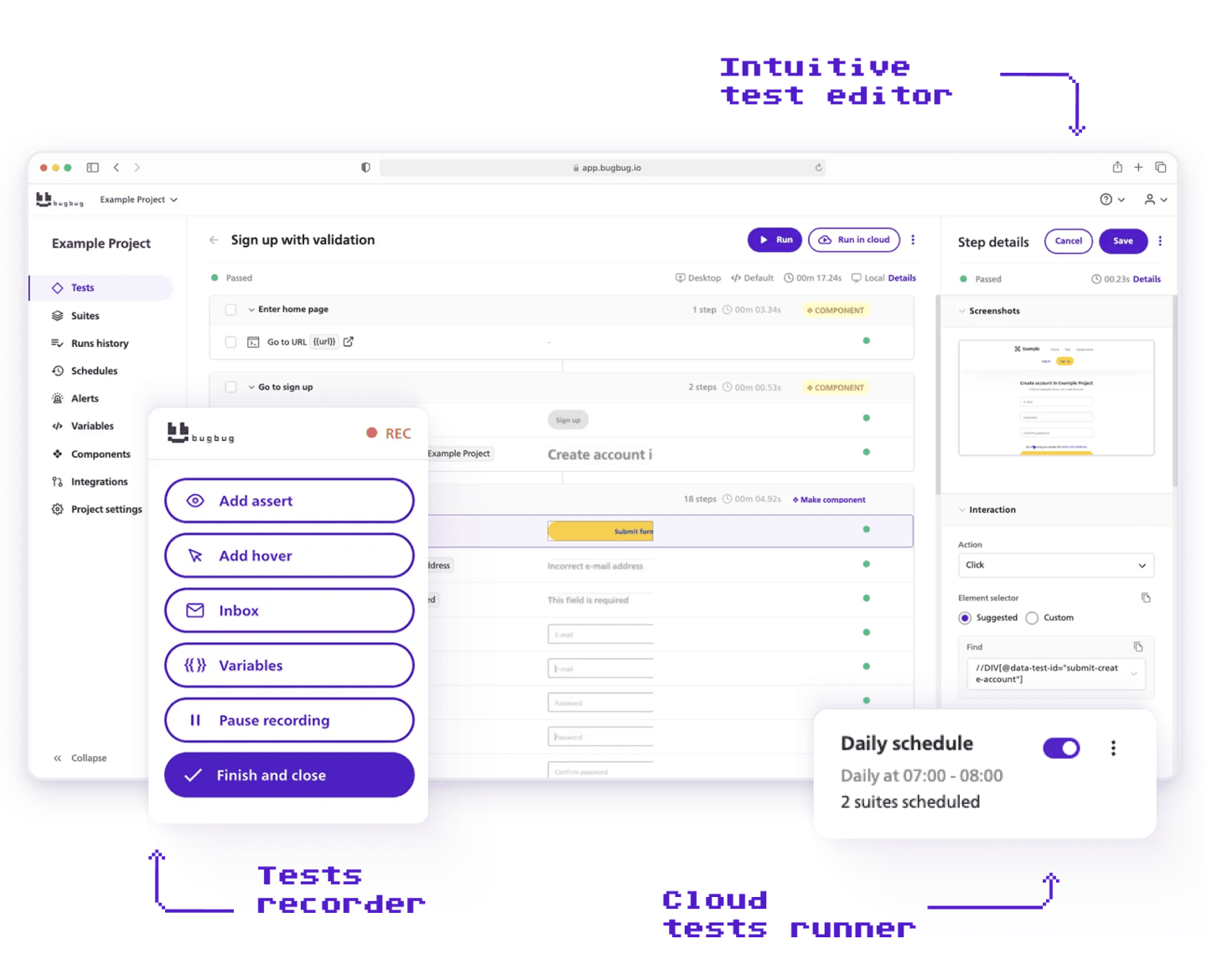
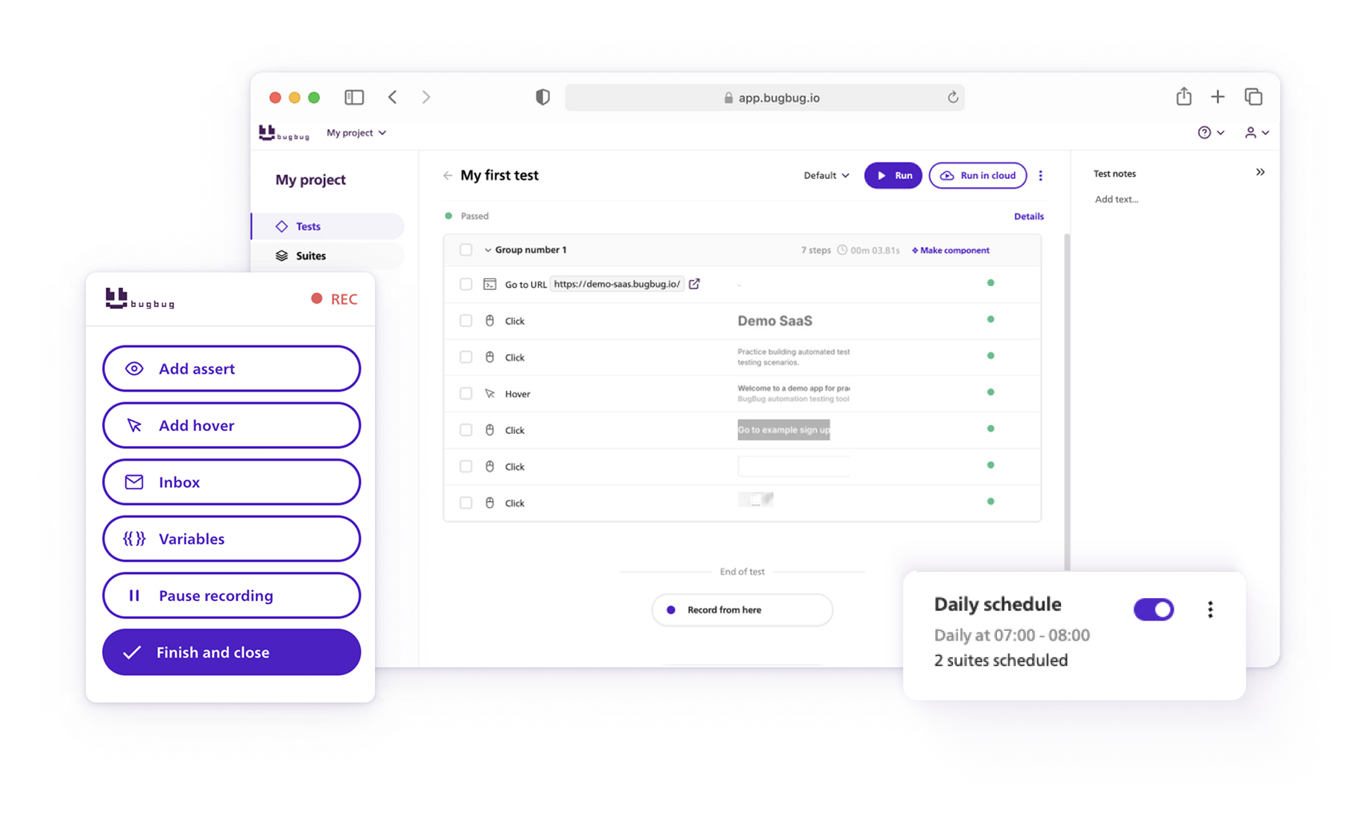
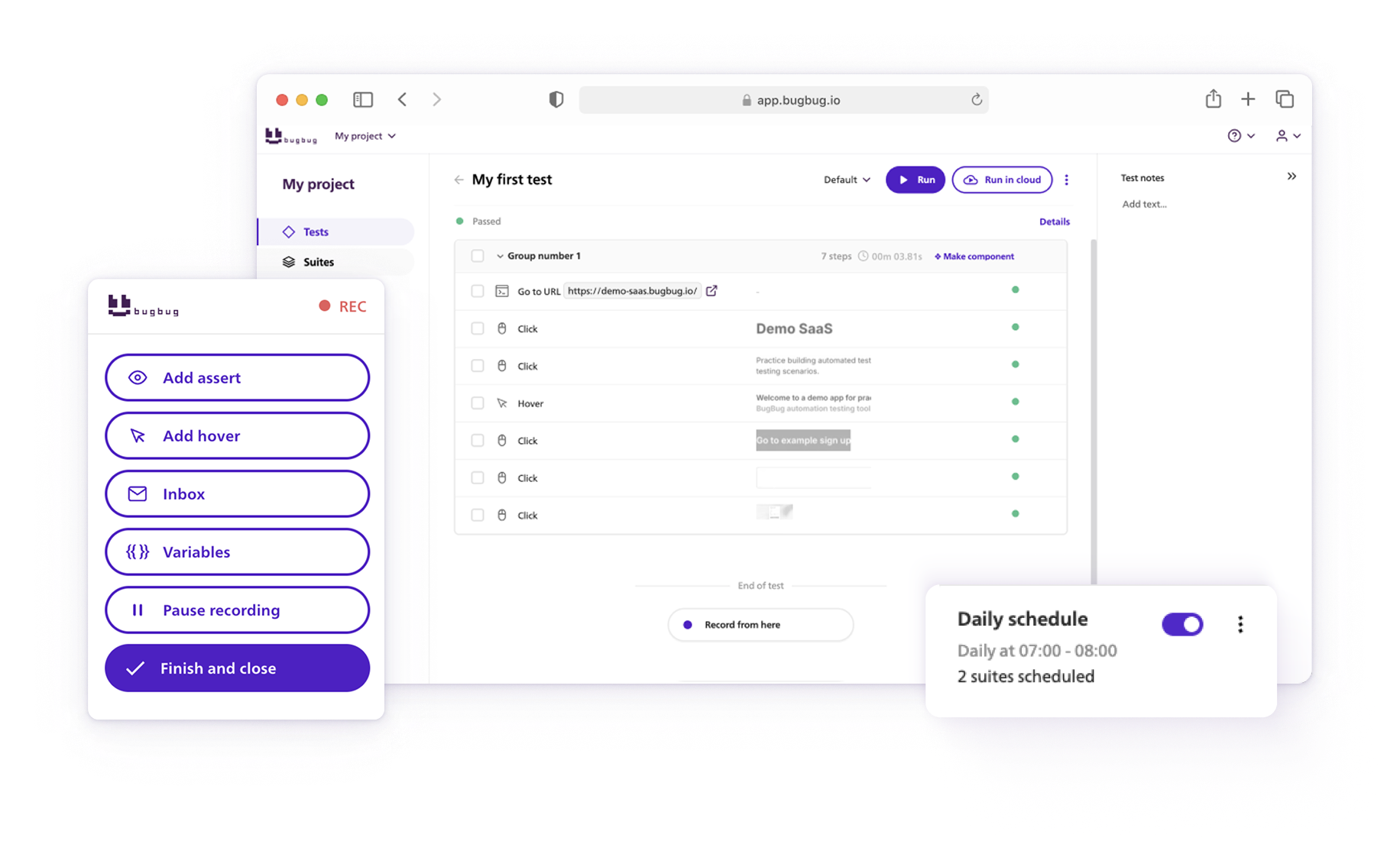
BugBug gives product teams, QA leads, support specialists, or individual testers one shared system to define, maintain, and govern the workflows that matter most to the business. Record critical user flows visually, define the assertions that represent the expected business outcome, reuse common components, and update individual steps as the product changes. BugBug handles selectors, waiting, scrolling, and other brittle browser mechanics, so QA can focus on coverage quality instead of framework maintenance.
Tests are not locked inside the recorder. With YAML import and export, teams can review, diff, version, and manage test definitions outside BugBug—unlike Mabl, Testim, or Reflect, where tests are trapped inside the platform.
MCP capabilities let approved AI agents (Claude, Cursor, ChatGPT) work with the same governed test assets - discovering, running, debugging, and proposing fixes without creating a separate automation layer or bypassing permissions and test ownership.
This makes BugBug the only tool in its tier with native agent integration at SMB pricing.
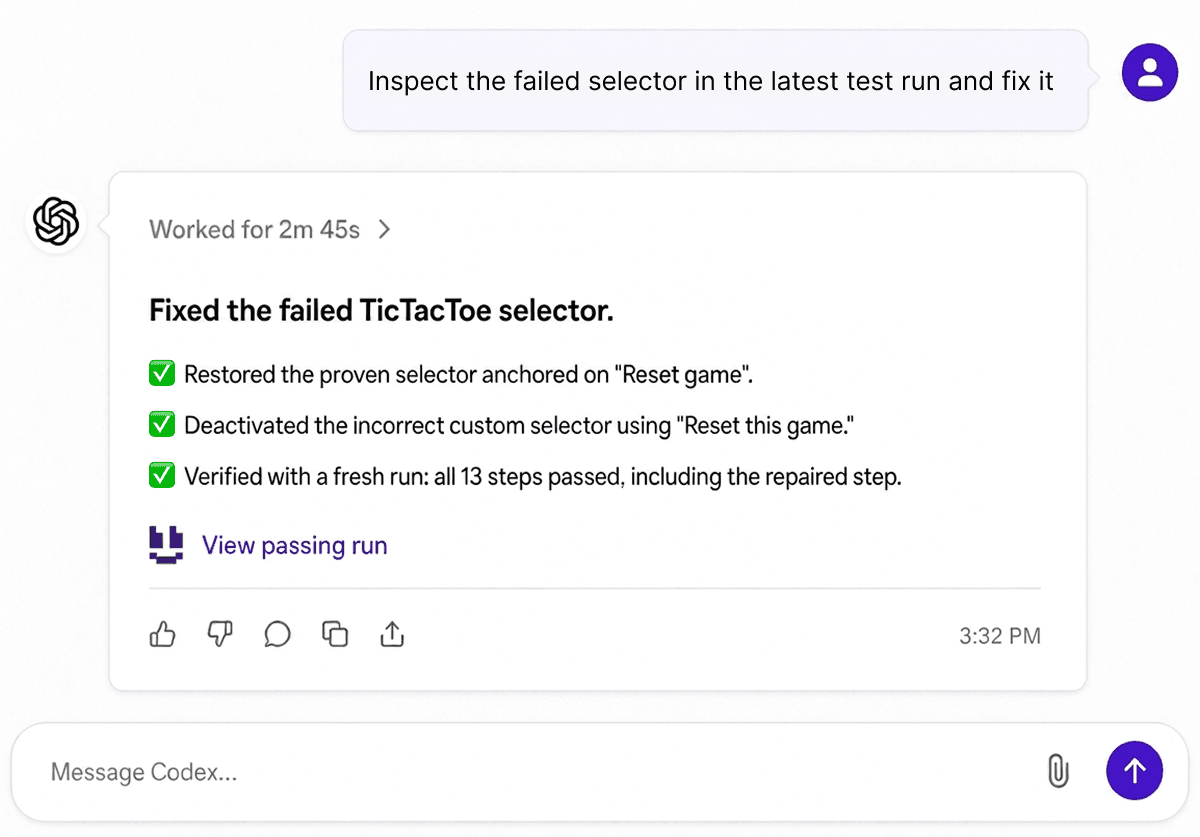
Suites, environments, schedules, execution history, screenshots, and failure evidence stay connected to the same tests, making it easier to coordinate releases, investigate regressions, and show what was actually verified.
Pricing: $0 to start (unlimited local runs); $99/mo (unlimited cloud runs), $189/mo (unlimited users and full CI/CD).
The result is more regression coverage, clearer accountability, and less vendor lock-in, without increasing dependence on dedicated automation specialists, and while QA remains responsible for what each critical test is meant to prove.
The most upvoted take in the QA community on AI testing right now is "avoid it entirely." The reasoning is worth taking seriously: AI doesn't understand your domain, so it doesn't understand what's important to test.
A team that generates a suite autonomously and never reviews it ends up with tests that pass confidently while testing nothing - which is worse than no suite at all, because it creates false safety.
That failure mode is real.
It's also specific: it describes autonomous generation without human review, not AI-assisted testing where a human records the flow and AI keeps the selectors stable. The difference matters more than the marketing. If you've been burned by the first category, the second one is what you were actually looking for.
Choose BugBug for team-owned test automation
BugBug brings product teams, QA, engineering and AI agents into one governed regression system: visual for testers, structured for engineering and MCP-ready for agents.
Get started
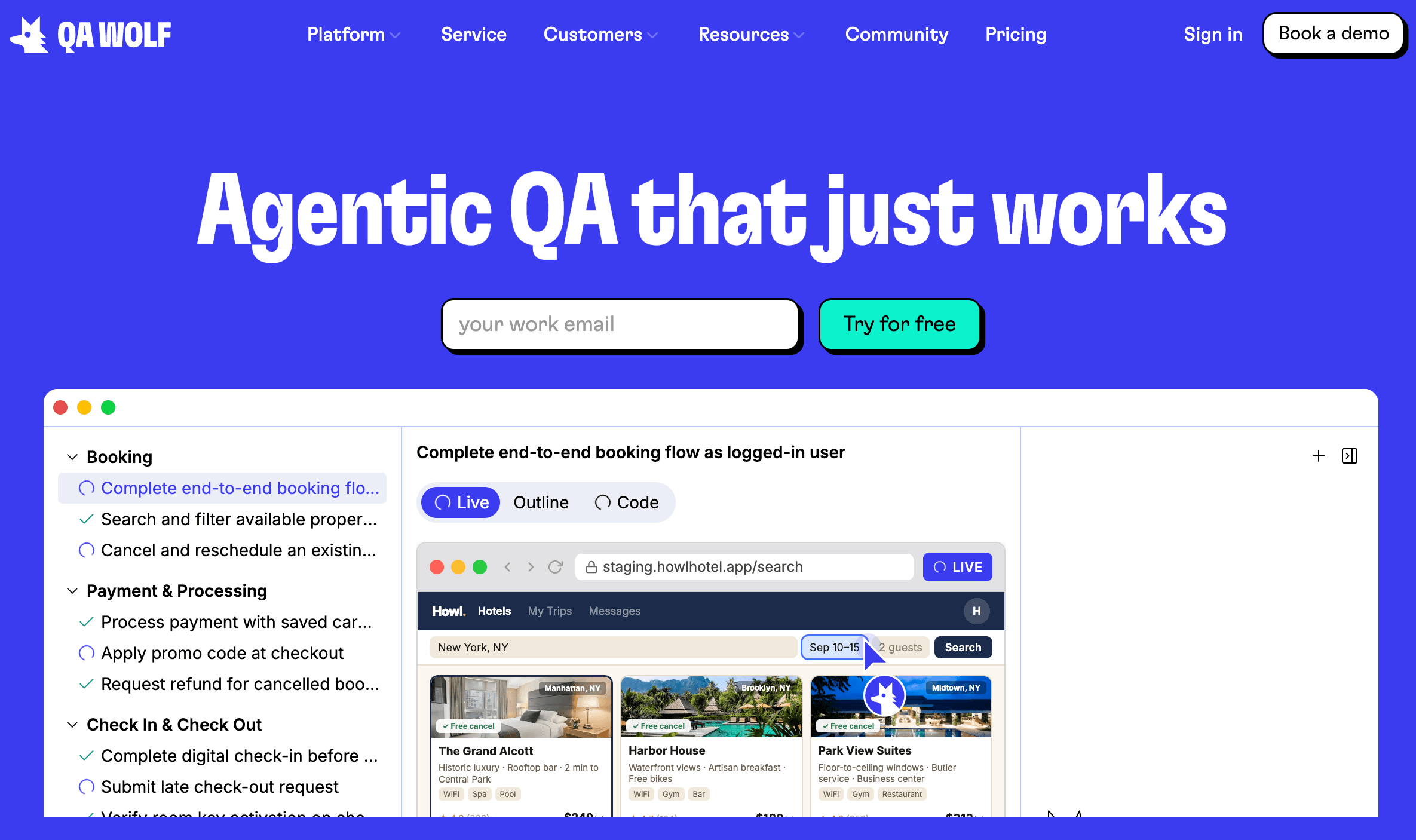
Their engineers build and maintain your Playwright suite.
Best for: Companies choosing to outsource QA entirely.
Avoid if: ~~$90K/yr median spend isn't on the table.
Not software - a service, and a good one at the right size, effectively pairing an AI test engineer model with a human delivery team rather than just a SaaS tool. Zero-flake guarantee, and you own the resulting Playwright code. Part of the appeal is compressing test writing from hours to minutes, even if vendor claims vary - for example, Testers.ai claims to generate tests in minutes instead of hours. At SMB scale, the price is headcount money. Spend it on this only if you've decided never to build QA in-house.
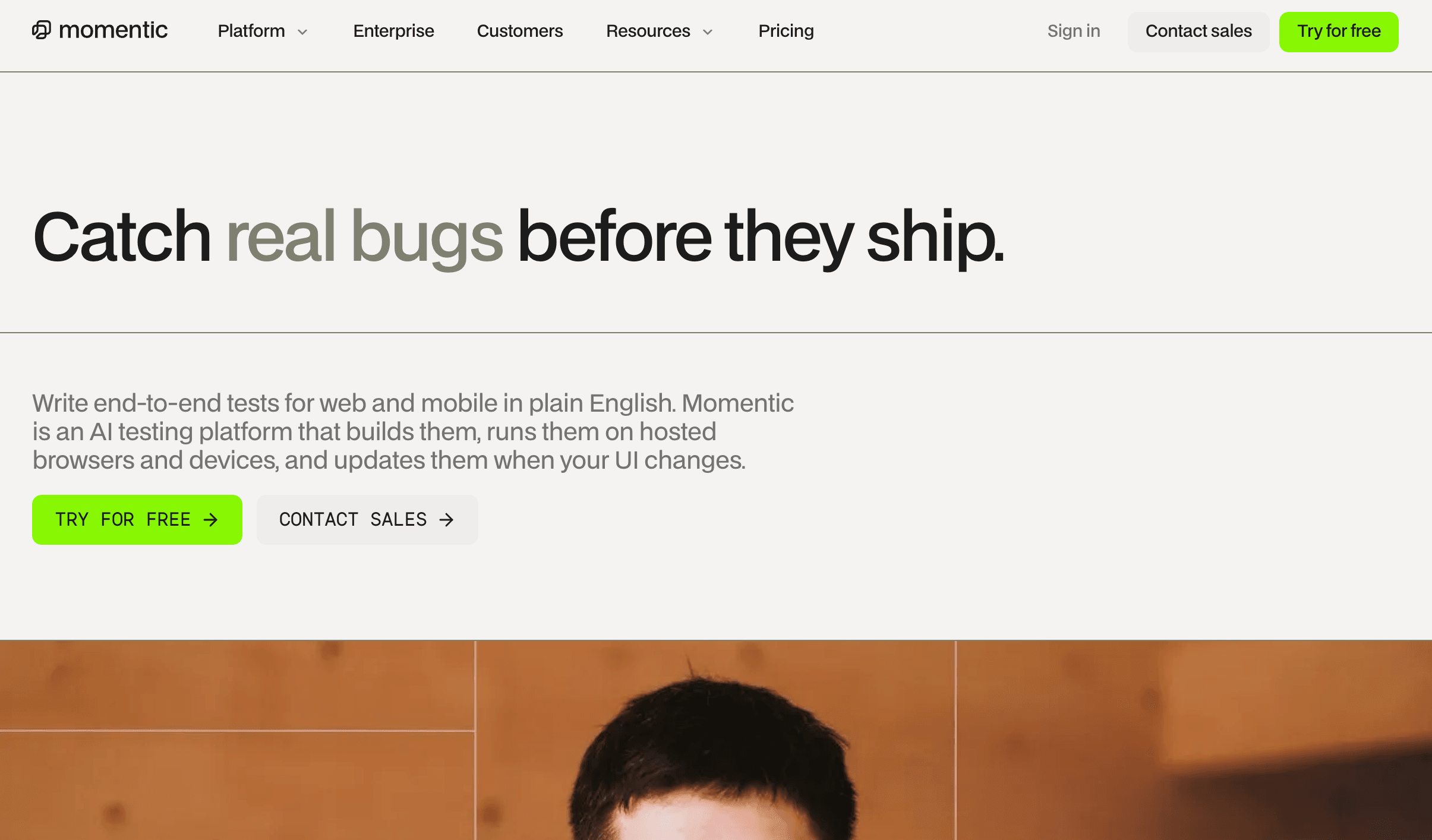
Plans, writes, runs, and heals E2E tests.
Best for: AI-native product teams that need verification at PR-time.
Avoid if: You want self-serve pricing beyond $250/mo.
The most credible pure agent for modern product teams. Plans flows up front, caches resolved steps, and triages failures into labeled buckets while using LLMs to understand test intent instead of only executing steps. Above the entry tier, pricing goes opaque fast—budget for a sales cycle. Autonomous systems still need regular audits of generated tests to catch redundant scripts and inaccuracies, and they improve when teams update the model with new code patterns and user feedback over time.
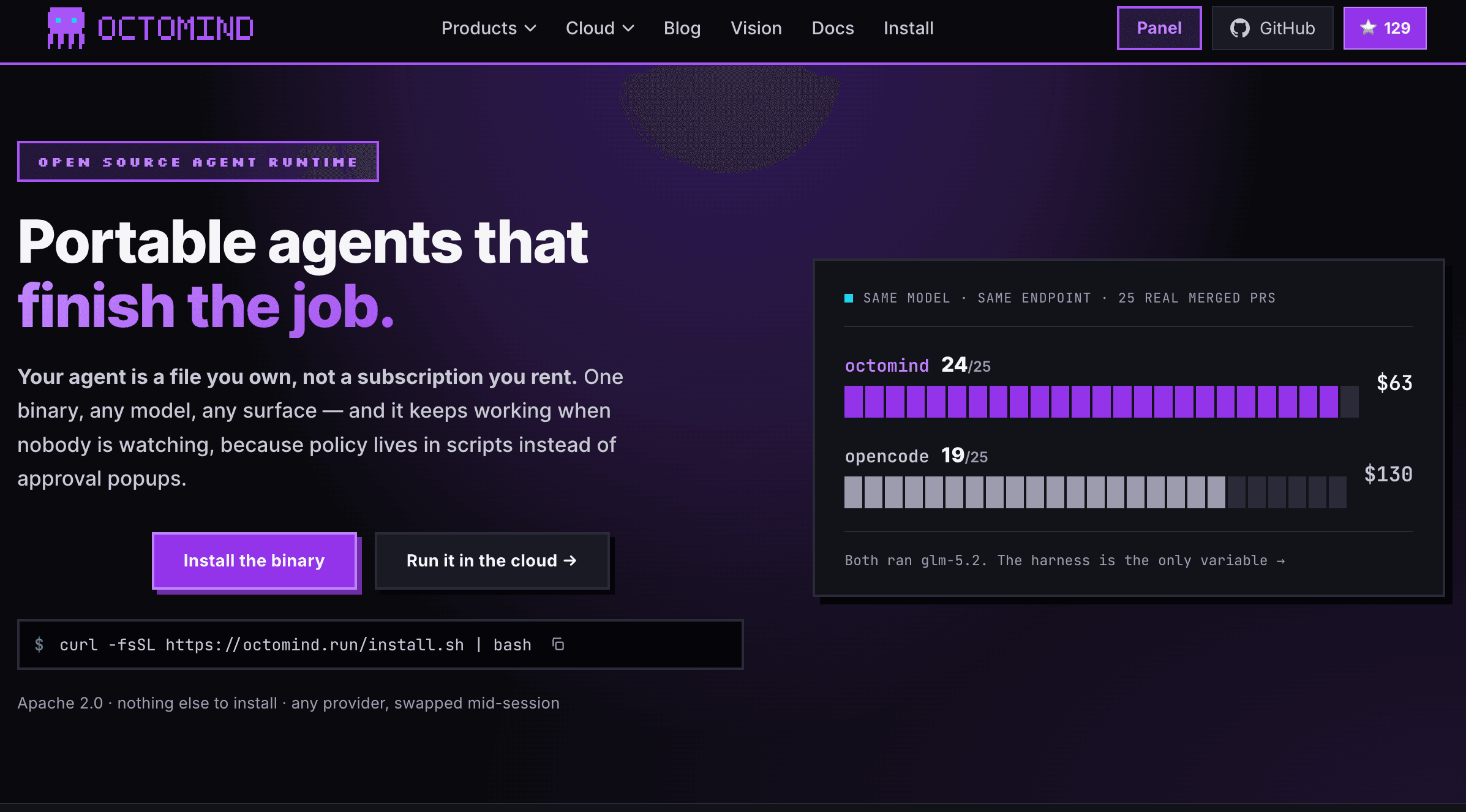
Writes and maintains Playwright tests you own.
Best for: Engineering managers who want Playwright coverage without writing it, including generated test scenarios in Playwright format.
Avoid if: Non-engineers need to contribute—there's no recorder.
The anti-lock-in agent, and the strongest exit story in the autonomous tier. Output is portable Playwright code in your repo, with generated test cases that developers can refine there. Developers are the only on-ramp, though—if your PM or manual tester should contribute on a team with mixed technical skills, look at the low-code tier instead.
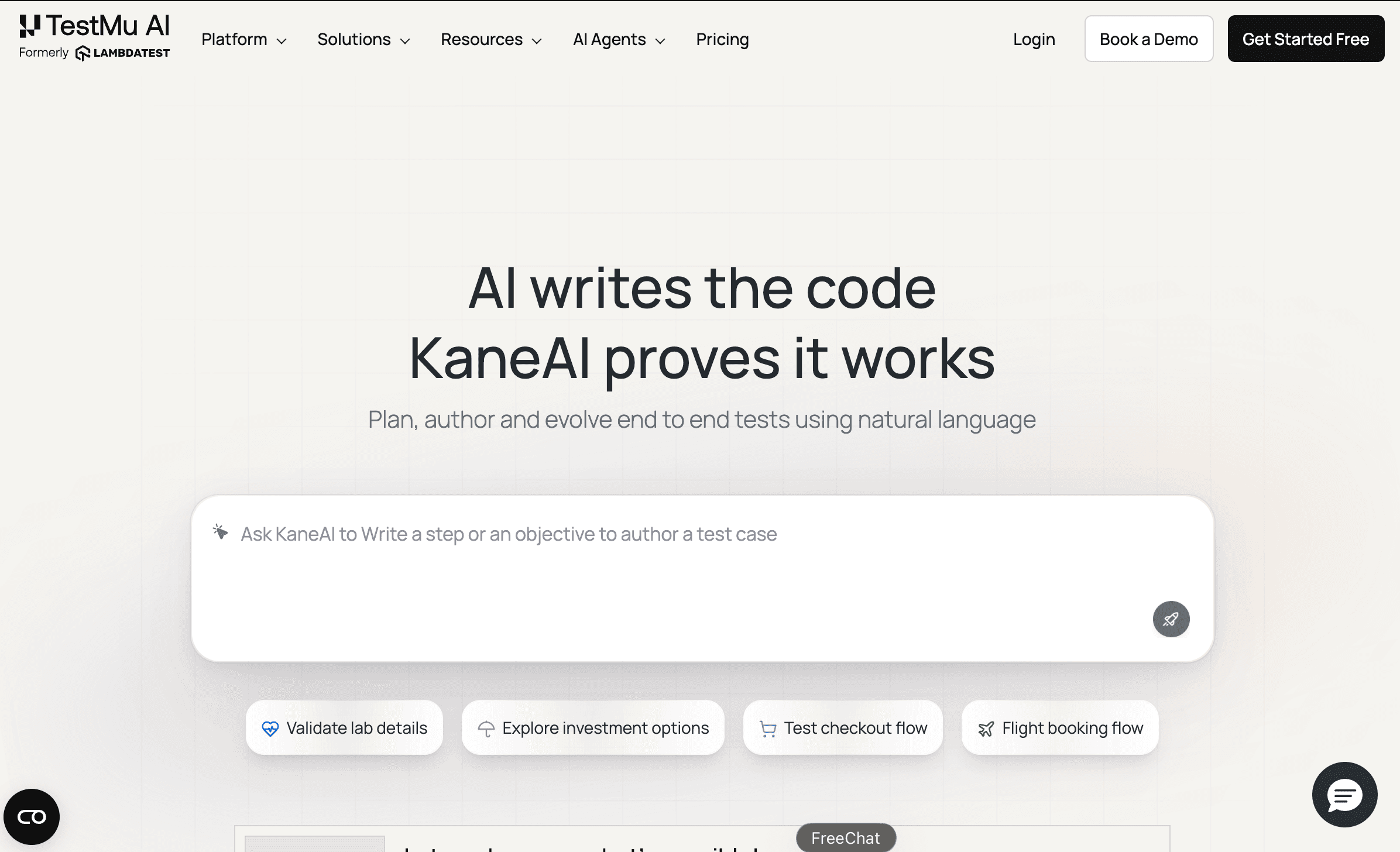
Generates tests from Jira tickets and PRDs.
Best for: QE organizations already on LambdaTest infrastructure.
Avoid if: Quote-driven, per-agent pricing across six SKUs sounds like a procurement project.
KaneAI supports test design and test plans from inputs like Jira tickets and PRDs, not just raw generation. The appeal here is breadth—web, mobile, API, export to your framework of choice—wrapped in an enterprise buying process. If you're not already a LambdaTest shop, the integration gravity isn't worth it. Enterprise buyers often compare it with other tools such as ACCELQ when they want codeless automation with CI/CD integration.

Covers web, mobile, and API in one UI.
Best for: Growth-stage companies with a QA lead and real budget.
Avoid if: Test portability matters, or per-seat pricing and ~~$500/mo entry stretches you.
The most complete platform play among the low-code incumbents, with built-in test management, mature auto-healing, agentic workflows, strong CI/CD. Many AI-powered testing tools in this class also support parallel testing, so teams can run multiple tests simultaneously to speed continuous integration. The trade: your tests live inside the platform and never leave—you pay per seat, and pricing above entry is quote-based.

Under an enterprise umbrella.
Best for: Mid-market teams that want a name procurement recognizes.
Avoid if: You'll ever want your tests out—export options are minimal, or you want flat pricing without per-seat charges.
The AI-powered testing approach behind its smart-locator tech genuinely reduces breakage as UIs evolve. Vendors in this category often claim self-healing accuracy as high as 95%, but buyers should validate that on their own app. Tricentis ownership buys vendor stability and upsell pressure in equal measure. Also charges per-seat, so team growth = cost growth. Fine choice if lock-in and seat-based pricing don't scare you; they should at least give you pause.
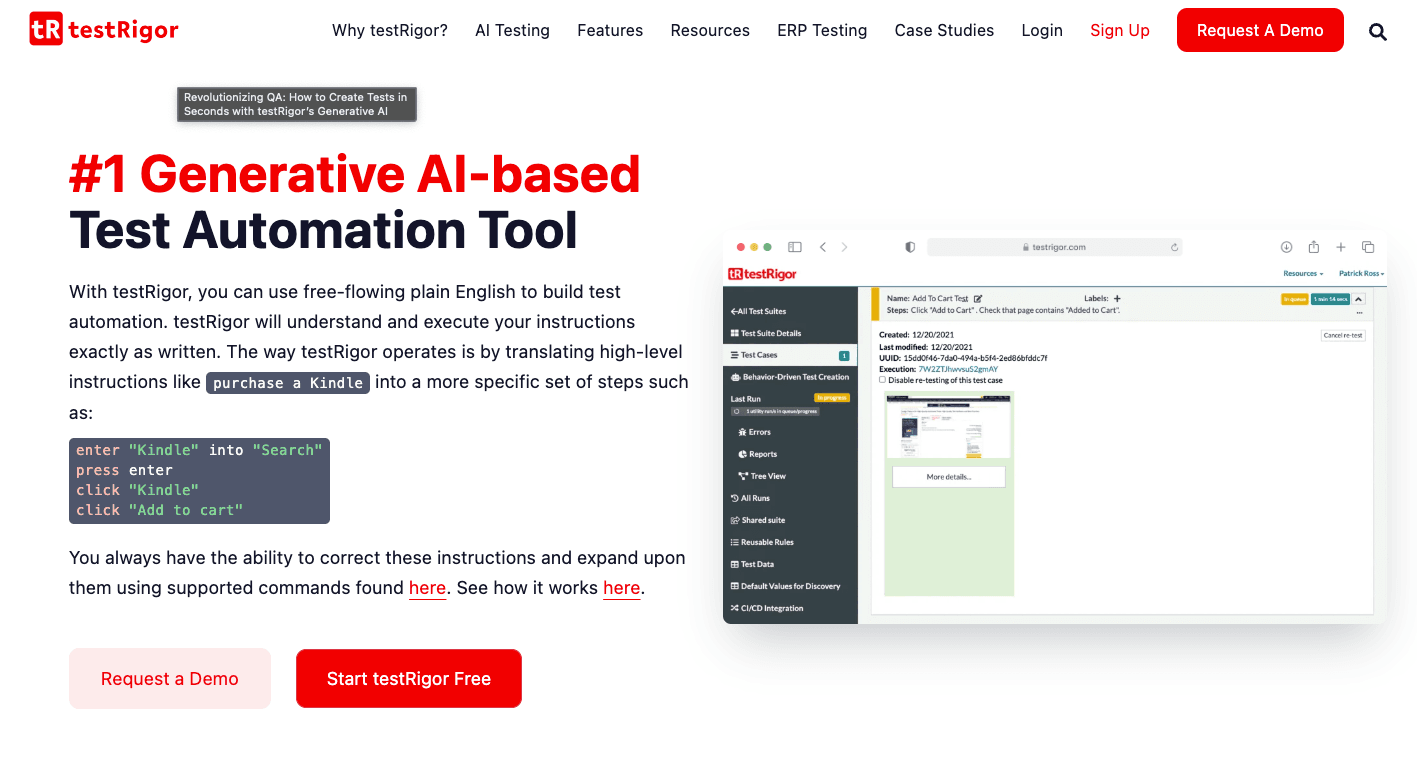
Across web, mobile, and desktop.
Best for: QA teams converting large manual suites into automation.
Avoid if: A proprietary English DSL worries you—those sentences run nowhere else.
Genuinely accessible to manual testers with zero automation background, with natural-language authoring that turns plain-English prompts into executable test steps, and broader platform coverage than anything else in this tier. This codeless workflow can help teams create tests and expand test coverage up to 3x faster than coding-heavy approaches. The cost is double lock-in—proprietary format and $10–50K/yr pricing. Great on-ramp, expensive exit.

With plain-language steps and per-run pricing.
Best for: Small teams that prefer paying per run.
Avoid if: Run-metered pricing punishes your CI frequency, platform-locked tests are a dealbreaker, or you want unlimited users without per-run costs.
This is the closest analog to BugBug, with different trade-offs. SmartBear backing, ~$212 per 500 runs. Fair is fair: if you're comparing Reflect against us, the pricing model and user limit are the real forks—per-run metering vs. flat unlimited, and Reflect's user/account constraints vs. Run your CI math before choosing. Per-run pricing matters even more if each test run is part of parallel testing, where multiple tests run simultaneously and can cut execution time by up to 3x versus sequential runs.
👉 Read more about AI test case generation.
Here's the part of AI in software testing every vendor list glosses over, and the reason we built our own AI the way we did.
When teams adopt generative AI testing tools, they expect one outcome and get another. They expect AI to eliminate test maintenance. What they mostly get is faster test creation—with maintenance still largely intact. Rainforest QA's survey of 625 developers found something stronger: 55% of teams using open-source frameworks spend over 20 hours weekly on maintenance. Meanwhile the World Quality Report puts hallucination and reliability among the top concerns about generative AI in quality engineering—ranked above cost.
That matches what our own users told us. When 36.8% of surveyed users asked for AI assistance, we prototyped test generation first—the flashy demo. It fell apart exactly where every AI test generation demo falls apart: complex interactive flows. The agent handles a login form in the demo and loses context three pages into a real checkout. So we shipped artificial intelligence in test automation the other way around:
BugBug's AI makes recorded tests stable from day one - smart selectors, intelligent waits, automatic scrolling. Then it helps you fix them when they break, without silently rewriting your suite.
Connect Claude, Cursor, or ChatGPT over MCP. AI agents can run tests, analyze failures, and propose fixes. You approve every change. No autonomous generation into a black box.
Export to YAML. Own your tests forever. No vendor lock-in.
Team-owned regression and visual testing
Get started
Skip the feature matrices. Match your team:
Developer-led team, Playwright literacy, an engineer willing to own the suite → Playwright + Claude Code or Cursor. Free, portable, powerful. Budget the owner's hours honestly—they're the real cost.
Funded QA org, $40K+ annual budget, complex product → the autonomous tier. QA Wolf if you want it done for you; Momentic or Octomind if you want an agent in-house; KaneAI if you're already on LambdaTest.
Web-only SaaS team, 0–3 QA, nobody owns testing full-time, need coverage this sprint → BugBug. $0 to start (unlimited local tests); $99/mo for cloud runs if you need scheduled execution. No per-seat charges. YAML export keeps your tests portable.
Design-heavy product where pixels are the product → add a dedicated visual AI tool (Applitools, Percy) alongside your functional coverage. It's a different job—visual testing and visual validation that identify meaningful UI differences across devices, not flow verification—and no tool on this list replaces it. Dedicated tools for cross browser testing can also reduce maintenance costs significantly, and Applitools has publicized cases where it saved a company one million dollars annually.
Happy (automated) testing!
Your next release. Properly tested.
Join 1,200+ QA teams that automated their regression coverage with BugBug.

Dominik Szahidewicz is a Software Quality Evangelist specialising in quality assurance, test automation, and modern software testing practices. He creates practical, research-driven content that helps QA professionals, developers, and product teams improve test coverage, automate repetitive testing, and release more reliable web applications.
Drawing on his experience in technical writing, data analysis, and application consulting, Dominik translates complex testing concepts into clear, actionable guidance. His areas of interest include end-to-end testing, no-code test automation, regression testing, and the use of AI in software quality assurance.

Senior software engineer at BugBug, where he's spent 6 years helping shape the product. He's a T-shaped developer skilled in frontend with React and TypeScript, browser extensions, backend work, and building AI agents and tooling. His strengths also include UX instincts, a product-minded approach, and process automation.
Join thousands of QA experts. Subscribe to our newsletter.
Get more testing tips and product related content. Zero spam.
Discover essential business tools for startups. Read the article to find the right tools for your success.
Compare the best SaaS testing tools for startups, QA, and dev teams. See use cases, pricing, and key SaaS flows to automate.
Discover essential accessibility testing tools and software in our guide. Learn how to make your applications accessible for everyone.
How to find bugs in your code? They live to damage your code, to make you lose time and effort and money.
AI can generate 100 test cases in seconds. Deciding which to keep, making them run, and maintaining them is the real work. Here's the workflow.
Comprehensive guide to testing search functionality with 100+ test cases, real-world examples, and tips for automating search tests using BugBug.
Is affordable testing possible? Many teams discover too late that their “cheap” QA platform comes with variable costs.
1st of our automation testing guides with essential recommendations for startups and saas teams
Check the 10 reasons why the profession of manual tester can be recognised as surprisingly interesting.