How to Reduce Test Maintenance Overhead
Written byDominik SzahidewiczReviewed byPaweł Bylina


Updated: August 27, 2026View as Markdown
You have one or two manual QA people, five to forty engineers, no automation engineer, and a web app that ships every week or two. Test maintenance overhead is eating whichever of those people drew the short straw.
So here's the Monday you already know. Fourteen tests failed over the weekend. Two are real bugs. The other twelve are a selector that moved during Friday's UI tweak, a modal that renders 400ms slower, a test account whose trial expired, and a login flow that eleven separate tests each set up their own way. By lunch you've fixed nothing in the product. You've fixed the suite.
Most advice on this problem is a list of selector tips. We looked at what actually separates the teams whose suites survive from the ones whose suites get muted in CI, and it isn't selector hygiene. It's whether anyone fixes red tests the day they go red.
Here's the evidence, then the order to work through it.
When we analyzed our 31 best-fit accounts to work out what made them different from average customers, we expected the answer to be about volume or company profile. It wasn't.
The accounts that last do two things nobody else does consistently:
The gap between accounts that reach that state and accounts that don't:
| Fix-and-gate accounts | Everyone else | |
|---|---|---|
| Average months active | ~~18 | ~~11 |
| Monthly test runs | ~~2,200 | ~~1,200 |
| Projects in use | 11 | 5.6 |
Fair caveat: 31 accounts is a small sample, and this is correlation — teams that were going to succeed anyway probably also fix their tests. Treat the direction as real and the precision as rough. But the direction is unambiguous, and it matches what we see in support: the suites that die don't die from one catastrophic breakage. They die from six weeks of nobody fixing three red tests.
Which means the first fix is organizational, not technical.
As BugBug's founder Paweł Bylina puts it: test automation without ownership is just an expensive decoration.
💡 Also check: Codeless Automation Testing Tools - Hands-On Breakdown
"The tests are flaky" is a feeling, not a measurement.
Run this for two sprints. Every time a test goes red, tag it: bug or suite.
That gives you your false-failure rate — failures caused by the test or the environment, divided by total failures. It's the single number that tells you whether you have a maintenance problem or a quality problem.
Track two more while you're at it:
Quadient hit the version of this that ends a tool relationship. Their team was running E2E tests on Selenium and Cypress and getting enough false positives that they stopped trusting results before deployment. The maintenance cost wasn't the fixing — it was the loss of signal. A suite you don't believe is worth zero regardless of how green it is.
👉 See how you can fix flaky tests in few simple steps
Every test is a subscription, not a purchase. You pay for it every release, forever.
Teams add tests because adding feels like progress. Almost nobody prunes. The suite grows, the maintenance bill grows with it, and the test covering a settings toggle nobody has touched since 2024 costs the same to maintain as the one covering checkout.
Cut on these rules:
What survives: signup, login, the money path, the two or three actions your product exists to perform, and anything a customer has reported twice.
Upfluence is a useful calibration point here. They automated roughly 120 test cases across their most-used features — not their whole platform — and reported eliminating production regressions entirely. 120 well-chosen tests beat 400 tests nobody maintains.
| Failure cause | What it actually costs | The fix |
|---|---|---|
| Selector broke after a UI change | 5–20 min per test, every redesign | Attribute-based selectors (data-testid), or a recorder that captures stable selectors automatically — never CSS position or visible text |
Hardcoded waits (sleep 3000) |
A slow suite plus random CI failures on slow days | Wait on state: element visible, request finished, spinner gone. Never on the clock |
| Shared or stale test data | Cascading failures nobody can reproduce locally | Each test creates and disposes of its own data. Reset accounts between runs |
| Duplicated setup steps | One auth change breaks 40 tests at once | Extract login and setup into a reusable component referenced everywhere |
| Environment drift | Green locally, red in CI, three hours to explain | Dedicated test environment with seeded data — not staging-that-someone-is-using |
Only the first is really "flakiness." The rest are structural, and the fixes are boring, one-time, and permanent.
Polly.Help did exactly the fourth and fifth of these when they replaced manual regression: reusable components for the flows that repeat, plus scheduled runs across separate environments. An 11–50 person SaaS with a small QA team — the same shape as most teams reading this.
Here's the cost nobody measures: the debug loop.
Step 47 of a 60-step test fails. You change one line. To verify, you rerun the whole test — three minutes of logging in, navigating, filling forms, all to reach step 47 again. Six rounds is eighteen minutes of watching a browser do things you already know work. Multiply by twelve failures on a Monday.
This is where tool choice changes the arithmetic rather than the vocabulary.
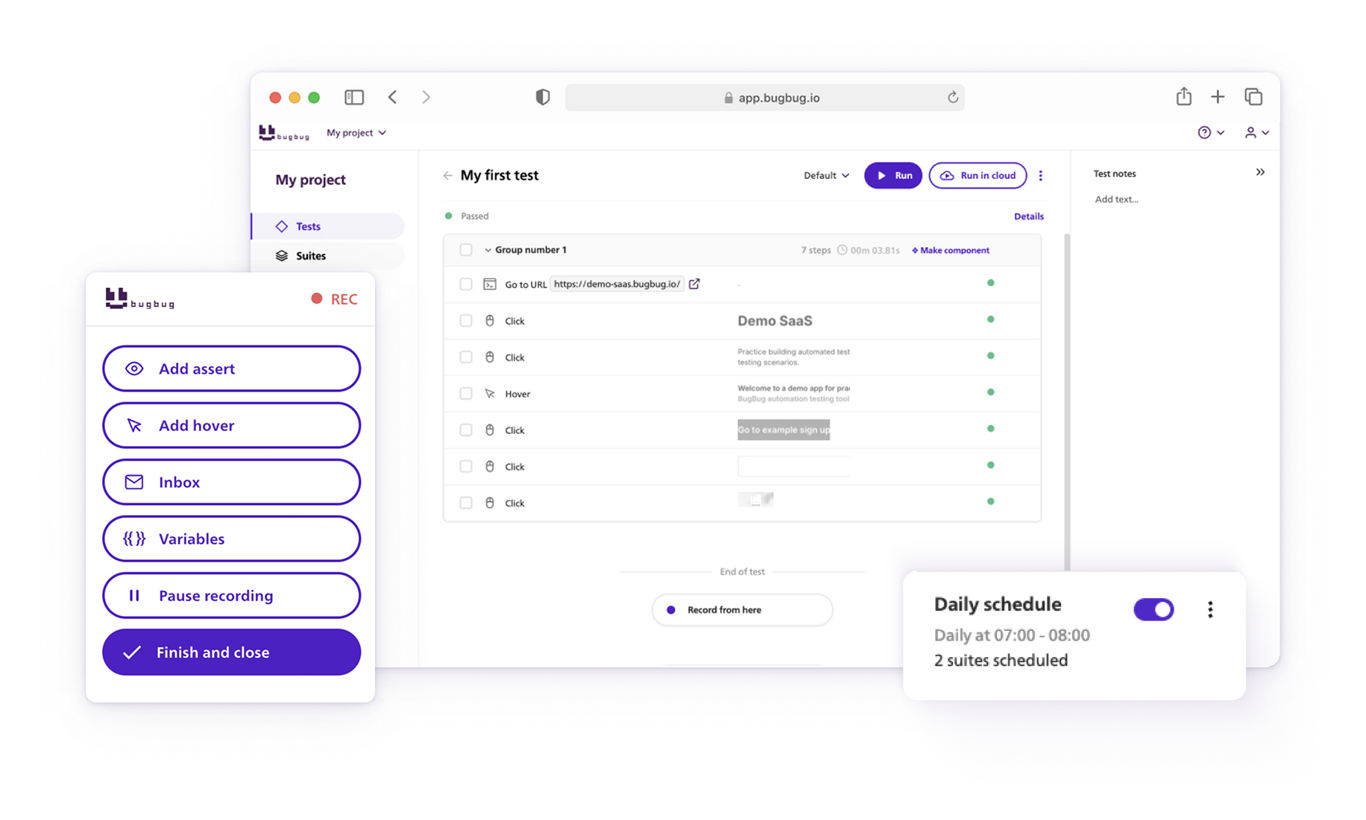
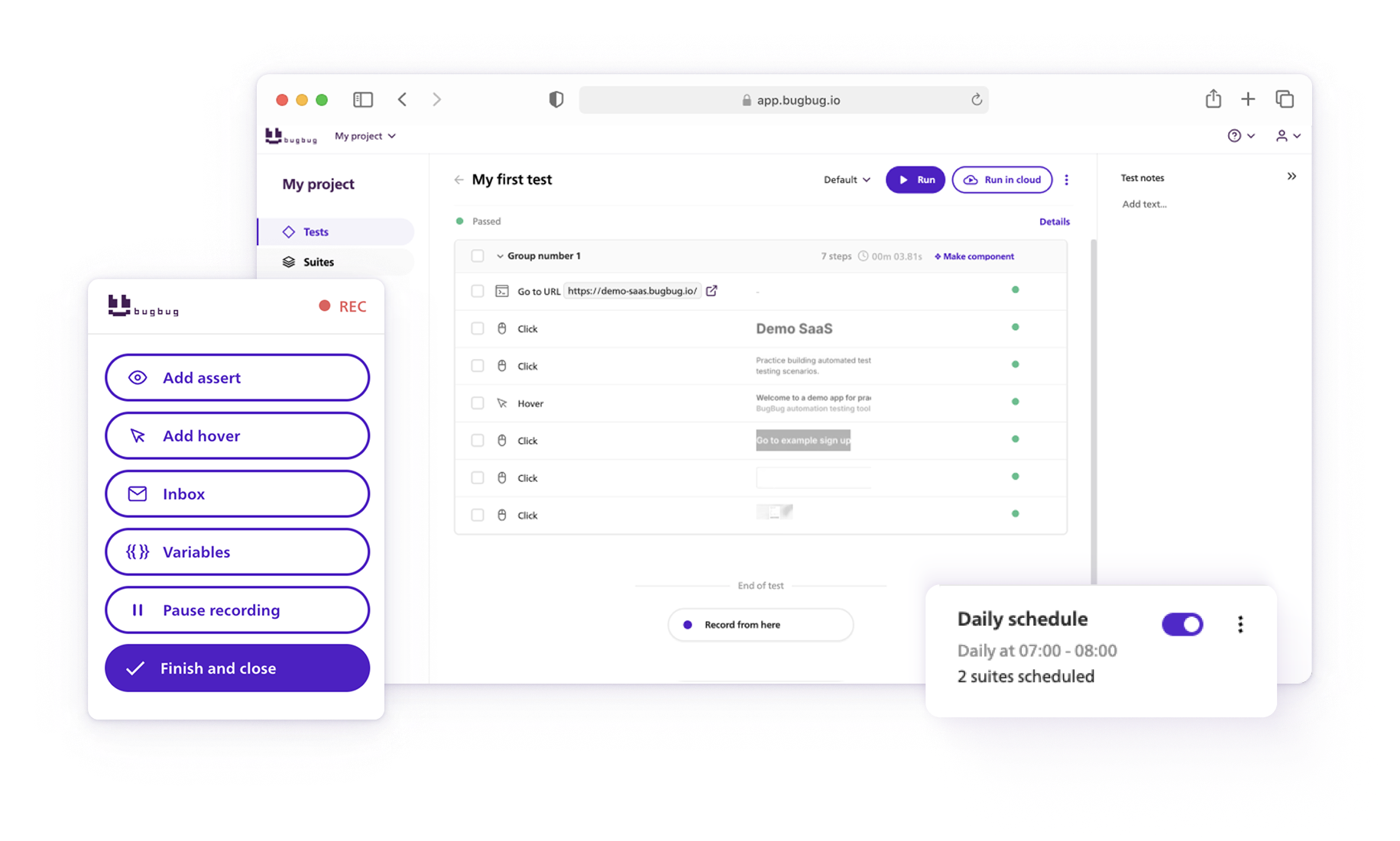
BugBug lets you insert, edit, or delete a step anywhere in a test and rerun from that point instead of starting over or re-recording. The recorder captures selectors as you click, so a UI tweak usually means re-recording one step, not the flow around it. Repeated flows become reusable components, so an auth change is one edit instead of forty. Smart waiting covers the timing conditions you'd otherwise hardcode.
Quadient measured about a 50% reduction in test building time versus their Selenium and Cypress setup, and their DevOps lead's stated reason for switching was runner stability — the false positives stopped. Their tests also ended up runnable by any team member rather than only testers, which is the ownership point from section one showing up as a product property.
The honest limitation: BugBug runs on Chromium and Chrome only. No Firefox, no Safari, no mobile browsers, no desktop apps. If cross-browser regression is part of your coverage requirement, that's where BugBug stops and Playwright or a grid-based tool starts.
Ask the uncomfortable question: if the person who wrote your suite left tomorrow, who fixes it?
For a lot of teams the answer is nobody. There's a Cypress repo one engineer built two years ago; he's on the platform team now. The manual QA who knows exactly which workflows break can't touch it. The support lead who's seen the same regression from customers three times this quarter can't either.
That's the real maintenance ceiling. Not selector strategy — access.
The people who understand what should be tested are frequently not the people who can write Playwright. So the fix has to be structural: the test needs to be one artifact that more than one role can read, edit, and run.
That's the shape BugBug is built around now. Manual QA, product owners, and support specialists create and maintain flows visually. Engineering gets the same tests as YAML they can export, diff, and version — which also means no lock-in if you leave. CI runs them through the CLI and API. Results are legible to someone who has never opened a trace file.
Two practical details make this real rather than aspirational. First, readable steps: if a failure reads "click 'Complete purchase'" instead of a 40-character XPath, a support specialist can diagnose it. Second, no per-seat pricing — putting your whole team in the tool costs nothing extra. Seat-metered tools quietly manufacture the bus-factor problem by making you decide who's worth a license.
👉 Also check our beginners guide to automation testing
Playwright deserves a fair hearing here, because it's what our own users named first.
It genuinely lowers maintenance for teams that can run it: auto-waiting removes a whole class of timing flake, the trace viewer collapses diagnosis time, and fixtures kill setup duplication. Practitioners in r/QualityAssurance describing their move off Cypress consistently cite maintainability — command chaining that's painful to keep clean, weak multi-tab and iframe handling, dashboard costs at scale. Playwright fixed those. Pair it with Claude Code or Cursor over MCP and test authoring gets genuinely fast.
The cost Playwright doesn't remove: someone has to own the repo. Fixtures, page objects, CI config, and the upgrade treadmill are engineering work, permanently. In the same threads you'll find people asking how to migrate a few hundred existing tests — that's the other half of the bill. If you have an engineer whose job includes that, Playwright is likely your lowest-maintenance option. If you don't, you're one resignation away from an unmaintained repo.
Choose Playwright or Cypress if engineers own tests as part of their role, your app is JavaScript-heavy with complex state, you need Firefox or Safari coverage, or you're already invested in fixtures and trace-based debugging.
Choose a visual tool like BugBug if you're web-only on Chromium, the people who know the workflows aren't the people who write code, nobody wants to own test infrastructure, and your current suite is maintained by exactly one person with other priorities.
In order, highest return first:
If step 7 lands on "we need something the whole team can maintain," BugBug's free plan gives you unlimited local runs with no credit card. Record the one flow you're most tired of fixing and see whether it survives your next release. If it doesn't, you've learned something cheap.
Happy (automated) testing!
Your next release. Properly tested.
Join 1,200+ QA teams that automated their
regression coverage with BugBug.

Dominik Szahidewicz is a Software Quality Evangelist specialising in quality assurance, test automation, and modern software testing practices. He creates practical, research-driven content that helps QA professionals, developers, and product teams improve test coverage, automate repetitive testing, and release more reliable web applications.
Drawing on his experience in technical writing, data analysis, and application consulting, Dominik translates complex testing concepts into clear, actionable guidance. His areas of interest include end-to-end testing, no-code test automation, regression testing, and the use of AI in software quality assurance.

Paweł Bylina is a software engineer, test automation product leader, and founder and CEO of BugBug, a no-code end-to-end testing platform used by teams in more than 50 countries. He has over 15 years of experience building software and leading engineering teams as a developer, engineering manager, CTO, and SaaS founder.
Paweł created BugBug after repeatedly seeing teams struggle with test automation that was costly to implement and difficult to maintain. He now works closely with QA engineers, developers, and engineering leaders to improve how software teams create and maintain reliable automated test coverage.
His expertise includes end-to-end testing, regression testing, browser automation, no-code test automation, QA strategy, and software quality. He shares practical insights drawn from building BugBug and working with software teams worldwide.
Join thousands of QA experts. Subscribe to our newsletter.
Get more testing tips and product related content. Zero spam.
Discover essential business tools for startups. Read the article to find the right tools for your success.
Learn how to automate regression testing without devs or QA. Discover a risk-based strategy and practical workflows.
This article delves into the journey of becoming an Automated Test Engineer, offering insights into the essential skills, knowledge, and steps required to embark on this career path and increase your current salary.
Compare the best SaaS testing tools for startups, QA, and dev teams. See use cases, pricing, and key SaaS flows to automate.
This guide covers the best automated testing tools for startups in 2026 — for development teams of 3 to 30 who move fast and protect what matters.
Best free and open-source test automation tools for 2026: Playwright, Cypress, Selenium and best free plans from commercial tools.