Reflect.run is a clean, well-designed no-code testing platform. It's fast to adopt, easy for non-technical teams, and gets you to your first test quickly. For teams starting out with web automation, those qualities genuinely matter.
But most teams searching for Reflect.run alternatives aren't looking to give up on no-code testing. They're hitting a specific set of friction points as their test suite grows:
Cloud-only execution. Every test run — including debugging sessions during development — goes through the cloud. You can't run tests on your own machine. That adds cost and latency at every iteration.
No free plan. Reflect.run charges from the first test run. There's no way to validate fit before committing to a purchase.
Limited debugging control. There's no equivalent of inserting a step mid-test and rerunning from that exact point. When a test fails, your options are more limited than with tools built around step-level debugging.
Usage-based pricing. Costs scale with execution volume, making long-term spend harder to forecast as your test suite grows.
What Is Reflect.run? Why Do Teams Look for an Alternative?
Reflect.run is a no-code browser test automation platform. Teams create tests through a visual interface — clicking through their application to record interactions — without writing code. Tests run in the cloud and integrate with CI/CD pipelines for automated execution on every build.
Best for:
Small QA teams and non-technical users who want fast no-code test creation with minimal setup
Teams comfortable with cloud-only test execution and usage-based pricing
Organizations that prioritize quick onboarding over long-term cost control and local execution flexibility
Reflect.run pricing: It uses tiered pricing based on users and execution volume. There is no permanent free plan — teams pay from their first test run.
Teams typically explore alternatives when:
Cloud-only execution means paying for every run — including development and debugging sessions where local execution would be free.
Test suite growth makes usage-based pricing unpredictable month-to-month.
They need to insert a step mid-test and re-run from that exact point — Reflect.run's debugging model doesn't support this.
No free plan means no low-risk way to validate fit before purchasing.
Limited self-healing means manual updates are required every time the UI changes.
Reflect.run Alternatives: Codeless Tools
BugBug — The Low-Maintenance Alternative to Reflect.run
Best for: SaaS teams, and web-first product companies that want fast, maintainable automation — with predictable pricing and minimal overhead.
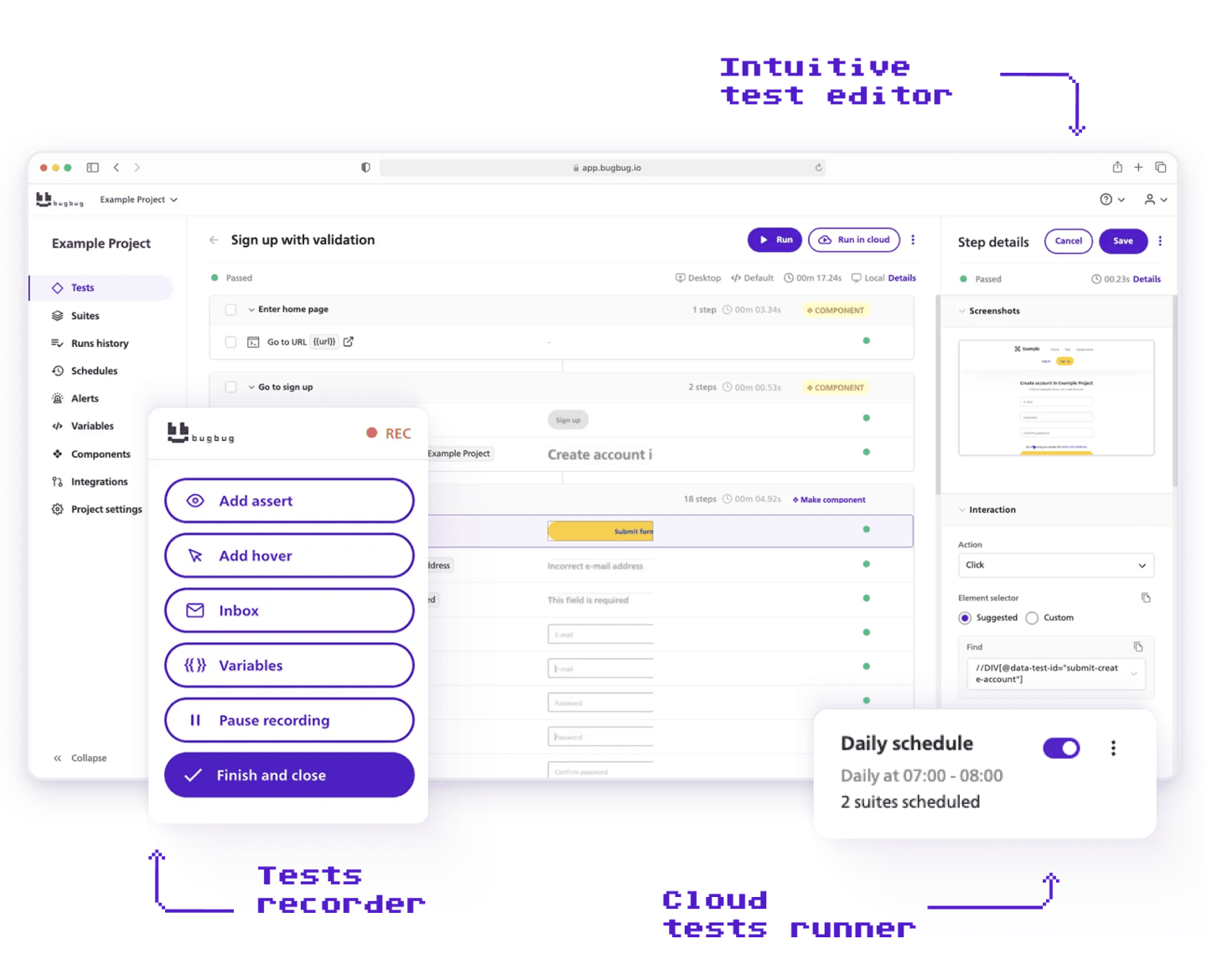
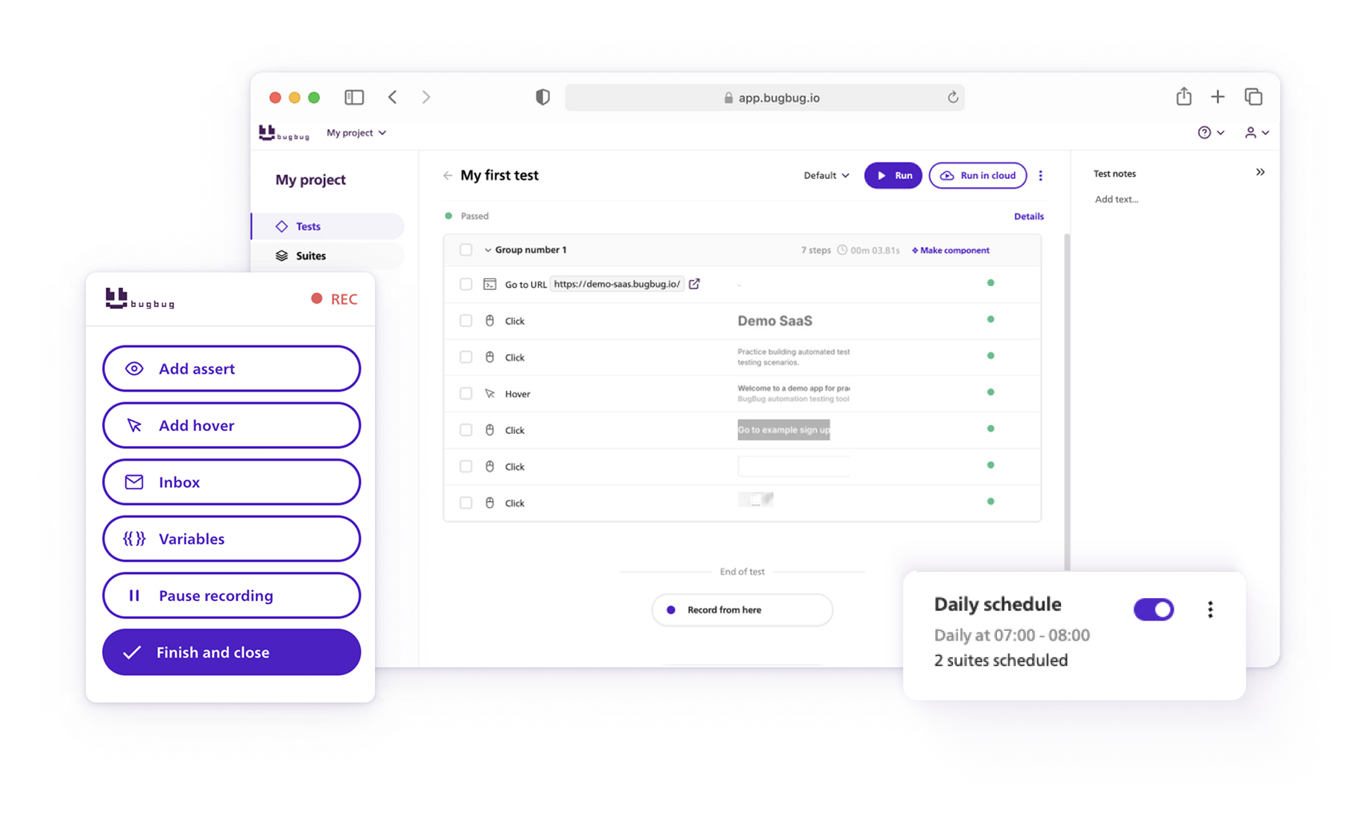
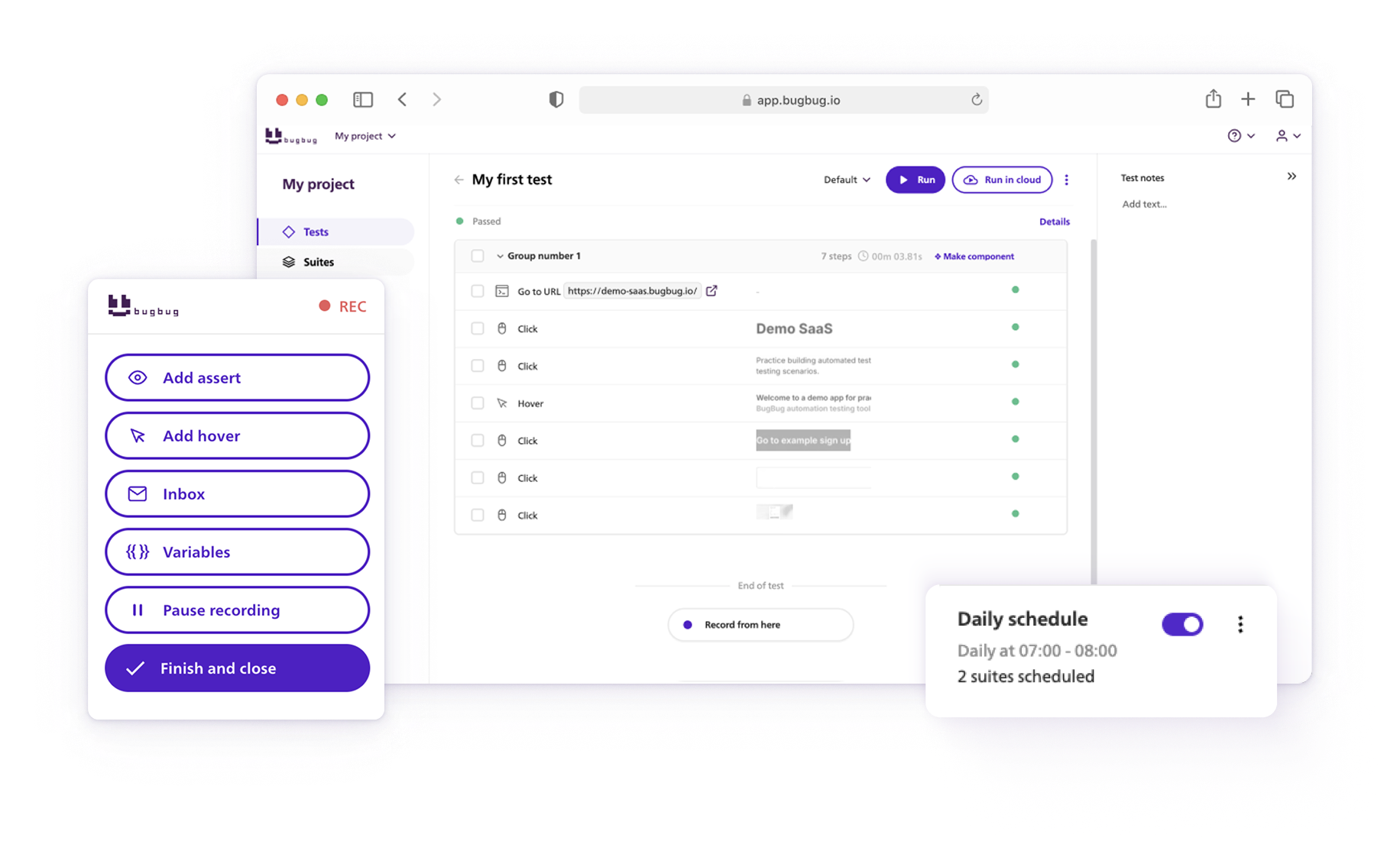
BugBug is built specifically for modern web application testing. Instead of a broad “testing ecosystem,” it focuses on what most SaaS teams actually need: stable E2E browser automation that doesn’t become a maintenance project. BugBug streamlines the testing process for developers by integrating seamlessly into existing workflows, reducing bottlenecks and making it easier to create and maintain tests.
If your product lives in the browser, BugBug removes much of the complexity (and scaling friction) that comes with heavier or usage-priced platforms. As a no-code testing tool, BugBug can democratize the testing process by enabling collaboration across different departments.
Strengths:
No-code test creation: Record clicks, inputs, and flows directly in your browser and turn them into automated web tests instantly — no framework or setup required.
Low maintenance: Edit & Rewind and smart waits reduce flaky tests and keep your web test suite healthy without ongoing manual upkeep.
Unlimited execution: Run tests locally or in the cloud without run limits. Schedule suites to monitor your web app's health continuously.
CI/CD integration: Connects with GitHub, GitLab, and other pipelines so web tests run automatically on every build.
Built for web apps: Optimized for Chromium-based environments with support for modern web behaviors and dynamic elements.
Limitations:
Chromium/Chrome only: BugBug runs tests in Chromium-based browsers. If cross-browser coverage across Firefox or Safari is a hard requirement, you'll need to supplement with another tool.
No deep framework customization: Teams that need complex data-driven scripting or framework-level control beyond pragmatic JavaScript support will find dedicated frameworks like Playwright or Cypress a better fit.
BugBug VS. Reflect.run
Both tools are no-code and fast to adopt. The differences are about what happens after you've built your first tests and your team starts to scale.
Reflect.run answers: I want clean, cloud-native no-code testing with minimal local tooling. BugBug answers: I want codeless automation I can run locally for free, debug at the step level, and scale on flat pricing.
Best for: Web teams managing large UI test suites with frequent UI changes.
Testim is an AI-powered test automation platform for web UI testing. Its self-healing locators automatically adapt when your application's interface changes — reducing maintenance effort on large, fast-moving test suites. It's a significant step up in both capability and price from Reflect.run.
Strengths:
AI self-healing locators: Automatically adapts to UI changes, reducing maintenance burden on large, fast-changing test suites.
Codeless and code-based flexibility: Mix visual test creation with custom JavaScript for complex scenarios.
Scales for large suites: Built for organizations running hundreds or thousands of UI tests.
Strong CI/CD integration: Designed for enterprise DevOps pipelines.
Limitations:
No free plan: Starts at $450–$1,000+/month — a significant barrier for small and mid-size teams.
AI maintenance opacity: Self-healing locators can silently adapt to wrong elements, masking real regressions.
Overkill for stable applications: If your UI doesn't change frequently, you're paying for AI you don't need.
Web-focused only: No mobile or desktop testing support.
Mabl
Best for: Enterprise DevOps teams running continuous testing at scale with AI-driven maintenance and deep CI/CD pipeline integration.
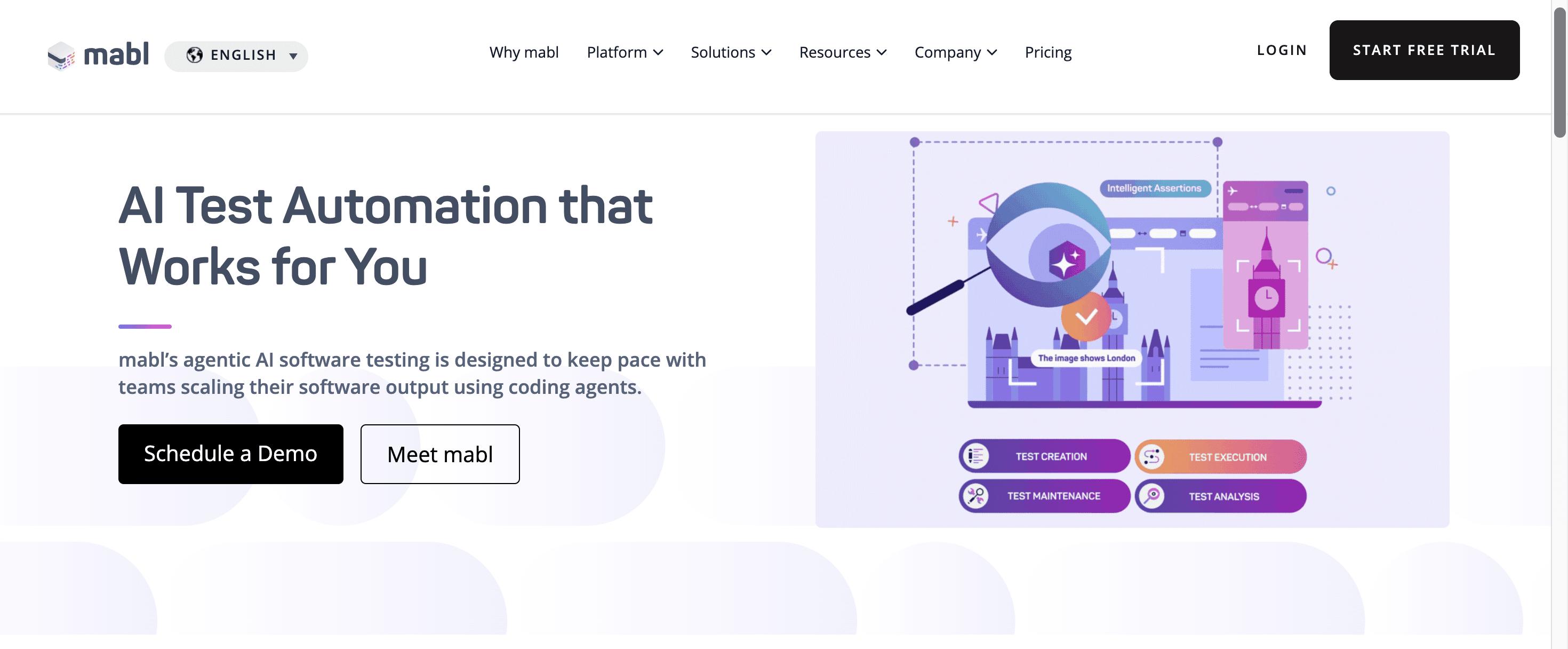
Mabl is an AI-native test automation platform for UI and API testing. It uses machine learning to adapt tests automatically when your application changes, with deep CI/CD integrations and visual regression testing built in. It's a significant step up in both capability and pricing from Reflect.run.
UI and API testing combined: Covers both from a single platform.
Deep CI/CD integration: Native integrations with Jenkins, GitHub Actions, Azure DevOps, and CircleCI.
Visual regression testing: Detects visual changes across runs, not just functional failures.
Limitations:
Enterprise pricing: Not practical for startups or small teams.
Steeper learning curve: Getting full value from Mabl's AI features requires meaningful onboarding investment.
Overkill for stable applications: Auto-healing ROI only materializes when UI changes frequently.
AI maintenance opacity: Tests can silently adapt to unintended changes, masking real regressions.
Rainforest QA
Best for: Product teams wanting fast validation plus optional crowdtesting.
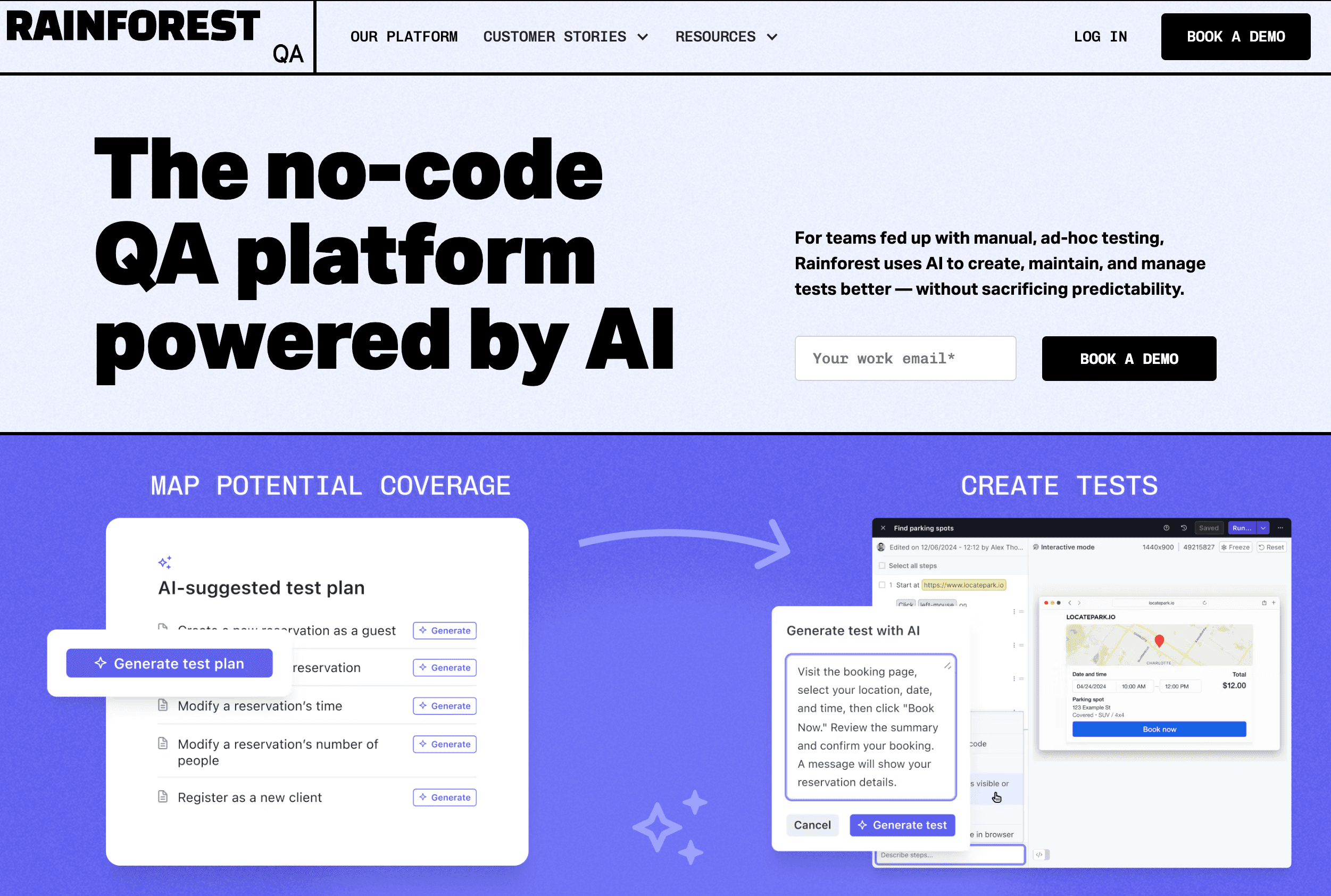
Rainforest QA combines no-code automation with on-demand crowdsourced human testers. Unlike Reflect.run's fully automated model, Rainforest uses human testers to execute and validate test cases — providing a layer of human judgment alongside automation.
Strengths:
Hybrid human + automated model: Human testers catch edge cases and usability issues that pure automation misses.
Real device and browser coverage: Tests run on actual devices across multiple browsers.
No-code test creation: Accessible to non-technical teams without a recorder learning curve.
Useful for exploratory testing: Human judgment adds value where automated tools produce false confidence.
Limitations:
Crowd testing introduces variability: Human interpretation isn't identical across runs — not deterministic.
Too slow for CI gating: Crowd execution can't support per-commit or hourly automated runs.
Pricing scales unpredictably: Usage-based costs compound with test volume and crowd involvement.
No local execution: Everything runs on cloud VMs through crowd infrastructure.
TestSigma
Best for: Teams needing web + mobile + API coverage in one AI-powered platform.
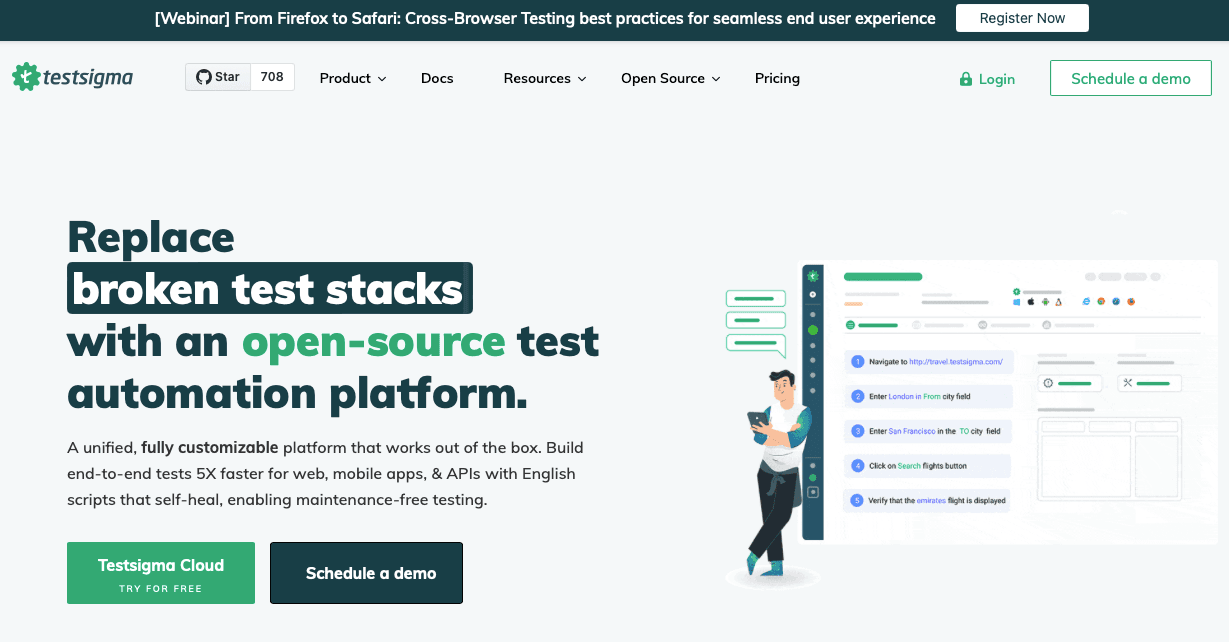
TestSigma is a cloud-based test automation platform combining natural language test creation with AI-driven maintenance. Where Reflect.run is a visual recorder, TestSigma lets teams write test steps in plain English — accessible to stakeholders who won't engage with a click-based recording workflow.
Strengths:
Natural language test creation: Write test steps in plain English — no recorder, no code. Accessible to non-technical stakeholders beyond the QA team.
AI-driven maintenance: Automatically adapts tests when UI changes, reducing broken selector maintenance across large suites.
Unified multi-platform coverage: Web, mobile, and API from one platform with cloud execution included.
Agentic AI features: Copilot and Atto assist with test planning, generation, and failure analysis.
Limitations:
No free plan: High entry cost — harder to validate before committing.
Codeless in name, often not in practice: Complex scenarios frequently require scripting despite no-code positioning.
Overkill for web-only teams: Multi-platform scope adds configuration overhead for purely web-based testing.
Fully cloud-dependent: No local execution option.
Katalon Studio
Best for: Enterprises and Hybrid teams needing codeless + scripting flexibility.
Katalon Studio is an all-in-one test automation platform supporting web, API, mobile, and desktop testing. Unlike Reflect.run's web-only scope, Katalon covers all major testing surfaces from a single tool — with a free tier to start.
Strengths:
Broad platform coverage: Web, API, mobile, and desktop from one tool.
Codeless and scripted modes: Mix visual test creation with Groovy scripting for advanced scenarios.
Strong CI/CD support: Integrates with common pipeline tools.
Limitations:
Per-user pricing at enterprise scale: Costs compound with team size.
IDE-based — heavier than browser-native tools: Desktop IDE adds setup overhead compared to extension-based recorders.
Steep learning curve: Breadth of the platform requires meaningful onboarding before teams reach productivity.
Overkill for web-only teams: Multi-platform scope adds complexity if your scope is purely web.
When You Should Consider an Open-Source Framework Instead
If your team has JavaScript engineers and wants full ownership over test architecture — no SaaS pricing, no vendor dependency, no cloud-only execution — open-source frameworks are the most scalable long-term investment.
Choose Playwright if:
Cross-browser coverage is a genuine requirement — Playwright supports Chromium, Firefox, and WebKit from a single API
Your team is developer-led and wants a modern, low-level browser automation API with full scripting flexibility
You need network interception, authentication state management, and advanced parallel execution control
Choose Cypress if:
You're testing React, Angular, or Vue applications with a JavaScript-heavy engineering team
Real-time in-browser test execution and developer-centric debugging are the priority
You want a large community, an extensive plugin ecosystem, and strong documentation
Choose Selenium if:
Multi-language support is required — Java, Python, C#, or Ruby
You're integrating into an existing automation ecosystem built on Selenium tooling
Maximum browser flexibility across a wide range of environments is the core requirement
Open-source frameworks eliminate SaaS pricing and cloud-only execution entirely — but require full ownership. Your team writes every test in code, manages CI infrastructure, and maintains the framework as browsers and your application evolve. For non-technical QA teams, the overhead is real. Start here only when coding resources are genuinely available for the long term.
Reflect.run Alternatives — Final Thoughts
Reflect.run is a well-designed tool that genuinely makes no-code web testing fast to adopt. For teams in the early stages of automation — where getting started quickly matters more than long-term cost control — it does that job well.
The moment your test suite grows and pricing becomes unpredictable, or your team needs to debug during local development without incurring cloud costs, is when the alternatives above start to pull ahead. Most of the friction teams feel with Reflect.run isn't about the tool's quality — it's about the cloud-only, usage-based model becoming a constraint that simpler, flat-priced alternatives don't carry.
The question to answer before evaluating any Reflect.run alternative is: does cloud-only execution at usage-based pricing fit where my team is going, or do I need more predictability and local flexibility as the suite scales?
Action Points for Choosing the Best Reflect.run Alternative
1. Clarify whether local execution matters for your workflow:
If developers run tests during feature work — before pushing to CI — cloud-only tools add cost at every debug iteration.
Local execution availability fundamentally changes the economics of how often your team runs tests.
2. Compare pricing at your realistic test volume:
Model Reflect.run's usage-based pricing at your projected monthly run count as your suite grows.
Flat-pricing alternatives like BugBug become more cost-effective as volume scales — calculate the crossover point for your team.
3. Test debugging workflows with a deliberate failure:
Intentionally break a test in each tool you evaluate and measure how long it takes to identify the specific failing step and correct it.
The gap between Reflect.run's re-run model and Edit & Rewind step debugging is significant in practice — understand it before committing.
4. Validate free plan availability before purchasing:
BugBug offers unlimited tests on a free plan — validate the visual recorder approach on your real application before spending anything.
Reflect.run charges from first use — factor an evaluation period into your budget if you want to assess fit properly.
5. Check cross-browser requirements against your actual user base:
If your analytics show that the majority of your users are on Chrome, Chromium-focused tools like BugBug cover real-world usage without paying for broader browser coverage you won't use.
If Firefox or Safari coverage is a genuine business requirement, Reflect.run and Playwright are stronger fits than BugBug.
FAQ: Reflect.run Alternatives
Your next release. Properly tested.
Join 1,200+ QA teams that automated their regression coverage with BugBug.
Dominik Szahidewicz is a Software Quality Evangelist specialising in quality assurance, test automation, and modern software testing practices. He creates practical, research-driven content that helps QA professionals, developers, and product teams improve test coverage, automate repetitive testing, and release more reliable web applications.
Drawing on his experience in technical writing, data analysis, and application consulting, Dominik translates complex testing concepts into clear, actionable guidance. His areas of interest include end-to-end testing, no-code test automation, regression testing, and the use of AI in software quality assurance.
Join thousands of QA experts. Subscribe to our newsletter.
Get more testing tips and product related content. Zero spam.
10 Best BrowserStack Alternatives in 2026: Free and Paid Options
Compare BrowserStack alternatives including Sauce Labs, TestMu AI, TestingBot, Perfecto, Kobiton and open-source options, with pricing and best-fit guidance.
Cypress recorder is a powerful tool designed to enhance the efficiency of the testing process. Let's compare it with the BugBug codeless recorder.
January 15, 2026
READ MORE
We use cookies on our website to give you the most relevant experience by remembering your preferences. By clicking “Accept”, you consent to the use of all the cookies.