Top Testim Alternatives in 2026
Written byDominik Szahidewicz


Updated: October 2, 2026View as Markdown
🤖 Summarize this article with AI:
💬 ChatGPT 🔍 Perplexity 💥 Claude 🐦 Grok 🔮 Google AI Mode
Testim is a well-built AI-powered platform for web UI test automation. Its self-healing locators are a genuine capability — when your application’s interface changes frequently, AI-driven maintenance reduces the time your team spends updating broken selectors and fixing broken tests.
But teams searching for Testim alternatives are typically hitting one of three walls:
Many teams also want to avoid writing code and prefer a no code automation platform for ease of use, especially when enabling non-technical users to build and maintain tests. Features like test management and detailed reporting are also important considerations when evaluating alternatives.
If you want reliable web automation without the AI tax, the shortlist below gives you the honest alternatives.
BugBug – for SaaS product teams wanting stable, low-maintenance web testing with a free plan and flat pricing.
Mabl – for enterprise DevOps teams running continuous testing at scale who need AI-driven maintenance, deep CI/CD integration.
Rainforest QA – for teams without in-house QA wanting a hybrid human + automated validation model.
Katalon Studio – for teams needing unified coverage across web, API, mobile, and desktop with both codeless and scripted workflows.
Playwright – for developer-led teams wanting full open-source, cross-browser framework control, noted for its speed and reliability as a fast-growing framework.
Cypress – for developer-led teams building modern web apps who want fast feedback loops, a strong community ecosystem, and excellent developer experience.
Selenium – for teams with existing multi-language automation ecosystems needing maximum browser flexibility; the industry standard for flexibility and community support, but requires more manual maintenance compared to Testim's AI-assisted model.
Looking for reliable web automation without enterprise pricing?
Test easier than ever with BugBug test recorder. Faster than coding. Free forever.
Get started
Check also:
Testim is an AI-powered test automation platform for web UI testing. Its core capability is self-healing: when your application’s interface changes, Testim’s AI-driven locators adapt automatically rather than breaking. It supports both codeless and code-based test creation, with CI/CD integration and parallel execution built in. However, Testim requires programming skills to create more complex use cases, which can limit accessibility for non-technical users. Additionally, Testim's 'Smart Locators' may not capture all visual bugs that real users would notice, potentially impacting test accuracy.
Best for:
Teams typically explore alternatives when:
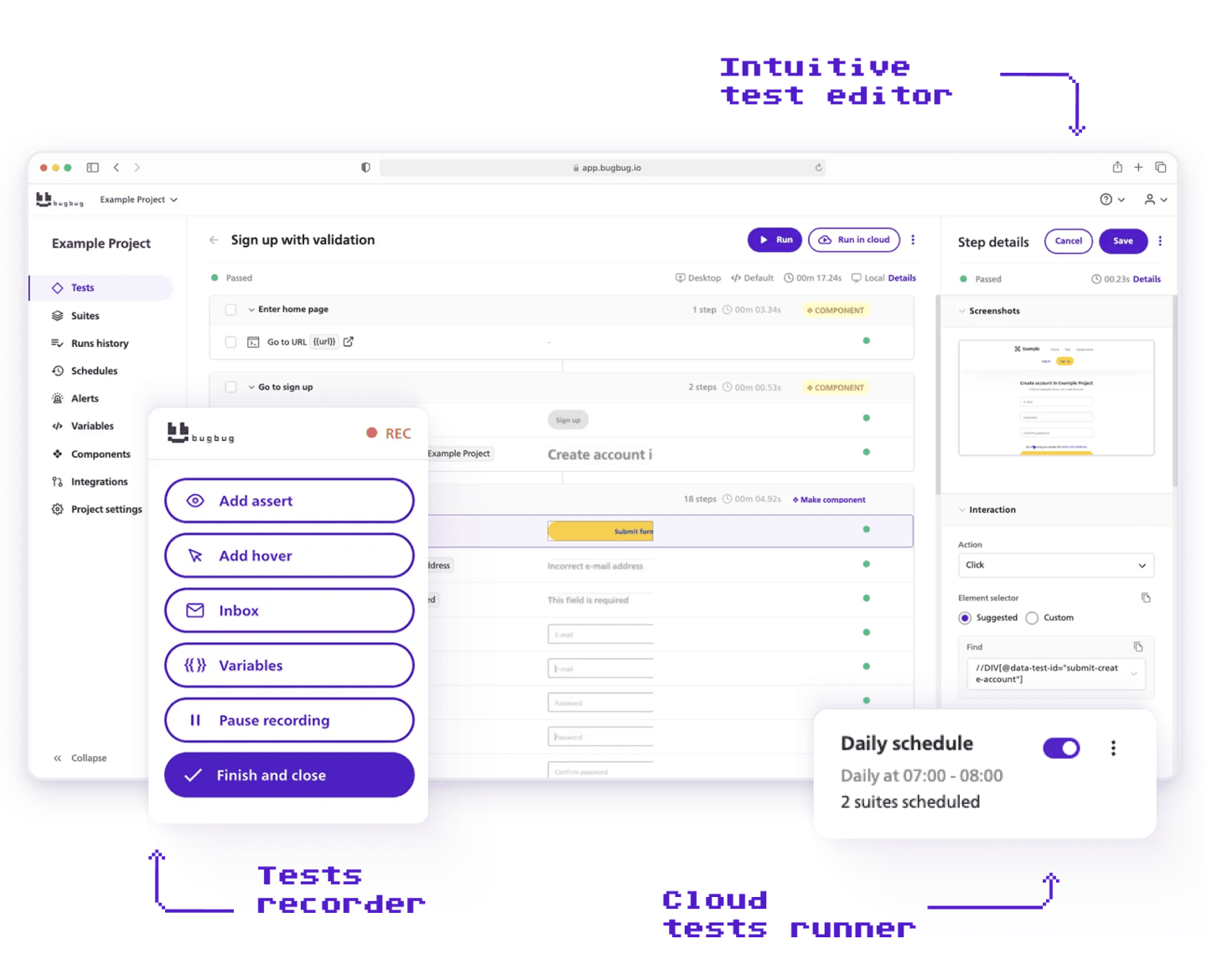
Best for: Startups, SaaS teams, and web-first product companies that want reliable E2E web automation without AI overhead — at a fraction of the cost.
BugBug is a lightweight, no-code automation platform designed for small teams and startups, making it accessible to non-technical users. It is an easy-to-use web testing tool that helps teams build reliable regression coverage for their web applications — without writing a single line of code or managing any infrastructure. Using a Chrome extension-based recorder, teams can interact with their app to create automated tests in minutes and run them locally or in the cloud on a schedule. With features like Edit & Rewind and smart waiting conditions, BugBug keeps test maintenance low even as your web app grows and changes.
Testim solves test maintenance with AI. BugBug solves it with simplicity: stable selectors that rarely break, and an Edit & Rewind feature that makes fixing a broken test faster than waiting for AI to repair it. For teams running stable web applications, that’s a meaningful difference — you’re not paying for AI infrastructure you don’t need, and you maintain full visibility into exactly what your tests are doing at every step.
Strengths:
Limitations:
Pricing: Free plan available. Paid plans start at $99/month (billed annually). All plans include unlimited users. 14-day free trial available.
The core difference isn’t about features — it’s about which problem each tool is actually built to solve.
BugBug is a no code automation platform, making it accessible for teams without programming skills. Its record and playback feature simplifies test creation and maintenance, allowing users to quickly automate workflows by recording browser interactions and replaying them as needed.
BugBug's approach helps teams quickly identify and fix broken tests, reducing downtime and improving reliability. The platform also includes test management features to help teams organize and track their testing activities efficiently. Designed to avoid extensive maintenance, BugBug is a sustainable choice for small teams who want to minimize ongoing test upkeep.
For teams with stable applications and straightforward regression needs, BugBug’s direct approach — record, run, fix with Edit & Rewind when something breaks — is faster and cheaper than a platform built around AI maintenance you won’t use. For teams where the UI genuinely changes at a pace that makes manual selector updates a daily burden, Testim’s self-healing has a real ROI case
👉 Also check on Self-healing Test Automation - Hype & Reality
| Feature | BugBug | Testim |
|---|---|---|
| Pricing | Free plan + flat $99/month | $450–$1,000+/month |
| Free plan | Yes — unlimited tests | No |
| Test creation | No-code test recorder + AI agents | Codeless + code-based |
| Edit & Rewind | Yes | No |
| Real cursor movement | Yes | No |
| Test maintenance | Stable selectors + manual Edit & Rewind | AI self-healing (can be opaque) |
| Local execution | Yes — run on your machine | Limited |
| Browser coverage | Chromium-based | Multi-browser |
| Mobile testing | Not supported | Not supported |
| Best for | Stable web apps, small-to-mid teams | Large, rapidly-changing UI test suites |
When Another Alternative Fits Better Than BugBug:
BugBug is built for web-only SaaS teams that want stable, codeless automation with local execution and flat pricing. Here’s when another tool on this list is the more honest recommendation.
BugBug’s free plan gives you unlimited tests to validate the approach on your real application before spending anything.

Best for: Enterprise DevOps teams running continuous testing at scale who need AI-driven test maintenance and deep CI/CD pipeline integration.
Mabl is an AI-native test automation platform for UI and API testing. It uses machine learning to automatically adapt tests when your application’s interface changes — reducing the manual effort of keeping a large test suite current as your product evolves. Test creation is low-code through a visual interface, with cloud execution and detailed reporting built in. Mabl is a cloud based testing platform, offering scalable online test execution. It also includes test management features for organizing and tracking tests throughout the testing lifecycle.
Strengths:
Limitations:
Pricing: Custom quotes only. 14-day free trial available.

Best for: Teams without in-house QA who want a combination of automated testing and human validation — and are comfortable with usage-based pricing.
Rainforest QA is a cloud-based testing platform that combines AI automation with a network of human testers. It’s positioned for teams that want broad QA coverage — including exploratory and edge case testing — without hiring in-house engineers. Unlike Testim’s fully automated model, Rainforest uses human testers to execute and validate test cases. Rainforest QA also includes test management features for organizing and tracking tests.
Strengths:
Limitations:
Free tier (5 hours/month). Pay As You Go starts at $200/month plus $5/hour (automated) and $25/hour (crowdtesting per browser). Enterprise pricing available on request.
Pricing: Free tier (5 hours/month). Pay As You Go starts at $200/month plus $5/hour (automated) and $25/hour (crowdtesting per browser). Enterprise pricing available on request.

Best for: Teams needing unified coverage across web, API, mobile, and desktop — with both codeless and scripted workflows in a single platform.
Katalon Studio is an all-in-one test automation platform supporting web, API, mobile, and desktop testing. It offers both codeless and Groovy scripting modes, making it a viable option for teams that want to start low-code and graduate to scripting as complexity increases. Katalon Studio includes test management features for organizing and tracking tests, and provides detailed reporting features to help teams monitor app stability and test outcomes.
Strengths:
Limitations:
Pricing: Free forever plan available. Paid plans start at $54/month (Runtime Engine) and $79/month (Studio Enterprise, per seat). 30-day free trial available.
If your team has JavaScript engineers and wants full ownership over test architecture — no SaaS pricing, no vendor dependency — open-source frameworks are the most scalable long-term investment for teams with the engineering resources to support them. These frameworks require writing code and programming skills, making them less suitable for non-technical users or teams seeking rapid deployment. Open-source frameworks like Selenium and Appium support multiple programming languages, offering flexibility for diverse development environments. Additionally, Selenium IDE is a record-and-playback tool that allows users to create automated tests without programming knowledge.
Open-source frameworks eliminate SaaS pricing entirely — but require full ownership. Your team writes every test in code, manages infrastructure, and maintains the framework as browsers and your application evolve. For non-technical QA teams, the overhead is real and often underestimated. Start here only when coding resources are genuinely available for the long term.
Testim is a well-built platform for the teams it’s designed for: enterprise QA organizations managing high-volume test suites across products where frequent UI changes make AI maintenance worth the cost. If that describes your situation, it belongs on your shortlist.
For everyone else — startups, growing SaaS teams, and organizations running stable web applications — the cost and complexity are hard to justify. Simpler tools get you to the same outcome faster, at a fraction of the price, with full transparency into what your tests are actually doing.
Many test automation platforms offer free trials or free versions, allowing teams to evaluate their features before committing to a paid plan. Additionally, test automation tools should provide detailed reporting and insights to help teams understand test results and improve their processes.
The question to answer before evaluating any Testim alternative isn’t “which tool has more features” — it’s: does my UI change frequently enough that AI self-healing pays for itself, or am I paying for a problem I don’t actually have?
1. Assess your actual maintenance burden:
2. Compare total cost of ownership honestly:
3. Test the free plan options first:
4. Evaluate debugging workflows with a real failure:
5. Validate CI/CD integration with your actual pipeline:
Testim handles a solid range of automated UI testing scenarios through its codeless and code-based testing modes. For straightforward functional testing — login flows, form submissions, navigation — the visual recorder works well. For genuinely complex test cases involving conditional logic, branching, parameterized test data, or multi-step flows across dynamic elements, you'll need to extend tests with custom JavaScript. That's where Testim's code-based testing mode earns its place.
The honest answer is that complexity tolerance depends on your team's technical depth. Non-developer QA teams will hit Testim's no-code ceiling faster than development teams comfortable writing custom scripts. If your testing efforts routinely involve complex scenarios that push beyond visual recording, dedicated testing frameworks like Playwright or Cypress give you more headroom — at the cost of writing and maintaining every test in code.
Testim's self-healing tests are its most marketed capability. When your application's UI changes — a button moves, a class name updates, an element is restructured — Testim's artificial intelligence attempts to identify the same element using alternative signals rather than breaking on the original selector.
In practice, self-healing works well for minor, predictable UI changes. Where it becomes risky is opacity: the AI updates the locator automatically, your test continues to execute and pass, but there's no guarantee it's testing the same element you originally intended. Root cause analysis on a failing test that has been silently self-healed multiple times can be significantly harder than debugging a test that simply broke on the original selector. For software development teams that need to trust their test results unconditionally, that opacity is worth weighing carefully against the maintenance time saved.
Testim is primarily focused on testing web applications — it does not natively support mobile app testing on Android or iOS mobile devices. If your testing scope includes web and mobile applications from a single platform, Testim isn't the right fit without supplementing it with a separate mobile testing tool.
For teams that need unified web and mobile coverage, platforms like Katalon Studio, TestSigma, and Sauce Labs support both surfaces. If mobile devices are a first-class testing requirement alongside your web application, factor that into your evaluation before committing to a web-focused tool.
Testim and code-based testing frameworks like Playwright or Cypress are solving the same problem — automated UI testing — but from opposite starting points.
Testim starts with a visual recorder and adds code-based testing as an extension for complex scenarios. Playwright and Cypress start with code and give you no visual recorder at all. The choice comes down to who is writing and maintaining your tests.
The key practical difference: open-source frameworks require your team to write every line of test code, manage continuous integration setup, and maintain testing frameworks as they evolve. Testim removes that initial creation overhead — but charges enterprise pricing for it. How many tests you need to create, and who will create them, should drive this decision more than any feature comparison.
Testim's key features for automated UI testing are:
What Testim notably lacks relative to some alternatives: a free plan, mobile app testing support, and local test execution for development workflows.
Testim's pricing — starting at $450–$1,000+/month with no free plan — makes it difficult to justify for small development teams or early-stage startups. The platform is designed and priced for enterprise QA organizations running large test suites across frequently-changing products, where the AI maintenance savings offset the subscription cost.
For small teams, the economics rarely work out. The monthly cost of Testim could cover multiple developer hours of manual test maintenance — which, on a small stable web application, is often the more practical investment. Simpler tools with free plans, like BugBug, let small teams build regression coverage without the enterprise price tag. Graduating to AI-powered platforms makes more sense once test suite scale and UI change frequency create maintenance overhead that simpler approaches can't absorb.
When a test failure occurs, Testim provides failure reporting with screenshots, execution logs, and AI-generated explanations intended to help teams identify root cause analysis faster. For straightforward failures — an element not found, a timeout, an assertion mismatch — this reporting is useful.
For failures that have been influenced by prior self-healing test updates, root cause analysis becomes more complicated. If the AI has modified a locator between runs and the test is now failing on a different element than originally recorded, diagnosing what changed — and why — requires more investigation than a simple selector failure in a non-healing tool. Teams that need clear, predictable test failure attribution should factor that diagnostic trade-off into their evaluation.
Testim supports cross-browser testing across major browsers but is primarily focused on web applications rather than testing across operating systems or mobile devices. For teams that need to execute tests across combinations of browsers and operating systems at scale, dedicated execution platforms like LambdaTest, BrowserStack, or Sauce Labs are better suited — they provide the infrastructure for running test scripts across hundreds of environment combinations simultaneously.
If your complex scenarios involve web and mobile applications across both iOS and Android mobile devices, Testim's web-only focus means you'll need a separate tool for the mobile surface. Platforms like Katalon Studio and TestSigma support both web and mobile from a single test authoring environment.
Testim is a test automation platform, not a robotic process automation tool. The distinction matters: test automation validates that your application behaves correctly by simulating user interactions and asserting outcomes. Robotic process automation automates repetitive business processes — data entry, document handling, system integrations — typically outside a testing context.
Some overlap exists in how each technology interacts with web interfaces, but Testim is not designed or positioned for RPA use cases. Teams looking for RPA capabilities alongside software testing should evaluate dedicated RPA platforms or broader enterprise automation ecosystems separately from their testing toolchain.
Testim supports continuous integration with common CI/CD pipeline tools including GitHub Actions, Jenkins, CircleCI, and Azure DevOps. Tests can be triggered on every build, with results reported back into the pipeline for pass/fail gating.
For communication tools, Testim integrates with Slack for test result notifications — a standard capability across most modern testing platforms. The depth of its communication tool integration is functional rather than advanced: you'll get failure alerts and run summaries, but not the kind of granular test health dashboards some teams build around dedicated reporting platforms like Sauce Labs.
Despite being an enterprise-positioned platform, Testim has limitations that matter at scale:
Your next release. Properly tested.
Join 1,200+ QA teams that automated their regression coverage with BugBug.

Dominik Szahidewicz is a Software Quality Evangelist specialising in quality assurance, test automation, and modern software testing practices. He creates practical, research-driven content that helps QA professionals, developers, and product teams improve test coverage, automate repetitive testing, and release more reliable web applications.
Drawing on his experience in technical writing, data analysis, and application consulting, Dominik translates complex testing concepts into clear, actionable guidance. His areas of interest include end-to-end testing, no-code test automation, regression testing, and the use of AI in software quality assurance.
Join thousands of QA experts. Subscribe to our newsletter.
Get more testing tips and product related content. Zero spam.
Discover the best Mabl alternatives for automated and visual testing. Compare top tools to find the right solution for your QA needs.
Compare Katalon Recorder with top browser automation tools. Explore features, limitations, and free alternatives compatible with Selenium IDE.
Explore the best Katalon alternatives in 2026. Find top automation tools for web and mobile testing to match your QA needs.
Explore the limitations of the most popular framework. Learn about alternatives and ways to overcome Selenium disadvantages.
Playwright vs Selenium. Which wins for modern apps, when Selenium still beats it, and what to do if you can't code.
Cypress recorder is a powerful tool designed to enhance the efficiency of the testing process. Let's compare it with the BugBug codeless recorder.
Explore the test suite in software testing and understand its role in creating and executing test cases. Learn how to manage test suites effectively.
Welcome to another article of Website Testing Guide series. This week we present a guide with regression testing example in BugBug.