Cloud Testing: What You Actually Need & What To Skip
Written byDominik SzahidewiczReviewed byPaweł Bylina


Updated: September 9, 2026View as Markdown
Most teams don't move testing to the cloud because they read a whitepaper about elastic infrastructure. They move because the regression suite now takes four hours on one laptop, and that laptop belongs to a person who would like to close it and go home.
That's the real trigger. And it changes which cloud testing service you should buy, because the answer depends entirely on why your tests can't stay where they are. Below is the honest version: what cloud testing actually solves, what it quietly breaks, the ten platforms worth knowing in 2026, and a decision framework you can use in ten minutes.
Cloud testing is running tests with cloud computing on cloud infrastructure, using cloud resources for cloud software testing instead of machines you own or maintain. Your browsers, devices, and runners live in a provider's data centre; cloud providers manage the underlying testing infrastructure, so you trigger a run from a UI, a CLI, or a CI pipeline and get back pass/fail results plus artifacts — video, screenshots, console logs, network traces — with less maintenance overhead. The tests themselves are unchanged. What changes is where the browser opens and who keeps that machine patched.
That covers a few distinct jobs, and it's worth separating them because vendors deliberately blur the lines, even though this model supports scalable, on-demand testing without physical infrastructure:
Most teams need one of the first two. Very few need all four.
Local execution gets dismissed too fast. It's free, it's fast for a single test, and you can watch the browser do the thing — which is worth a lot when you're debugging. Unlike traditional testing or traditional software testing tied to fixed machines, cloud execution shifts runs into elastic infrastructure, and the benefits of cloud here are faster provisioning and broader environment coverage.
| Local execution | Cloud execution | |
|---|---|---|
| Cost | Free (your machine) | $39–$500+/mo entry, scales with concurrency |
| Speed, single test | Faster — no upload, no queue | Slower per test; startup overhead per session |
| Speed, full suite | Sequential and slow | Parallel; 4h suite → ~30 min at 8 lanes |
| Runs unattended | No | Yes — schedules, CI triggers, nightly |
| Browser coverage | Whatever's installed | Instant access to many operating systems, browser combinations, and device configurations |
| Debugging | Watch it live | Video + logs after the fact |
| Environment access | Localhost, VPN, staging — all trivial | Needs a tunnel or IP allowlist |
| Maintenance | You patch the machine | Vendor's problem |
Run locally when: you're writing or debugging a test, your suite is under ~30 tests, your staging environment is behind a VPN you can't open up, or you're on a free plan and CI isn't wired up yet. If you haven't automated anything yet, don't start with the cloud question at all - our automation testing guide for startups walks through what to automate first.
Move to the cloud when: the suite blocks a deploy, tests need to run at 3am, one machine can't finish in the release window, or someone needs to see results who doesn't have the repo checked out. A cloud setup replaces physical hardware with on-demand virtual resources, so test environments can be provisioned in minutes instead of waiting on boxes and manual setup.
Most healthy setups do both: author and debug locally, execute in the cloud.
Ten platforms worth your time, grouped by what job they do. This list is scoped to cloud execution — if you're still deciding what kind of tool you need at all, start with our wider roundup of web testing tools and come back. Pricing checked September 2026; treat it as a starting point, not a quote. This category moves — both BrowserStack and Sauce Labs raised list prices in February 2026.
| Service | Best for | Cross-browser / devices | Who authors tests | Free tier | Pricing model |
|---|---|---|---|---|---|
| BrowserStack | Broadest browser + real-device coverage | Yes — 30,000+ devices | Engineers | Trial only | Per parallel session |
| Sauce Labs | Enterprise grids, mobile + web | Yes | Engineers | OSS only | Per parallel session |
| LambdaTest (TestMu AI) | Cheaper grid, fast orchestration | Yes | Engineers | Yes | Per module + parallels |
| BugBug | Regression a product team owns, on managed infra | No — Chromium only | Product team or engineers | Yes | Free plan with 1 user, Paid plans from $99/mo |
| Testsigma | Plain-English authoring in the cloud | Yes | Anyone | Yes | Per user / per run |
| Mabl | QA orgs wanting AI-assisted visual authoring | Yes | QA specialists | Trial only | Quote-based, ~$500/mo up |
| Katalon TestCloud | Teams mixing visual and coded tests | Yes | Either | Studio free | Per user |
| Cypress Cloud | Teams already standardised on Cypress | Limited | Engineers | Yes | Per test result |
| Grafana Cloud k6 | Load and performance, not functional | N/A | Engineers | Yes | Per virtual-user-hour |
| Playwright + CI runners | Teams that will own the stack themselves | Yes | Engineers | Free (infra costs) | Your CI bill |
Best for: teams with real cross-browser or cross-device obligations and budget approval.
Skip it if: you ship a Chromium-first web app and just want tests to run nightly. You'll pay grid prices for a grid you don't use.
The widest matrix in the market: real devices, desktop browsers, local tunnels, visual testing via Percy. If your bug reports say "only on Safari 16 on an iPhone 12," this is the shortest path to reproducing it under real world conditions across locations and device types, with access to diverse environments, devices, and even simulated user traffic from around the world. BrowserStack is a cloud based testing platform that also fits compatibility testing across real devices.
The catch is the pricing axis. Automate is priced per parallel session, starting around $99/month per parallel for desktop and $175/month for desktop plus mobile. One parallel is one lane — your CI will queue behind it the moment you trigger two builds at once.
Best for: enterprise teams with existing Selenium/Appium suites and a procurement process.
Skip it if: you're under 50 tests. You'll pay for capacity you can't use.
Mature, stable, well-documented, strong on mobile. Published tiers run $39/month for Live Testing, $149 for the Virtual Device Cloud, and $199 for the Real Device Cloud when billed annually, with unlimited users and unlimited testing minutes — but exactly one parallel test on every standard tier. There's no general free tier, though qualifying open-source projects get free accounts.
Unlimited minutes on one lane is a queue, not a grid. Do the arithmetic before you sign: 200 tests averaging two minutes each is roughly 6.5 hours sequentially, and about 50 minutes across eight lanes.
Best for: teams that need grid coverage and are cost-sensitive.
Skip it if: you need one vendor relationship with zero ambiguity right now — the rebrand is still settling.
LambdaTest began rebranding as TestMu AI in January 2026, which currently makes buying slightly confusing — you'll see both domains in search results. The product is the same shape as BrowserStack at lower entry prices and suits teams testing across multiple cloud platforms or cloud providers at a lower entry cost: a free tier exists, Live starts around $15/user/month, and Web Automation starts around $79–$99/month, with HyperExecute as the fast-orchestration upsell.
Best for: web-first SaaS teams, software houses and support or implementation teams that own regression for business-critical browser flows and have no automation engineer to spare.
Skip it if: you need cross-browser or mobile coverage, or your team has decided it wants to own a code-based framework — in which case Playwright is the honest answer, not us.
Full disclosure: this is our tool, so weigh accordingly.
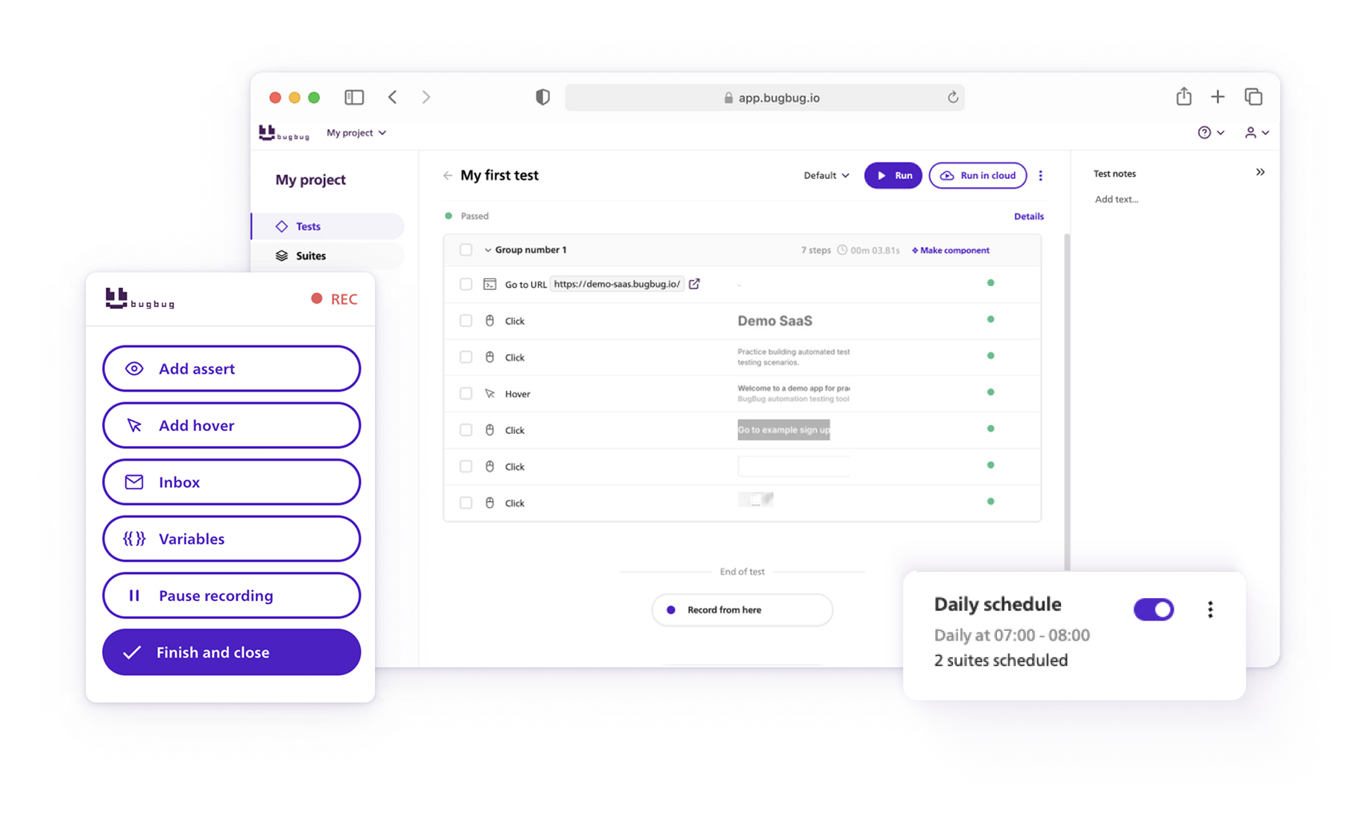
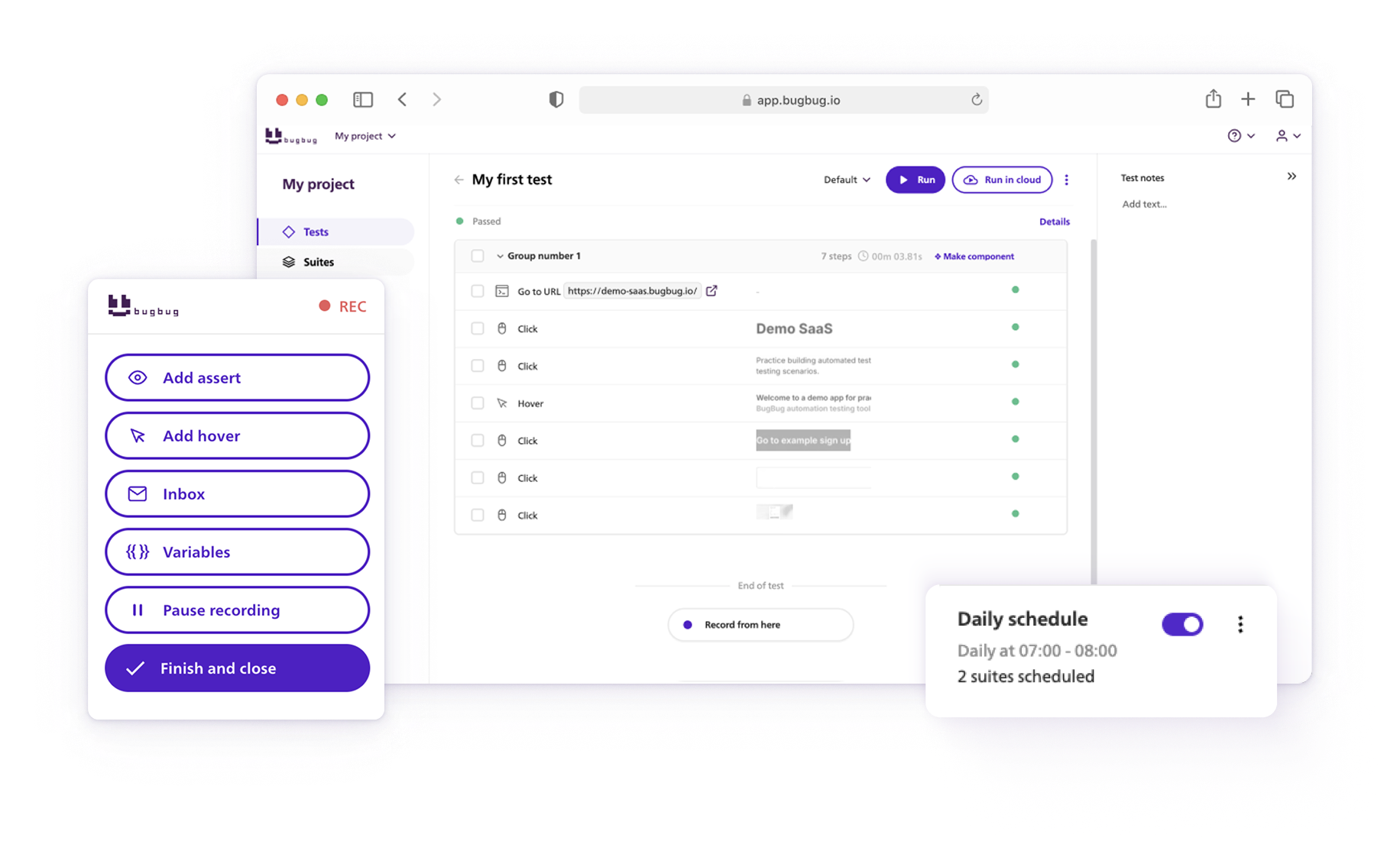
Tests are created visually by clicking through the app in a Chrome extension. They then run on managed cloud browsers, on a schedule or triggered from CI via CLI or REST API, and every run leaves execution history, screenshots, console logs, real-time reporting and analytics, and a PDF report a support lead or a CTO can read without opening a pipeline log. That centralized access to the cloud environment also improves collaboration for distributed teams.
Practical details: the free plan covers 1 user and 15 tests. Pricing is flat and published, and users are unlimited on Pro Plan ($189/mo) which matters more than it sounds, because the person who needs to see a failed run is often in support or product, not engineering, so access controls matter too.
The honest limitation: BugBug is Chromium only. No Firefox, no Safari, no real mobile devices. If cross-browser coverage is the reason you're going to the cloud, stop here and buy a grid.
Best for: manual QA teams transitioning to automation with cross-browser needs, with support for cloud-based application testing across cross-browser workflows.
Skip it if: vendor lock-in is a board-level concern, or your app has complex state that plain English struggles to describe. If you've already trialled it and the pricing or the proprietary syntax stopped you, we've compared the Testsigma alternatives worth a second look.
Write test steps as English sentences, run them across web and mobile in the cloud. Genuinely fast for non-engineers to pick up, especially teams moving from manual testing toward automated testing in the cloud. The trade-off is the usual one for natural-language platforms: your tests are written in a proprietary syntax that doesn't leave the platform.
Best for: growth-stage companies with a dedicated QA team and budget.
Skip it if: you're a 25-person startup. The price assumes a QA org you don't have.
Auto-healing locators, visual and API testing checks in the same UI, which is useful when testing within a cloud service stack like APIs and databases, plus decent analytics. Well-built. Priced for organisations that have a Director of QE: entry is around $500/month and real contracts land higher, quote-based.
Best for: teams split between codeless and coded testers.
Skip it if: you want something you can learn in an afternoon. The surface area is large.
Katalon Studio is free and installs locally; TestCloud adds hosted browser execution. The appeal is range — codeless recording for the people who need it, Groovy/Java underneath for the people who want it.
Best for: existing Cypress suites that take too long in CI.
Skip it if: you're not on Cypress. And if you're on Cypress but questioning whether to stay — usually because of runtime, flake, or the cost of parallelization — that's a framework decision before it's a cloud one. Our breakdown of Cypress alternatives covers where teams move and why.
If your team already writes Cypress specs, Cypress Cloud is the parallelization and recording layer: it splits your spec files across CI machines for exact parallel test execution, speeds up test execution, records runs, and flags flaky tests while improving test coverage across multiple configurations. It is not a cross-browser device cloud, and it only helps if you're on Cypress. Free tier exists and is usable for small teams.
Best for: performance and load testing with a scriptable, git-friendly workflow.
Skip it if: what you actually need is functional regression — these are not substitutes.
Different job. k6 scripts define virtual users; the cloud runs them from multiple regions and charts the results for load, performance, and scalability testing. Use it before Black Friday, before a launch, before a migration. Don't try to make it your functional regression suite.
Best for: teams with an engineer who is genuinely assigned to own the stack — not "the whole team owns it."
Skip it if: nobody's name is on it. Unowned test automation is expensive decoration; it decays within two release cycles, and then you're back to manual regression with extra steps.
Worth naming honestly, because plenty of teams should choose it, and because it's the option most vendors pretend doesn't exist. Playwright, Selenium and Cypress are all covered in our open source automation tools comparison if you're weighing the frameworks themselves. Playwright plus GitHub Actions, GitLab CI, or self-hosted runners gives you cloud execution with no vendor and no per-parallel fee. Codegen records flows for you, UI Mode gives you time-travel debugging, and an AI coding agent will draft specs on request. "You'd have to write code" stopped being a serious objection in 2025.
The cost isn't authoring. It's operation: runner images, browser version bumps, secrets, artifact storage, flake triage, and someone answering "why is the pipeline red?" every Tuesday. That's a standing commitment measured in engineer-days per month, forever.
This is the part that bites teams two weeks after they buy. Your tests worked locally. Now 30% fail in the cloud, and nothing about your app changed.
Almost always, it's one of these:
The viewport is different. Your local browser was maximised on a 27-inch monitor. The cloud runner is 1280×720. Your cookie banner now covers the submit button. Set an explicit viewport in your test config and stop guessing.
There's no saved state. Cloud runners hand you a clean browser profile: no saved logins, no autofill, no extension state, no cached assets. In cloud security testing, avoid production data and use synthetic data instead. Any test that quietly relied on "I'm already logged in" fails. Make authentication an explicit first step, or seed session state via API.
Latency is real now. Locally, your app responded in 20ms. From a cloud runner to your staging environment, it's 200ms and occasionally 2 seconds. Teams can also simulate different network conditions in a cloud environment, but shared cloud infrastructure can still introduce performance variation. Fixed sleep(2) waits that were reliable on your machine become coin flips. Replace every hardcoded wait with a condition — wait for the element, the network response, or the state change.
Parallel runs collide on data. The moment you go from one lane to eight, tests that register test@example.com start failing on "email already taken." Generate unique data per run, or give each lane its own account. Same for anything that mutates shared state: one test cancelling an order another test is checking. On top of that, environment configuration complexity across virtual machines can produce false results.
Your staging environment is unreachable. This blocks more cloud migrations than any technical limitation. If staging sits behind a VPN, basic auth, or an IP allowlist, cloud runners can't reach it. You need a tunnel (most grids ship one), an allowlist of the provider's egress IPs, or a publicly reachable test environment with credentials. You also need to verify security controls where connected services meet, not just whether the page loads.
Secrets end up in test steps. Do not hardcode staging credentials into a recorded step or a spec file. Use environment variables or your platform's variables/profiles feature, and rotate them like any other secret.
Fixing these six things resolves most "the cloud is flaky" complaints. The cloud isn't flaky — your local environment was doing you favours you didn't know about. Immediate cloud test execution helps detect bugs early, but security issues, expense management, and the shortage of skilled professionals still slow adoption for some teams.
The point of cloud execution is that it happens without a human, but you still need to define your testing needs and goals before choosing a cloud model or platform. That only works if you're deliberate about what runs where, and integrating cloud testing with CI/CD improves speed and agility across the testing lifecycle.
On every pull request — smoke suite, under 5 minutes. Login, the primary user flow, checkout or its equivalent, one API-backed page. Keep this environment as close to production configurations as practical. If it takes longer than 5 minutes, developers start merging around it, and you've built a suite nobody trusts.
On merge to main — critical path regression, 10–20 minutes. Everything a customer would notice within an hour of a bad deploy.
Nightly — full regression, however long it takes. This is where parallelization earns its cost. A 200-test suite at 8 lanes finishes before anyone wakes up.
Before release — full regression plus the flows you can't easily fake: signup, password reset, transactional emails, payment sandbox. Email flows are a common blind spot; if your tool can receive and assert on real emails, use it here.
Three practical rules that save more time than any tool choice:
For the CI/CD wiring itself, most platforms expose a CLI or REST API you call from a pipeline step. That's a five-line job definition, not a project. The same API surface is increasingly what AI coding agents use to trigger suites and pull failure details — several tools, BugBug included, have community MCP servers wrapping their API for exactly that. Useful, and worth checking whether it's official or community-maintained before you build a workflow on it.
Six months after the migration, this is the only thing that predicts whether cloud testing worked. The tool rarely does.
Generating browser automation is close to free now. Playwright's codegen records it, AI agents write it, recorders capture it. So the bottleneck has moved. What's scarce is:
A named owner. Not "the team." A person or role who is accountable for the suite staying green, with time allocated for it. The single most common failure pattern in test automation is a suite built in one enthusiastic month by someone who then moved to feature work.
Results people outside engineering can read. If checking whether last night's regression passed requires repo access and CI literacy, the only people who can act on failures are the people with the least time. Support and product teams usually know first when a customer-facing flow is broken — they should be able to see the run.
Evidence that survives the release. Execution history, artifacts, and a report you can attach to a release ticket or send to a client. Software houses and implementation teams need this contractually; everyone else needs it the week something ships broken and nobody can reconstruct what was verified.
Access control that matches reality. Once runs can hit staging with real credentials — and once AI agents can trigger them through an API or an MCP server — you need permissions and an audit trail, not a shared API key in a Slack thread.
Ask any vendor how they handle those four. It's a more useful screen than the feature matrix.
List prices are the least useful number in this category. Teams consider cloud testing for speed and cost efficiency, but billing still gets messy fast. What determines your bill:
The question to ask any vendor before signing: "What does this cost when we run 200 tests, eight at a time, four times a day?" Cloud testing can reduce infrastructure costs significantly, but those savings disappear when rapid scaling is unmanaged. If they can't answer it from the pricing page, add 40% to whatever they quote.
Match yourself to a profile:
You need Safari, Firefox, or real mobile devices. Use a grid — BrowserStack for breadth, LambdaTest for value, Sauce Labs if procurement prefers an incumbent. Nothing else genuinely substitutes. If you deploy in more than one provider environment, prioritize Testing Across Clouds so the same checks prove the app works in each target cloud.
You have an engineer assigned to own a test framework. Playwright on your own CI runners. Add Cypress Cloud or a grid only when runtime or browser coverage forces it. Don't buy a platform to solve a problem you've already staffed.
You have a QA org and budget. Mabl or Katalon. You're buying analytics and governance as much as execution.
You're a manual QA or support team automating known customer journeys, cross-browser. Testsigma.
Regression is owned by manual QA, support, implementation or product — and there's no automation engineer to hand it to. This is where BugBug fits. The people who know which flows break record them by clicking through the app; the runs happen on managed cloud browsers on a schedule or from your pipeline; failures land in Slack with a screenshot, and every run leaves a report anyone can read. Nobody has to stand up runners or own a framework to get there. The trade is narrow and real: Chromium only, no mobile, no desktop apps. For SaaS teams, SaaS Testing in the Cloud should also validate user roles and tenant separation.
You're a software house running the same acceptance checks across ten client deployments. Look for reusable components, per-environment variables, and reports you can hand to a client; when service interactions matter, Testing the Whole Cloud checks how those services work together, not just one browser flow. That's a platform decision, not a grid decision — BugBug, Testsigma and Katalon all play here.
You need load testing. Grafana Cloud k6 or BlazeMeter. Separate budget line, separate tool, separate conversation.
Happy (automated) testing!
Your next release. Properly tested.
Join 1,200+ QA teams that automated their regression coverage with BugBug.

Dominik Szahidewicz is a Software Quality Evangelist specialising in quality assurance, test automation, and modern software testing practices. He creates practical, research-driven content that helps QA professionals, developers, and product teams improve test coverage, automate repetitive testing, and release more reliable web applications.
Drawing on his experience in technical writing, data analysis, and application consulting, Dominik translates complex testing concepts into clear, actionable guidance. His areas of interest include end-to-end testing, no-code test automation, regression testing, and the use of AI in software quality assurance.

Paweł Bylina is a software engineer, test automation product leader, and founder and CEO of BugBug, a no-code end-to-end testing platform used by teams in more than 50 countries. He has over 15 years of experience building software and leading engineering teams as a developer, engineering manager, CTO, and SaaS founder.
Paweł created BugBug after repeatedly seeing teams struggle with test automation that was costly to implement and difficult to maintain. He now works closely with QA engineers, developers, and engineering leaders to improve how software teams create and maintain reliable automated test coverage.
His expertise includes end-to-end testing, regression testing, browser automation, no-code test automation, QA strategy, and software quality. He shares practical insights drawn from building BugBug and working with software teams worldwide.
Join thousands of QA experts. Subscribe to our newsletter.
Get more testing tips and product related content. Zero spam.
Discover essential accessibility testing tools and software in our guide. Learn how to make your applications accessible for everyone.
In this guide we will look at the history of the Agile Testing Quadrant, its uses and limitations. We will also discuss attempts to modernize them.
Are AI Testing Tools Worth the Hype? The integration of AI into software testing is transforming how we approach quality assurance.
Compare BrowserStack alternatives including Sauce Labs, TestMu AI, TestingBot, Perfecto, Kobiton and open-source options, with pricing and best-fit guidance.
Discover the importance of QA testers in software development and whether automation can eliminate the need for this crucial role. Learn more here!
Who are DataDog alternatives? Explore the top DataDog competitors among available testing solutions on the market.
Discover a complete software test plan example, including scope, strategy, test cases, execution, and defect tracking, plus a free test plan template.
Learn how to automate regression testing without devs or QA. Discover a risk-based strategy and practical workflows.