UiPath Alternatives to Test Cloud: What to Use
Written byDominik Szahidewicz


Updated: July 12, 2026View as Markdown
You didn't set out to buy an enterprise RPA platform. You needed to stop shipping broken logins and failed checkouts — and UiPath Test Cloud happened to be the testing module bolted onto the automation suite your company already had a sales conversation about.
Now you're configuring Orchestrator, allocating test robots, learning Studio, and decoding a consumption-unit pricing model to run what is, at its core, web regression testing. That's the mismatch worth naming out loud: Test Cloud is a testing layer inside an RPA platform, and if testing is the only job you actually have, you're carrying a lot of platform you'll never use.
This guide covers the alternatives that make sense when your real problem is test automation — not company-wide process automation. Each one gets an honest verdict on setup cost, who ends up maintaining the tests, and where it genuinely fits. And if it turns out you do need RPA, there's an honest section at the end pointing you to the right place.
UiPath Test Cloud is a capable enterprise testing product. It supports web, API, and mobile, ships self-healing and Autopilot AI features, and integrates test management, requirements traceability, and execution in one place. For a large QA organization already standardized on UiPath, that consolidation is a real advantage.
The friction shows up when a smaller or leaner team inherits it, especially since organizations often start looking for alternatives to UiPath because of high costs, complex setup, and difficulty spotting high-ROI automation opportunities in the first place:
Pricing you can't see until you're in a sales call. The entry Automation Cloud tier lists at $25/month, but the real Test Cloud tiers are quote-based — "contact sales," custom pricing, built around a consumption-unit model with virtual-user bundles and per-license allocation. For a team that just wants to know what web testing will cost, that opacity is a wall.
Infrastructure before your first test. Orchestrator setup, test-robot provisioning, Studio installation, Test Manager configuration. The platform is built to scale across an enterprise, which means the on-ramp is measured in weeks, not minutes.
A platform sized for a job you don't have. Change Impact Analysis for SAP systems, governance controls for regulated industries, agentic testing across desktop and enterprise apps — powerful if you need it, pure overhead if your surface is a web app with a login, a checkout, and an onboarding flow.
Test creation still assumes technical ownership. Studio offers low-code and coded modes, but the productive path runs through people who know the UiPath toolchain. For a QA engineer who doesn't, there's a real ramp before they can build or fix a test.
If any of that describes your situation, the honest move isn't a cheaper enterprise platform — it's a tool built for the actual scope of your problem. Here's the shortlist, ranked by how much setup and maintenance they take off your plate, while separating test automation from broader automation goals so you can tell whether replacing UiPath is really a testing decision or an RPA one.
| Tool | Best for | Setup time | Code required | Who maintains tests | Free plan | Pricing |
|---|---|---|---|---|---|---|
| BugBug | Web-only SaaS, non-dev QA | Under 10 min | No | Anyone (visual) | Yes | Flat, from $99/mo |
| Playwright | Developer teams | Hours–days | Yes | Developers | Open-source | Free |
| Cypress | JS teams, component apps | Hours | Yes | Developers | Open-source | Free + paid Cloud |
| Testsigma | Mixed teams, web+mobile+API | Days | Low / plain English | Mixed | No | Quote-based |
| Katalon Studio | Migrating from Selenium/UiPath | Days | Optional | Mixed | Free tier | From ~$175/mo/seat |
| Selenium | Max flexibility, full control | Days–weeks | Yes | Developers | Open-source | Free + infra cost |
Read the table, then the verdict on whichever tools survived your first cut. The descriptions exist to explain the setup and maintenance columns — because those are what decide your next quarter.
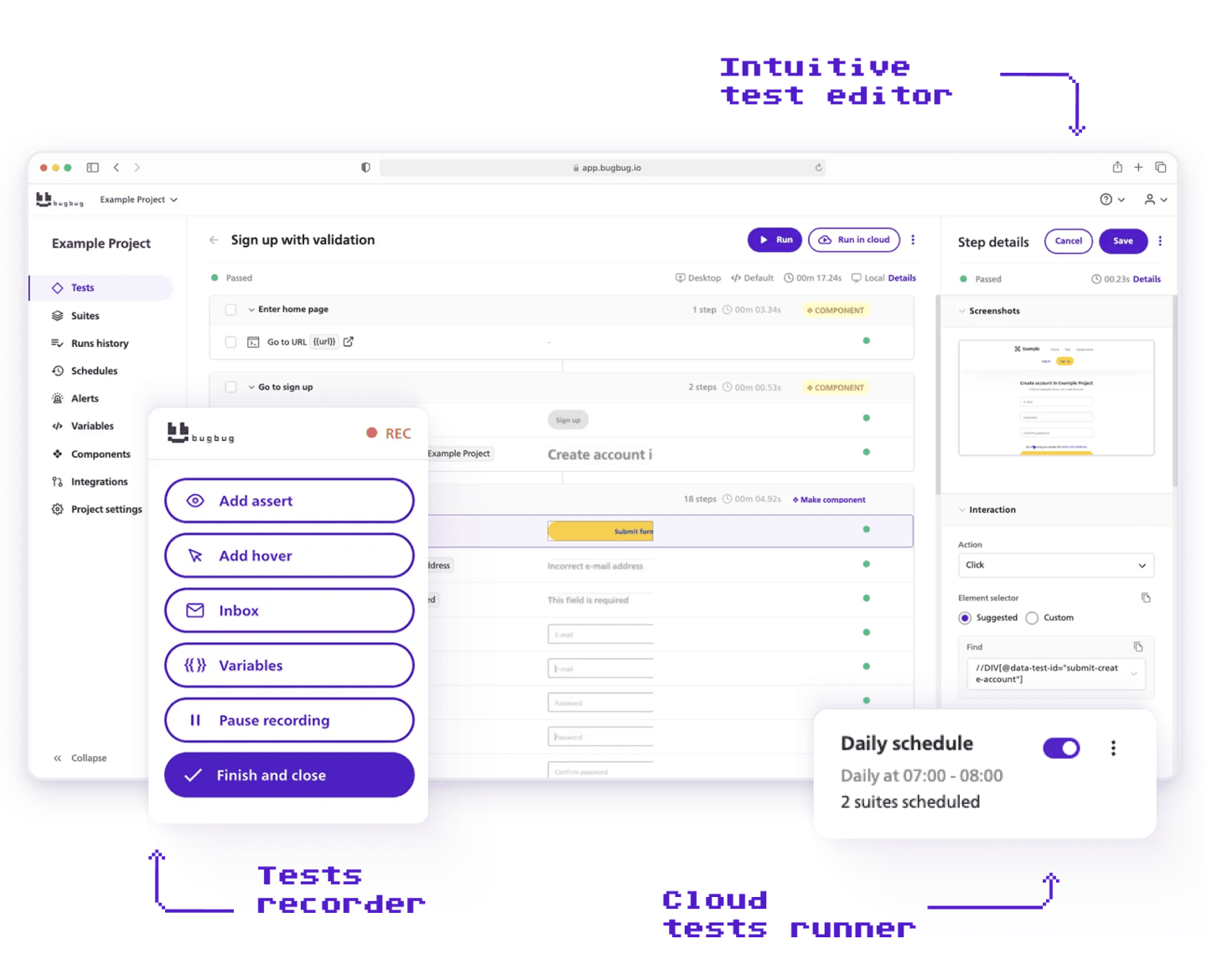
Best for: Web-only SaaS teams, startups, and non-developer QA who need reliable regression coverage without RPA overhead, enterprise licensing, or infrastructure.
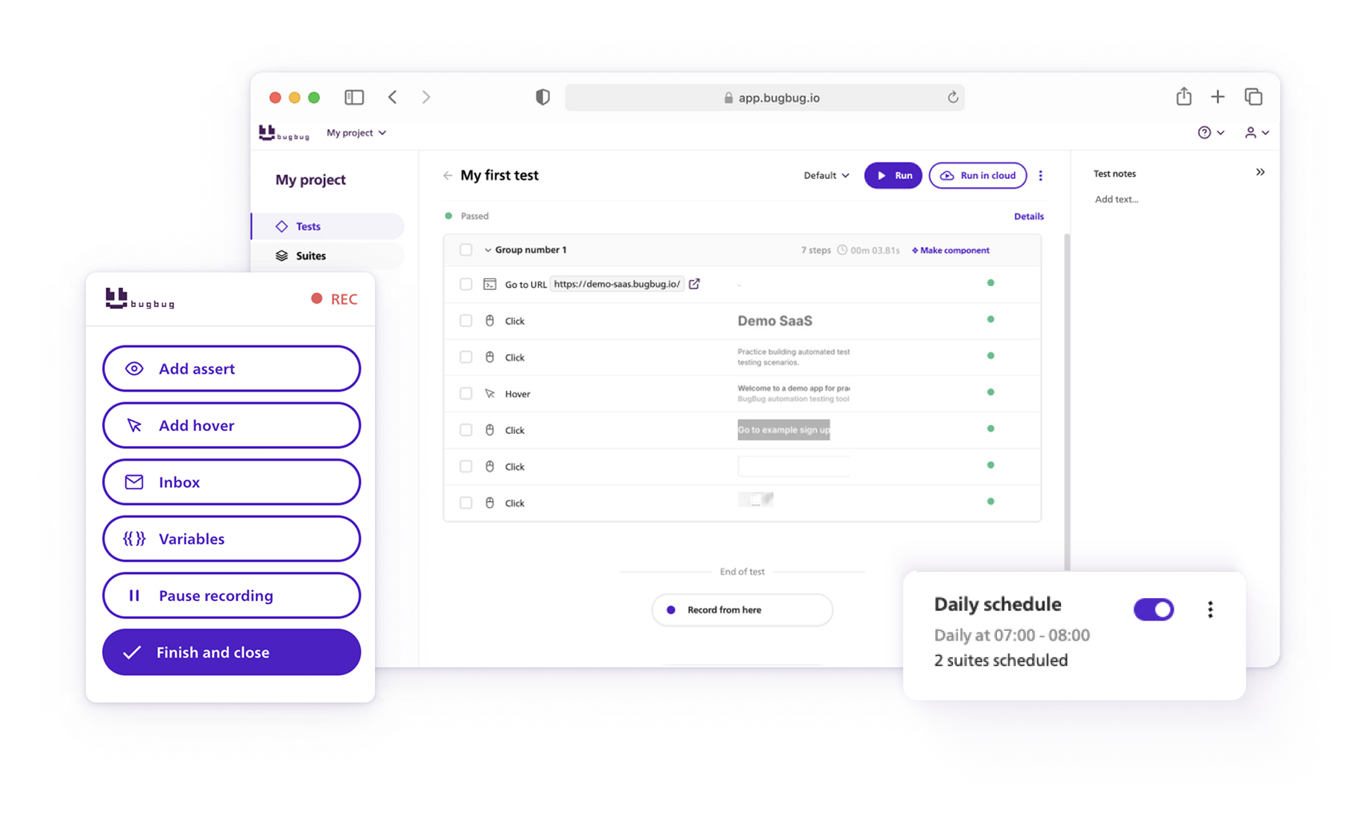
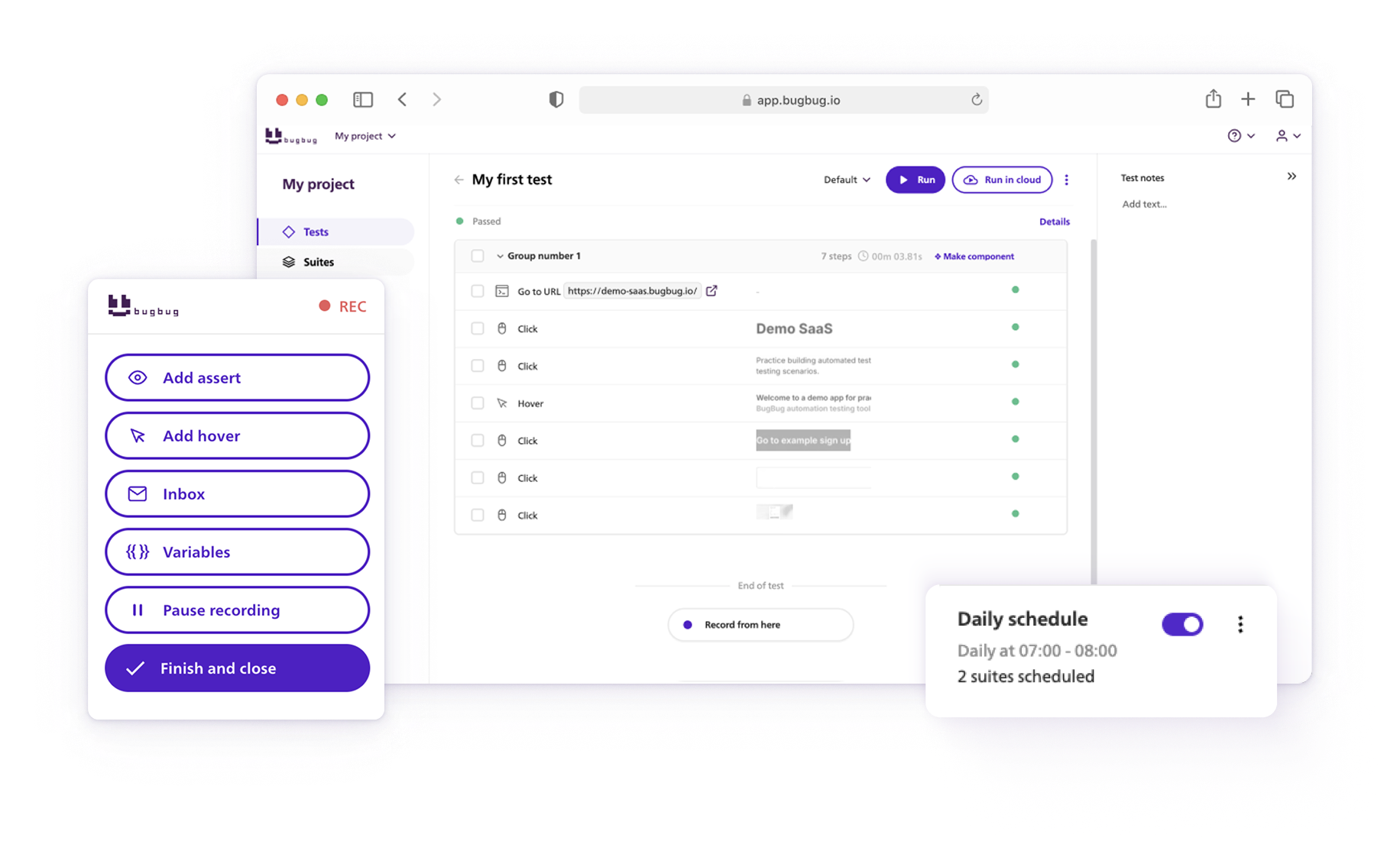
BugBug lets you record tests by clicking through your app with a Chrome extension. No Studio IDE, no Orchestrator to configure, no robots to allocate. You install the extension, record a flow, and run it locally or schedule it in the cloud — all inside the free plan. Where Test Cloud asks for weeks of setup before the first test runs, BugBug's first test runs in under 10 minutes.
The maintenance loop is the real differentiator. When a test breaks, Edit & Rewind lets you insert a step anywhere and rerun from that point — so you isolate the failing step, fix it in place, and rerun without touching code or filing a ticket to whoever owns the UiPath toolchain. Stable selectors target the flakiness class that eats QA time. Built-in email testing validates signup confirmations and password resets without a separate service. And the pricing is flat and public: from $99/month, no consumption units to forecast.
Where it costs you — honestly:
The verdict: BugBug is the cleanest break from Test Cloud when your scope is genuinely web testing. It removes the platform, the infrastructure, and the developer dependency in one move — as long as you're web-only on Chromium. If that matches your actual scope, the cost and complexity gap versus Test Cloud is stark.
👉 Also check the full comparison: UIPath vs BugBug
Automate your tests for free
Test easier than ever with BugBug test recorder. Faster than coding. Free forever.
Get started

Best for: Developer-led teams that want full cross-browser web automation with a modern, actively developed open-source framework.
If your reason for leaving Test Cloud is that it's too heavy for a web-focused team that can write code, Playwright is the natural destination - specifically as a replacement for Test Cloud's automation layer, not UiPath's broader RPA. It gives you genuine cross-browser reach (Chromium, Firefox, WebKit), native browser protocols instead of a proxy, and one of the best debugging toolsets in open source: trace viewer, video on failure, screenshot capture. Microsoft backs it, so the development pace is consistent, and there's no licensing cost and no vendor lock-in. Open-source alternatives to UiPath, including Robot Framework and TagUI, appeal for the same reason: they avoid high licensing costs, but they also shift ownership to the team.
Where it costs you: Every test is code — JavaScript, TypeScript, Python, Java, or C#. Non-developer QA and product teams can't contribute. There's no native mobile testing. And your team owns the CI infrastructure, the runner config, and the scripts; that total cost of ownership includes implementation time, bot maintenance, and ongoing engineering overhead, which can outweigh the zero-license price because there's no managed execution layer the way Test Cloud provides one.
The verdict: For a team that writes code and wants to escape platform overhead, Playwright is the honest upgrade — better tooling than Test Cloud at zero licensing cost. Just know that maintenance never leaves the developers. Every selector change is a code change, a PR, a review. That's fine if your whole team codes; it's a dealbreaker if the people who own your tests don't.

Best for: JavaScript-fluent front-end teams testing React, Angular, or Vue apps who want fast, in-browser E2E testing with real-time debugging.
Cypress runs inside the browser and gives you real-time visibility into what your app is doing during a test — plus a time-travel debugger, first-class component testing, and a large plugin ecosystem. For a developer team that lives in JavaScript and wants a lean, testing-focused tool after the weight of Test Cloud, it's the most battle-tested option.
Where it costs you: JavaScript/TypeScript only — no entry for non-developers. No Safari support. The single-domain limitation means flows that redirect through an auth provider need workarounds you then maintain. Parallel execution requires the paid Cypress Cloud plan.
The verdict: A genuine pleasure for JS developers and a big step down in overhead from Test Cloud — but authoring and upkeep stay locked to people who write code. If your team's problem with Test Cloud was complexity, Cypress solves that; if it was that non-developers couldn't participate, Cypress doesn't.
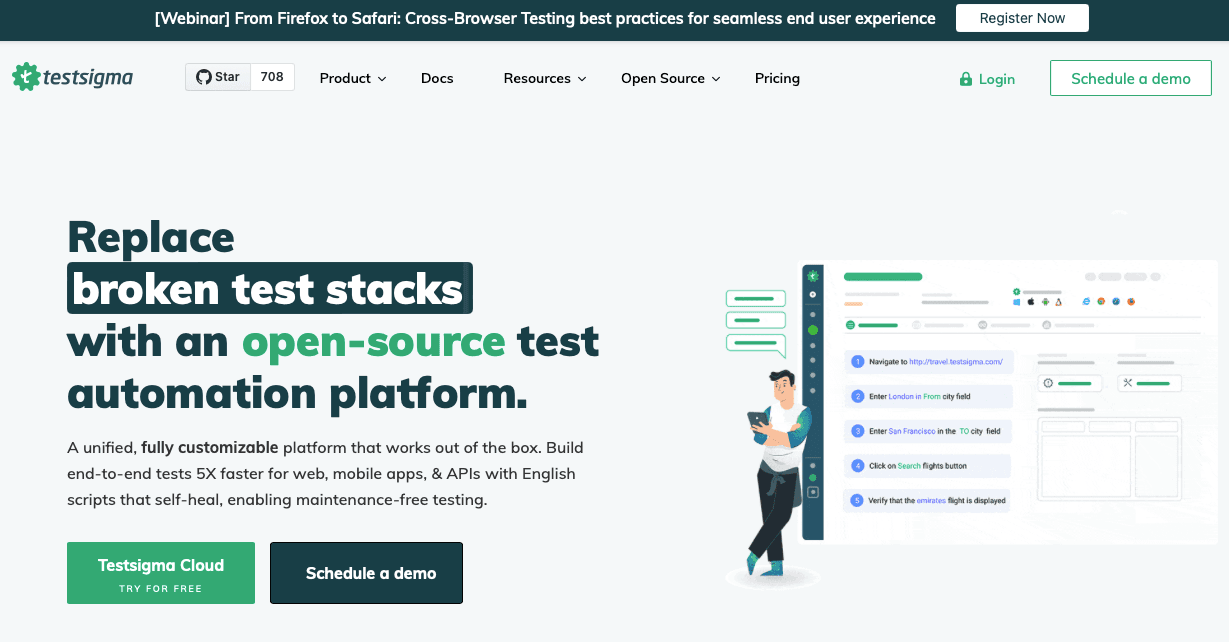
Best for: Mixed teams that need web, mobile, and API coverage from one platform and want a low-code on-ramp closer to Test Cloud's breadth.
Testsigma is purpose-built for testing rather than an RPA module, which makes it a natural consideration for teams whose pain with Test Cloud was specifically the testing experience. You author tests in plain English or via a recorder, cover web/mobile/API from one cloud platform, and lean on AI agents for self-healing and failure analysis. For teams that need more than web but want out of the UiPath toolchain, the breadth is real.
Where it costs you: No free plan, so entry cost is high relative to web-only tools. Despite the codeless positioning, complex scenarios routinely fall back to scripting — which means the maintenance you thought you'd avoided reappears exactly when the test matters. Execution is cloud-only. And pricing is quote-based, so you're back in the same "contact sales" pattern you may have left Test Cloud to escape.
The verdict: The closest match to Test Cloud's multi-platform scope with a friendlier authoring layer. The plain-English on-ramp is honest, but the no-code promise erodes on complex flows, and the pricing opacity mirrors what you're leaving. Right pick if you genuinely need web + mobile + API; overkill if your scope is web-only.

Best for: Teams migrating off Selenium or Test Cloud that want both codeless and scripted modes in one tool, across web, API, mobile, and desktop.
Katalon occupies a useful middle ground — not a pure RPA platform, not a developer-only framework. It combines a visual recorder with Groovy/Java scripting, covers web, API, mobile, and desktop, ships AI-assisted self-healing, and offers a supported migration path off Selenium and legacy tools. For teams leaving Test Cloud who want the option to scale into scripting later without starting from a raw framework, it's a credible transition.
Where it costs you: The IDE-based approach adds friction versus a browser extension. Setup is heavier than recorder-first tools, it's resource-intensive on large suites, and per-seat pricing bites at scale. For a strictly web-only team, most of the platform is overkill.
The verdict: Broad coverage and dual authoring modes make it a real Test Cloud alternative for multi-platform teams — but the IDE itself becomes something you maintain. Justified for a broad QA function; heavy for a team whose whole surface is a web app.

Best for: Teams that want maximum framework flexibility and multi-browser coverage, with full control over architecture and execution.
Selenium is the open-source foundation the whole category is built on — free, every major browser, every major language, no vendor relationship. For teams leaving Test Cloud who specifically don't want another commercial platform, it's the cleanest break from licensing entirely.
Where it costs you: No built-in recorder — test creation means writing code. No auto-waiting, so flakiness needs explicit management. You own the Grid setup, the infrastructure, and the maintenance. It's the steepest setup on this list, and for new projects many teams now choose Playwright instead for exactly that reason.
The verdict: The right call only if you want total control and have the engineering capacity to own everything. It trades Test Cloud's platform overhead for infrastructure-ownership overhead — a different cost, not a smaller one. Most teams leaving Test Cloud for a web-focused tool will be happier with Playwright (if they code) or BugBug (if they don't).
Some readers land here because they searched alternatives to UiPath while comparing broader automation tools in a wider automation landscape, not just test software. If that's you, none of the tools above is your answer. They test web apps; they don't automate business processes.
Here's the honest routing, briefly:
Sending you to the correct tool matters more than keeping you on the page. If your problem is RPA, solve it with RPA. Newer AI-led options are also expanding this space with ai capabilities focused on data transformation and reporting, not just repetitive tasks or other automation processes.
The decision underneath all of these is the one Test Cloud obscures by bundling testing into a platform: separate the scope of your real problem from the scope of the tool. If your problem is web regression testing and the person who owns it doesn't write code, you don't need an enterprise automation suite — you need a recorder, and the right choice also depends on whether the owner is developers, QA, IT teams, or business analysts.
If that's you, BugBug's free plan takes 10 minutes to set up. No credit card, no Orchestrator, no consumption units — just a Chrome extension and your first recorded test. Ready to catch some bugs?
Happy (automated) testing!
Your next release. Properly tested.
Join 1,200+ QA teams that automated their regression coverage with BugBug.

Dominik Szahidewicz is a Software Quality Evangelist specialising in quality assurance, test automation, and modern software testing practices. He creates practical, research-driven content that helps QA professionals, developers, and product teams improve test coverage, automate repetitive testing, and release more reliable web applications.
Drawing on his experience in technical writing, data analysis, and application consulting, Dominik translates complex testing concepts into clear, actionable guidance. His areas of interest include end-to-end testing, no-code test automation, regression testing, and the use of AI in software quality assurance.
Join thousands of QA experts. Subscribe to our newsletter.
Get more testing tips and product related content. Zero spam.
Learn how to automate regression testing without devs or QA. Discover a risk-based strategy and practical workflows.
Discover the importance of QA testers in software development and whether automation can eliminate the need for this crucial role. Learn more here!
Explore the test suite in software testing and understand its role in creating and executing test cases. Learn how to manage test suites effectively.
Unlock the potential of BDD testing in your software development process. Learn all about behavior-driven development and bdd testing frameworks.
Build a CI/CD testing pipeline in 30 minutes with BugBug. Learn how to run reliable E2E smoke tests on every PR, block bad merges, and scale safely.
This article delves into the journey of becoming an Automated Test Engineer, offering insights into the essential skills, knowledge, and steps required to embark on this career path and increase your current salary.
Build an effective QA strategy aligned with your business goals. Explore best practices in quality assurance and test automation.
Discover how to calculate ROI for test automation with easy formulas and practical examples. Learn to evaluate costs and track results effectively.
Read this comprehensive guide on how to choose the right CI/CD tool. Selecting the tool that aligns with your project is essential.