Ecommerce Test Plan Template: Examples & Checklist
Written byDominik SzahidewiczReviewed byMariusz Wójcik


Updated: September 9, 2026View as Markdown
Why do you need an ecommerce test plan template?
It's 11 p.m. on a Thursday and checkout is broken. Only for PayPal, only on mobile, only if the cart has a promo code applied. Nobody catches it until a customer tweets about it Friday morning. When the team goes back to figure out what happened, the answer is always the same. Nobody had written down that payment methods, promo combinations, and mobile checkout were all supposed to be tested this release. Everyone assumed someone else had it covered.
"We'll just test everything before launch" isn't a plan. It's a hope. A test plan turns "we should test the site" into "here's exactly what gets tested, how, by whom, and by when." Gaps show up on a checklist instead of in a support ticket, which matters when one missed checkout or payment bug can cost sales fast. For small to mid-sized ecommerce teams, product managers, QA leads, and developers who need a practical plan they can adapt without building a full automation framework first, this guide breaks down the core sections to include, the key scenarios to cover by module, how to use and update the template over time, and how to run it with manual testing, automation, or both. Below is the structure a real e-commerce test plan needs, a free template you can copy and fill in today, and a worked example so you're not staring at a blank page. (If you're looking for the bigger picture — testing types, tools, and an ongoing QA strategy beyond this one document — see our complete guide to e-commerce testing.)
A test plan isn't a test case list, and it isn't a vague QA strategy doc either. It's a working document with five parts. Skip one and you'll find out which one during a release.
Say what's being tested this cycle — and just as importantly, what isn't. "Test the site" is not scope. "Test the new one-click checkout flow and anything it touches: cart, payment, order confirmation" is scope. If a redesign only touched the product listing page, your plan shouldn't pretend to cover the entire site. That's how testing time gets spread thin over things that didn't change, while the thing that did change gets a five-minute smoke test.
Write the objective as a sentence, not a bullet: what does "this release is safe to ship" actually mean here?
List the specific modules in scope: search functionality, product pages, shopping cart, checkout, payment, accounts, order history. These are the core features and core functionality in scope for this release. Then add whatever changed recently — a new shipping calculator, a migrated payment provider, a redesigned cart drawer. Recently changed code is where regressions hide. When you write test cases, tie sample test cases and cases for e commerce to each changed module. An unchanged module that's been stable for six months needs a lighter pass than the thing that shipped Tuesday.
Not every release needs full-depth everything. Match the type to what's actually at risk as part of broader quality assurance:
A copy change to the footer doesn't need a performance pass. A new payment integration needs security and functional testing at minimum, and probably compatibility too.
Name the specific browsers, OS versions, and devices you're testing against in staging and production for cross browser testing, and detail the supported browsers, devices, and operating systems. Not "cross-browser" — "Chrome and Safari on the last two iOS versions, Chrome and Edge on Windows 11" — so the ecommerce site functions correctly across supported combinations. Entry criteria should include a stable staging environment and approved test cases before testing begins. Then define your test data: real product SKUs with real stock levels, expired and near-expiry promo codes, test cards for each payment method you support, with the backend in test mode where relevant. Testing checkout with one product that's always in stock will never catch the bug where the last unit in inventory causes a race condition.
Who's testing what, and by when. The testing process should define defect severity levels such as Blocker, Critical, Major, and Minor. Who signs off before release. And — the part most plans skip — what "done" actually means in a detailed test plan. "Done" isn't "we ran out of time." It's a stated bar: no P1 bugs open, checkout tested on all supported payment methods, performance holds at expected peak load. Without exit criteria, testing just stops whenever the deadline arrives, not when the site is actually ready.
Here's a fillable version of the structure above — one ecommerce website testing plan, five sections, ready to copy into Google Docs or Notion and adapt to your store.
A few notes on using it:
A test item like "checkout" isn't a test. It's a category. The gap between a plan that catches bugs and one that just looks thorough is specificity. Not "test the cart," but "test what happens when someone stacks two promo codes that were never supposed to combine."
Here's what specific looks like, module by module.
This is where releases actually break, because it's where the most conditional logic lives in the checkout process. Concrete scenarios worth writing into your plan:
These should become functional test cases in a standardized template to ensure consistency.
Cart bugs are quiet — they don't crash anything, they just charge the wrong amount or mishandle item updates, which is why a cart test belongs in every release check.
Shopping cart test cases should also cover add, remove, and quantity-change behavior in the shopping cart.
Mobile is where e-commerce testing plans get thin, usually because online shopping on mobile has to behave consistently across devices or small UX differences turn into lost sales. Add cross-browser checks for common mobile and desktop combinations. At minimum: checkout completing on a small screen without horizontal scrolling, tap targets big enough for a thumb. Teams that test ecommerce websites should run the same purchase path on key device and browser pairings, not assume one passing run covers the rest. Retest the promo and payment edge cases above on mobile — don't assume they behave the same as desktop.
Write these into the Test Items table as Notes, not as a separate document. The plan should point at the scenario, not just the module name. For the full breakdown inside each of these areas, see our complete list of e-commerce test cases — this plan tells you what's in scope and reminds you to check the same flows across browsers and operating systems, not just desktop versus mobile, while that page tells you exactly what to check once it is.
A test plan is only as good as whether it gets run every release. This is where most plans quietly die. Someone writes a thorough document in week one, and by week four "we're a little behind, we'll catch up next cycle" becomes the permanent state.
Manual testing works fine at low release frequency — a handful of releases a month, one or two testers who know the app well. It gets expensive fast once releases ship weekly and the same checkout, cart, and payment scenarios need re-checking every single time. That's not a skill problem, it's a math problem: the same regression checks, run by hand, over and over.
Automated testing is where the scenarios above stop being a document and start being something that runs itself for regression testing. If your team doesn't have a dedicated automation engineer, that's usually the actual blocker. Not the will to automate, but the time it'd take to stand up and maintain a coded framework on top of everything else. Automated tests can also be executed across various environments as part of release checks for your e commerce platform. (If you're weighing that trade-off in general, our guide to automation testing for startups walks through when it's worth it.)
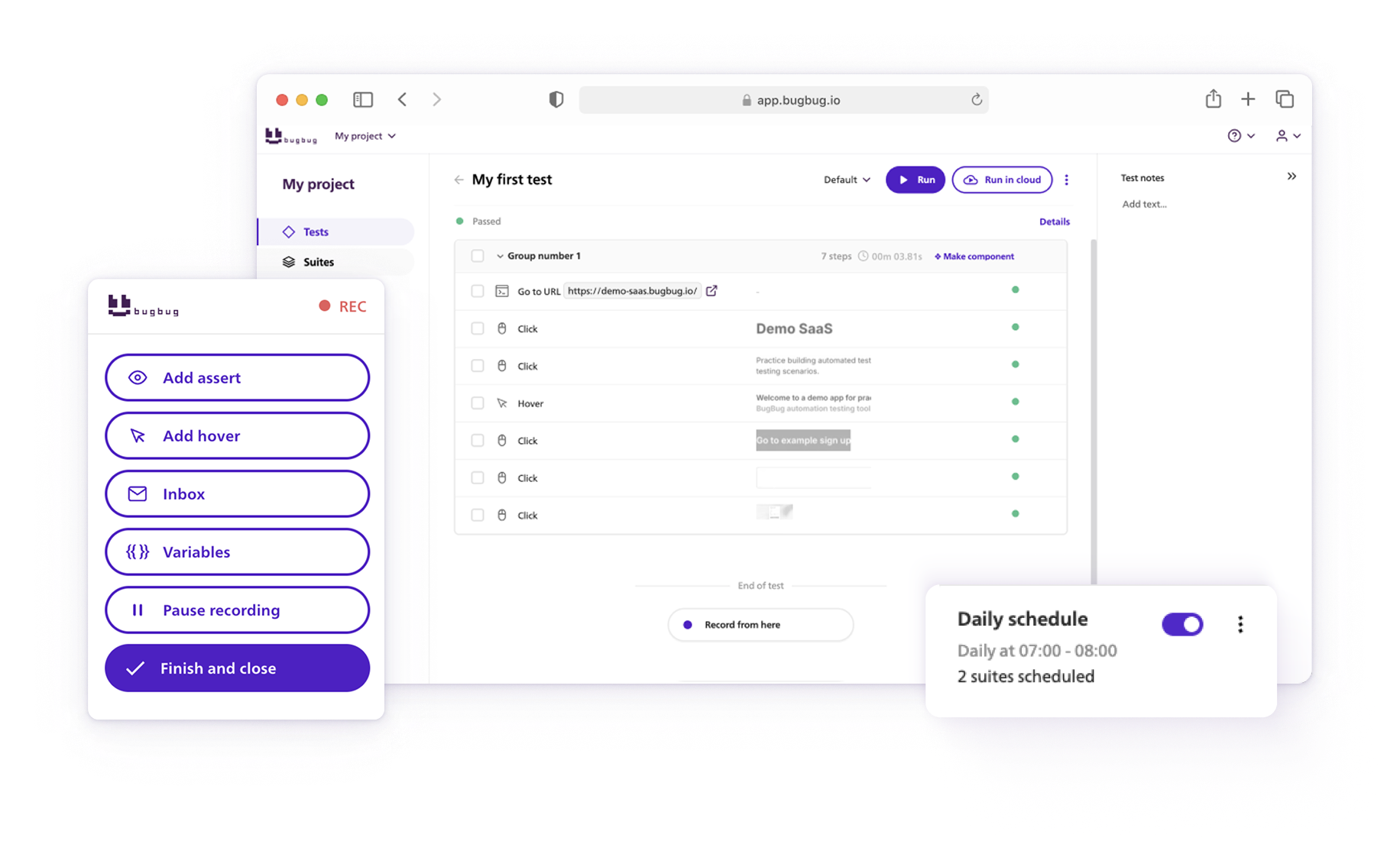
That's the specific gap BugBug fills: you record the checkout flow, the cart edge cases, and the promo code scenarios above by clicking through them once in the browser — no Selenium grid, no Playwright scripts to maintain. Edit & Rewind lets you insert a new step — like that 100% discount edge case — into an existing test without re-recording the whole flow. You can also schedule the suite to run against every release, which helps with test management for recurring runs and coverage instead of relying on someone remembering to do it manually.
One limitation worth knowing before you build a plan around it: BugBug runs on Chromium-based browsers only. If Safari or Firefox compatibility is genuinely high-priority for your store, you'll need it covered separately — either manually or with a cross-browser tool alongside it.
Here's the template from earlier, filled out for a fictional mid-size store — Northwind Outfitters. The release: a new one-click checkout, Apple Pay support, and a redesigned cart drawer.
Objective for this cycle: Ship one-click checkout and Apple Pay on the e commerce website without breaking existing card checkout, cart pricing, or order confirmation.
| Area | Why it's in scope |
|---|---|
| Checkout flow | New one-click checkout is shipping this release |
| Payment | Apple Pay added as a new payment method |
| Cart | New cart drawer UI replaces the old cart page |
| Area | Why it's excluded this cycle |
| Product listing page | Unchanged since last release, covered by last cycle's regression pass |
| Account settings page | No changes shipped this cycle |
Test items (excerpt):
| Module | Status | Priority | Notes |
|---|---|---|---|
| Cart | Changed | High | New cart drawer UI — verify quantity updates, promo stacking |
| Checkout | Changed | High | New one-click flow — verify it doesn't break existing multi-step checkout |
| Payment | Changed | High | Apple Pay added — test success and cancel mid-payment |
Test types & depth (excerpt):
| Test type | In scope? | Depth | Notes |
|---|---|---|---|
| functional test | Yes | Full | Every changed module above; software quality |
| security testing | Yes | Standard | Priority because payment changed |
| cross browser testing | Yes | Standard | Apple Pay is Safari/iOS-heavy — test there specifically |
Exit criteria this release actually used:
☑ All in-scope test items executed
☑ No P1/P2 bugs open
☑ Security review complete for Apple Pay integration
☑ Release approver signed off
Notice what's not here: a performance or full compatibility pass. Nothing about this release touched page load or non-Chromium browser behavior, so the plan didn't pretend it needed one. That's the difference between a plan built for this release and a generic checklist copy-pasted every cycle.
That depends less on your store and more on your release cadence and who owns testing.
If you release infrequently and have a dedicated manual tester who knows the app well, manual testing against a plan like this one is genuinely fine. Don't automate for the sake of it — the cost only shows up when the same checks repeat weekly and nobody has time to run them by hand every time.
If nobody owns testing full-time and releases ship every week or two — the situation most SaaS and e-commerce teams without a QA hire actually live in — that's where automating the scenarios in this plan pays off. Start with the highest-priority items from your Test Items table: checkout, payment, cart. Those cost the most when they silently break, and they're worth automating first regardless of which tool you pick.
If that's your situation and you're on Chromium-based browsers, BugBug's free plan is the fastest way to find out if it fits. No credit card, first test recorded in under 10 minutes.
Happy (automated) testing!
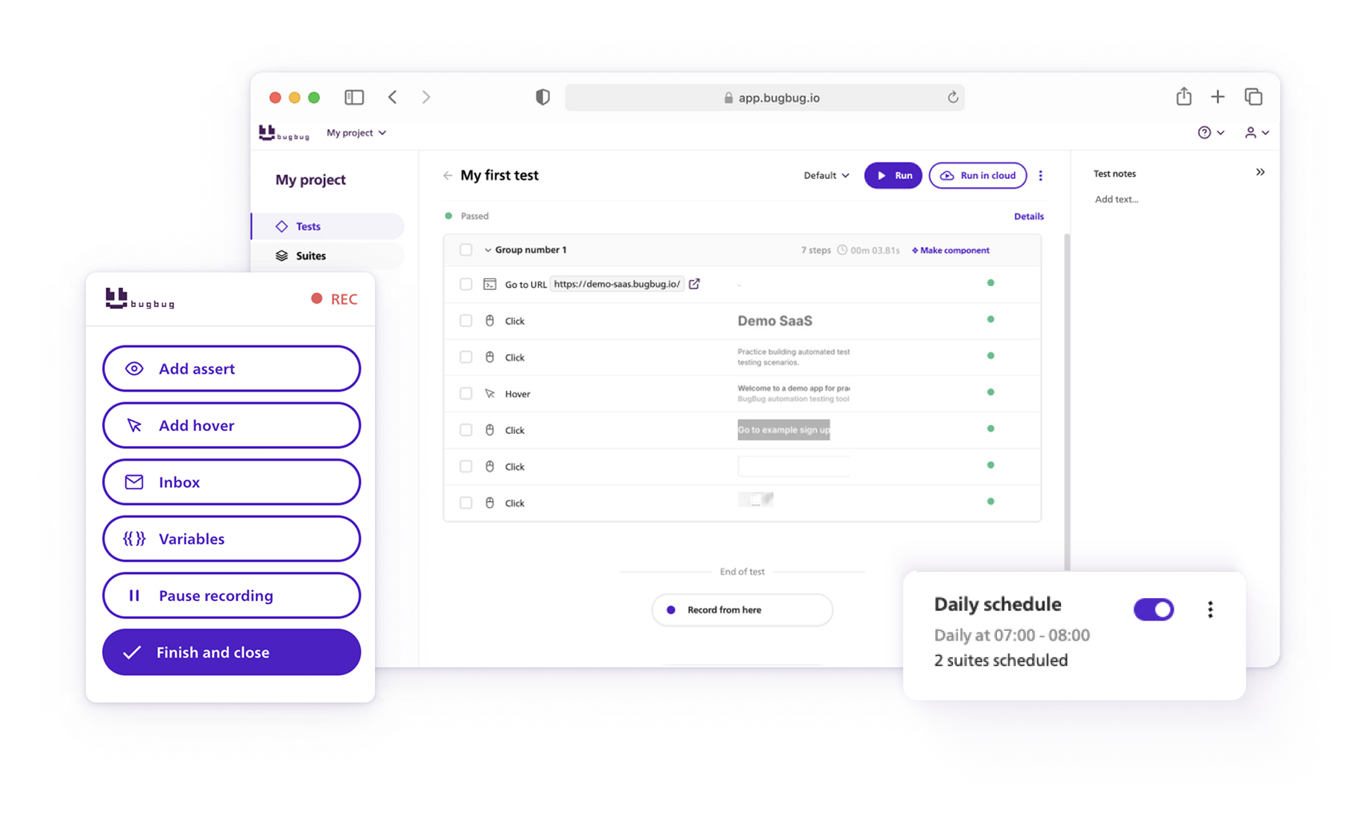
Your next release. Properly tested.
Join 1,200+ QA teams that automated their regression coverage with BugBug.

Dominik Szahidewicz is a Software Quality Evangelist specialising in quality assurance, test automation, and modern software testing practices. He creates practical, research-driven content that helps QA professionals, developers, and product teams improve test coverage, automate repetitive testing, and release more reliable web applications.
Drawing on his experience in technical writing, data analysis, and application consulting, Dominik translates complex testing concepts into clear, actionable guidance. His areas of interest include end-to-end testing, no-code test automation, regression testing, and the use of AI in software quality assurance.

Senior software engineer at BugBug, where he's spent 6 years helping shape the product. He's a T-shaped developer skilled in frontend with React and TypeScript, browser extensions, backend work, and building AI agents and tooling. His strengths also include UX instincts, a product-minded approach, and process automation.
Join thousands of QA experts. Subscribe to our newsletter.
Get more testing tips and product related content. Zero spam.
Copy a test case template with examples for functional, login, API, integration, performance and regression testing. Free Excel, Word and Sheets-ready files.
Use 80 ecommerce test cases for login, search, cart, checkout, payments, shipping, APIs, mobile, accessibility, performance and security. Excel and PDF.
Learn how to automate regression testing without devs or QA. Discover a risk-based strategy and practical workflows.
AI can generate 100 test cases in seconds. Deciding which to keep, making them run, and maintaining them is the real work. Here's the workflow.
This article delves into the journey of becoming an Automated Test Engineer, offering insights into the essential skills, knowledge, and steps required to embark on this career path and increase your current salary.
Discover how to calculate ROI for test automation with easy formulas and practical examples. Learn to evaluate costs and track results effectively.