

QA Certifications in 2026: What's Active, What's Retired
Written byDominik Szahidewicz


Updated: August 24, 2026View as Markdown
Two of the most commonly recommended QA certifications no longer exist. CSTE and CAST were retired by PeopleCert, with the last exam day on 1 February 2026, and the ISTQB Foundation Level Agile Tester is being replaced by an Advanced Level version. Of the certifications still available, ISTQB Foundation Level costs $229 for a 60-minute exam and never expires, while ASQ's CSQE costs $550 and requires eight years of experience. Here is the current state of each.
| Certification | Issuer | Cost (USD) | Exam | Pass mark | Prerequisites | Valid for |
|---|---|---|---|---|---|---|
| ISTQB Certified Tester Foundation Level (CTFL) v4.0 | ISTQB / ASTQB | $229 | 40 questions, 60 min | 65% | None | For life |
| ISTQB Advanced Level Test Analyst v4.0 | ISTQB / ASTQB | $249 | 45 questions, 120 min | See syllabus | CTFL + 3 years' practical experience | For life |
| ISTQB Advanced Level Test Management v3.0 | ISTQB / ASTQB | $249 | 50 questions, 120 min | See syllabus | CTFL + 3 years' practical experience | For life |
| ISTQB Test Automation Engineering v2.0 | ISTQB / ASTQB | $249 | 40 questions, 90 min | See syllabus | CTFL | For life |
| ASQ Certified Software Quality Engineer (CSQE) | ASQ | $550 (retake $350) | 175 questions, 160 scored, 4.5 hours | 550 of 750 scaled points | 8 years' experience, 3 of them in a decision-making role | 3 years, recertification required |
| ISTQB CTFL v4.0 (UK) | BCS | £200 | 40 questions, 60 min | 65% | None | For life |
Prices verified August 2026 from the issuing bodies: ASTQB exam pricing, ASQ CSQE, BCS CTFL. A US dollar price for the BCS route was not found; the £200 figure is the UK price.
Two certifications that still appear in most "best QA certifications" articles cannot be taken any more.
The Certified Software Tester (CSTE) and Certified Associate in Software Testing (CAST) were part of a PeopleCert portfolio that has been withdrawn. Vouchers stopped being sold on 1 August 2025, and the last day to sit either exam was 1 February 2026. There is no direct replacement for either.
Is CSTE still available in 2026? No. PeopleCert retired both CSTE and CAST. The last day to sit either exam was 1 February 2026, and vouchers stopped being sold on 1 August 2025.
Source: PeopleCert certification retirements update.
If you hold either credential, it remains yours — retirement means the exam is no longer offered, not that existing certificates are revoked. But it does mean that listing CSTE as a career goal in 2026 is planning for something that cannot happen.
The Foundation Level Agile Tester extension is marked as retiring. Its successor is the Advanced Level Agile Tester v2.0, which sits higher in the ISTQB structure and carries different prerequisites. If agile testing is your target area, check the current ISTQB portfolio before booking anything, because the transition is still in progress.
CTFL is the entry point into the ISTQB scheme and the certification most job postings name when they name one at all. If you are still deciding what the day-to-day role involves, start with the QA tester role before paying for an exam. The current version is v4.0, based on the CTFL syllabus v4.0.1 published on 15 September 2024.
The syllabus covers testing fundamentals, testing throughout the development lifecycle, static testing, test analysis and design techniques, managing test activities, and test tools. It is theory-heavy: you will be asked to identify the correct definition of a test level far more often than to solve a technical problem.
That is worth knowing before you book. CTFL proves you share a vocabulary with the rest of the profession. It does not prove you can automate a checkout flow.
Advanced Level splits by role rather than by seniority.
Test Analyst v4.0 — $249, 45 questions, 120 minutes. Focuses on test design techniques, risk-based testing and defect management.
Test Management v3.0 — $249, 50 questions, 120 minutes. Focuses on planning, estimation, metrics and team management.
Both require CTFL plus three years of practical testing experience under ASTQB rules. The experience requirement is enforced at registration, not at the exam, so check it before paying.
Test Automation Engineering v2.0 — $249, 40 questions, 90 minutes, CTFL required.
This is the closest ISTQB gets to automation practice, covering architecture for test automation, deployment risks, and maintenance. It is still a written exam about automation rather than a demonstration of automation. If you want proof that you can build something, see certification versus portfolio below. It also helps to understand the main test automation frameworks you may be asked to discuss in practical interviews.
CSQE is a different kind of credential — broader, more expensive, and much harder to qualify for.
Education reduces the experience requirement: one year for a diploma, two for an associate degree, four for a bachelor's, five for a master's or doctorate.
Two things are often reported incorrectly about CSQE. First, the pass mark is a scaled score, not a percentage — converting 550 of 750 into "73.3%" misrepresents how ASQ grades. Second, unlike ISTQB certifications, CSQE expires. Recertification through the journal route costs $120 for members and $160 for non-members; retaking the exam costs $450 or $550. Details on the ASQ recertification page.
CSQE aims at quality engineering as a discipline — audits, metrics, process improvement — rather than at hands-on testing. It suits a quality manager more than a test automation engineer.
No. And this matters, because a large number of paid courses are marketed as if one existed.
Is there an official Selenium certification? No. The Selenium project states it has not authorised anyone to offer an "official Selenium certification" and considers the term a trademark violation. Third-party courses that certify Selenium skills exist, but none of them is issued or endorsed by the Selenium project.
The Selenium support page is explicit: there is no officially recognised Selenium certification, the project has not authorised anyone to provide one, and describing a course that way infringes their trademark.
So when you see "Selenium certification", separate two different things:
| Certification from Selenium | Certificate about Selenium | |
|---|---|---|
| Who issues it | nobody — does not exist | training companies, tool vendors, course platforms |
| Endorsed by the Selenium project | — | no |
| What it proves | — | that you completed that provider's assessment |
| Typical cost | — | free to several hundred dollars |
Third-party certificates are not worthless. Some involve real coding assignments, and completing one is a reasonable way to structure your learning. But they certify the provider's course, not your standing with the Selenium project, and claims like "globally recognised" come from the organisation selling the course.
If your goal is to demonstrate Selenium skills rather than to collect a certificate, working through Selenium locators and a Selenium cheat sheet on real practice sites will get you further in an interview.
It depends on the issuer, and the difference is significant over a career.
ISTQB: all Foundation, Specialist and Advanced Level certificates are currently valid for life. No renewal fee, no continuing education requirement. Expert Level is the exception, with a seven-year validity. See ISTQB certification validity.
ASQ: CSQE must be recertified every three years, either by accumulating recertification units or by retaking the exam.
Over ten years, an ISTQB CTFL costs $229 once. An ASQ CSQE costs $550 plus three or four recertification cycles at $120 to $160 each. That gap should factor into the decision as much as the exam difficulty does.
We could not find a study published after 2024 that measures this directly and reports its sample size. The Stack Overflow Developer Survey 2024 has 65,437 respondents but does not break out QA certification requirements, and other industry reports we checked did not state sample sizes for their hiring statistics.
So we are not going to invent a percentage. Job requirements also move faster than certification guides do. Before paying for an exam, search current openings for the role and location you want, then count how often ISTQB, ASQ or any certification appears as required, preferred or not mentioned at all.
That gives you a better local signal than a global claim such as “X% of QA jobs require certification.” It still cannot tell you whether the credential helped someone get hired; it only tells you how often employers ask for it.
Certification is easiest to evaluate when you compare it with something you can show.
Building something testable costs nothing. Pick a public demo site or one of these websites with bugs for testing, automate a login and checkout flow, record what happens when it breaks, and put that in your portfolio. Tools with a free tier let you do this before you learn a framework, which means you can arrive at an interview with a working artefact rather than a certificate number.
This is not an argument against certification. It is an argument about sequence. A certificate answers "does this person know the vocabulary". A portfolio answers "can this person do the work". Interviews test the second question far more often than the first — as the questions in our guide to QA interview questions show.
If you are entering QA: ISTQB CTFL. It is the cheapest of the credentials compared above, has no prerequisites and never expires. Pair it with a portfolio and use the QA career roadmap to see what practical skills should come next.
If you are moving into test management: ISTQB Advanced Level Test Management, once you have CTFL and three years of experience.
If you are moving into automation: the honest answer is that no certification will move you as far as a public repository of working tests. If you want structure while learning, ISTQB Test Automation Engineering provides it — but treat it as a syllabus, not as a hiring signal. Our test automation learning path covers the practical route.
If you are heading toward quality management or process work: ASQ CSQE, provided you meet the eight-year experience requirement and accept the recertification cost.
If you are considering CSTE or CAST: you cannot. See above.
For a broader view of what the role involves before you spend anything, see our guide to QA skills and the comparison of QA vs QE.
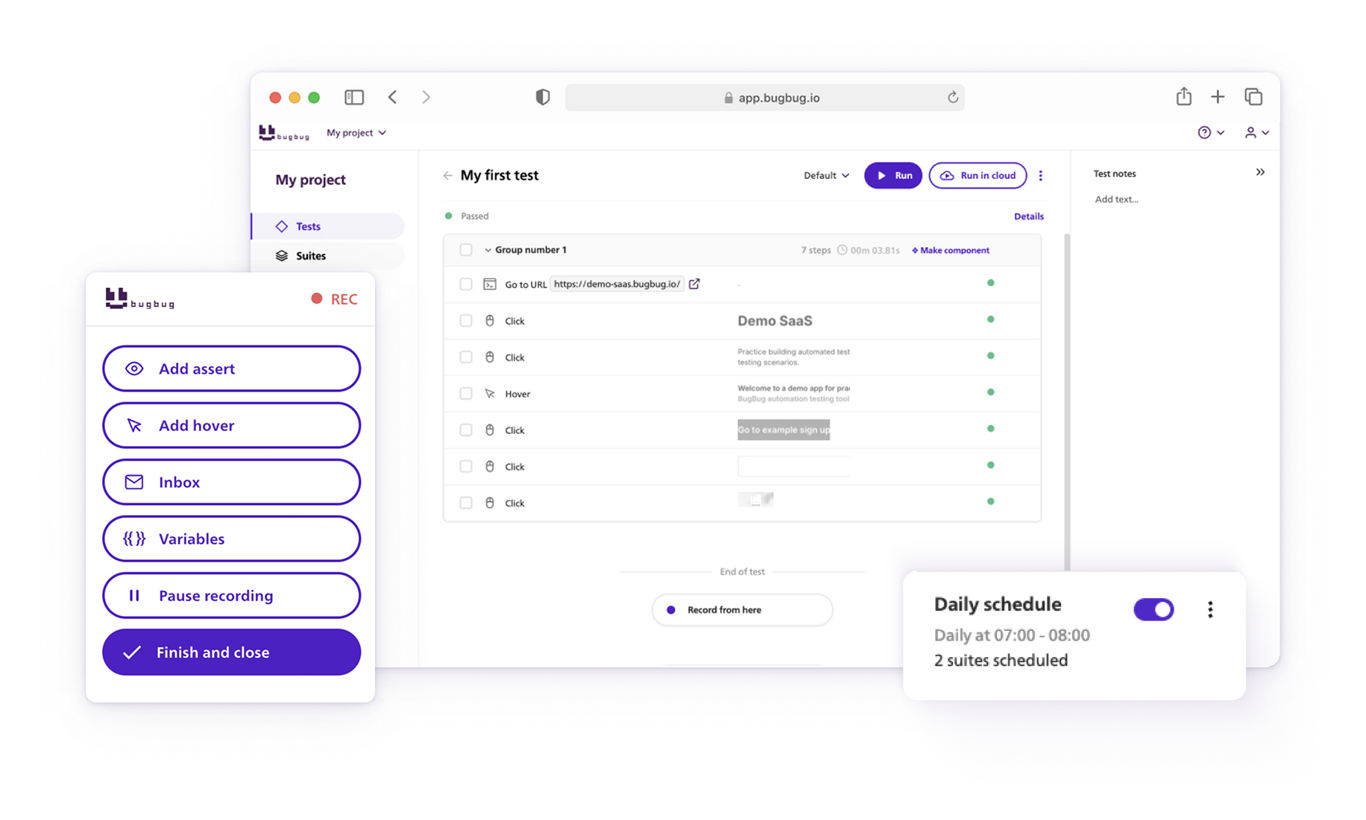
Your next release. Properly tested.
Join 1,200+ QA teams that automated their
regression coverage with BugBug.

Dominik Szahidewicz is a Software Quality Evangelist specialising in quality assurance, test automation, and modern software testing practices. He creates practical, research-driven content that helps QA professionals, developers, and product teams improve test coverage, automate repetitive testing, and release more reliable web applications.
Drawing on his experience in technical writing, data analysis, and application consulting, Dominik translates complex testing concepts into clear, actionable guidance. His areas of interest include end-to-end testing, low-code test automation, regression testing, and the use of AI in software quality assurance.
Get more testing tips and product related content. Zero spam.


