AI Testing Framework: Is It Solving the Right Problem?
Dominik SzahidewiczJanuary 24, 2026
🤖 Summarize this article with AI:
💬 ChatGPT 🔍 Perplexity 💥 Claude 🐦 Grok 🔮 Google AI Mode
Check also:
Vendors promise smarter test creation, automated decision-making, and fewer manual QA tasks — all powered by artificial intelligence.
But when you look at how most QA teams actually work, a different picture emerges.
Most teams aren’t blocked by a lack of AI. They’re blocked by:
These are key pain points in test automation that directly impact productivity and effectiveness. Brittle tests, which frequently fail due to minor changes, require ongoing test maintenance and can slow down the testing process.
An AI testing framework doesn’t magically fix these issues. In many cases, it adds another layer of complexity on top of them. Test maintenance is the most time-consuming part of the test automation process, especially when using open-source frameworks.
This is where the disconnect starts. A robust testing infrastructure is essential for addressing these pain points, and AI frameworks do not replace the need for strong fundamentals.
In theory, an AI testing framework is a structured system that defines how artificial intelligence is used across the testing process.
In practice, the term is used far more loosely.
Depending on who you ask, an AI testing framework might mean:
A collection of AI-powered testing tools
A machine learning pipeline that analyzes test results
A layer that generates or prioritizes test cases
A governance model for “human-in-the-loop” testing
A comprehensive test management platform that streamlines test planning, creation, execution, and maintenance
This lack of clarity is already a red flag.
AI testing frameworks have evolved from simple script execution to intelligent systems capable of autonomously creating, maintaining, and analyzing software tests.
At its core, an AI testing framework does not test your software. It coordinates how AI models and tools are applied to testing activities such as:
The critical distinction is this:
A framework orchestrates AI — it does not improve test quality by default.
Seamless integration with CI/CD and development workflows is a key feature of modern AI testing frameworks.
If your tests are flaky, slow, or poorly scoped, an AI testing framework will not fix that. It will simply operate on top of unreliable signals and produce confident-looking output.
This is why many teams adopt AI frameworks and still struggle with:
The framework didn’t fail — the assumption did. AI frameworks assume strong testing fundamentals. Without them, they amplify existing problems rather than solve them.
AI testing frameworks didn’t appear out of nowhere. They are a response to very real problems — just not the problems most small QA teams have.
In large organizations, testing environments tend to look like this:
At that scale, traditional automation alone stops being effective. Teams can’t manually analyze every failure, decide what matters, or prioritize coverage intelligently. This is where AI testing frameworks start to make sense. In fact, 81% of development teams use AI in their testing workflows to manage complexity and scale.
Their core promise is coordination:
AI can significantly impact the most time-consuming steps in the automated testing process, particularly test creation and maintenance.
In theory, this reduces human effort and increases signal quality.
But there’s an important, often unstated assumption behind all of this:
You already have a mature, stable, well-maintained automation setup.
AI testing frameworks assume:
Automated tests can quickly become obsolete without proper maintenance, leading to false-positive test failures.
Without these foundations, AI frameworks don’t create clarity — they create interpretation work.
This is why AI testing frameworks emerged first in enterprises, not startups. They’re designed to manage complexity at scale, not to bootstrap quality from scratch. Teams using open-source frameworks often spend more time on test creation and maintenance, even with AI assistance.
For small and mid-sized QA teams, the reality is very different.
Most teams are operating under constant constraints:
Limited technical expertise within these teams can make it difficult to configure and maintain AI testing frameworks, especially when advanced setup or troubleshooting is required.
In this context, introducing an AI testing framework often creates more problems than it solves. AI testing frameworks may not fully address complex scenarios that require advanced testing capabilities, such as intricate user flows or testing across multiple environments.
Try stable automation with Bugbug
Test easier than ever with BugBug test recorder. Faster than coding. Free forever.
Get started
All testing frameworks require configuration:
Test maintenance is a significant ongoing effort, as automated test maintenance is frequently a bottleneck in the code release process. This adds to the overall setup and upkeep required for AI testing frameworks.
This work doesn’t replace testing — it competes with it.
Instead of writing or fixing tests, teams end up maintaining the framework itself.
AI frameworks rely heavily on human-in-the-loop workflows. Someone still has to:
For small teams, this often means more manual work, not less — just redistributed into review and explanation tasks.
AI evaluation becomes a second testing layer, without clearly defined ownership.
Explainability is critical in testing. QA teams need to justify:
AI testing frameworks frequently struggle here.
When an AI model says “this test is low risk” or “this failure is probably irrelevant,” teams still need to explain that decision to developers, product managers, and stakeholders.
Some AI testing frameworks address this by offering logic insights, which mimic a senior test engineer's review and suggest improvements to test automation processes. These logic insights provide recommendations and intelligent suggestions, helping teams understand and enhance their testing strategies.
If the explanation is vague or probabilistic, trust erodes quickly — and teams revert to manual verification anyway.
This is the core issue.
Small QA teams adopt AI testing frameworks hoping to:
Instead, they often end up with:
The bottleneck doesn’t disappear — it just moves.
One of the most overlooked aspects of any AI testing framework is evaluation.
👉 Check more in: Generative AI Testing Tools - Evaluation Checklist
Traditional test automation has a clear feedback loop:
AI-driven systems complicate this loop.
When AI is involved in generating tests, prioritizing execution, or suppressing failures, QA teams must now evaluate the AI itself — not just the application under test.
This introduces new questions:
For most teams, these questions are harder to answer than a failing assertion.
In testing, explainability isn’t a “nice to have.” It’s mandatory.
QA teams are expected to explain:
AI testing frameworks often respond to this need with dashboards, confidence scores, or probability labels. Comprehensive test management platforms can help provide traceability and clear explanations for test decisions, making it easier for teams to justify actions and outcomes throughout the test lifecycle.
But these rarely translate into explanations that non-ML stakeholders can trust.
A statement like “this test was deprioritized due to low historical risk” is not actionable unless the team can explain:
Without strong explainability, teams fall back to manual checks — negating the supposed efficiency gains of the framework.
Most AI testing frameworks promote human-in-the-loop workflows as a safety mechanism.
In theory:
In practice:
Some platforms address this by allowing users of varying technical skill levels to easily create, manage, and review tests, reducing the burden of manual review and making test automation more accessible.
For small QA teams, this often becomes unsustainable. Instead of reducing workload, AI introduces a new class of work: supervising automated decisions that are difficult to verify quickly.
The result is not autonomy — it’s oversight fatigue.
Before adopting an AI testing framework, teams should pause and ask a more basic question:
Identifying the key pain points in your testing process is essential before adopting new tools.
What problem are we actually trying to solve?
In many cases, AI is applied to symptoms, not root causes.
Here are the most common misalignments.
AI testing tools can help automate complex test scenarios and generate test steps from plain-English descriptions, making it easier to address these challenges.
Should you use AI in software testing? AI-generated tests can speed up initial creation, but they don’t eliminate:
AI-powered test generation is a feature that enhances software testing processes by automatically generating test cases based on historical data. AI-assisted test creation is now a common feature across many testing tools, allowing users to enter a plain-English description of the steps for the test, which the AI translates into a test script. These AI-powered test and test generation capabilities can also improve bug detection and integrate with CI/CD pipelines to enhance software testing efficiency.
If your team already struggles to maintain existing tests, adding automatically generated ones often increases long-term cost.
AI frameworks promise smarter failure analysis. But if your test suite is:
AI will learn from that noise and reflect it back — with added confidence.
Fixing flaky tests usually delivers more value than classifying them with AI. Reduced maintenance in AI testing frameworks can eliminate the need to manually update locators for every minor UI change, reducing maintenance effort by up to 85% and making it easier to maintain automated tests.
AI can suggest where coverage might be missing, but it can’t decide:
However, AI-driven test case generation can help improve testing efficiency and coverage by automatically creating relevant test cases based on application behavior and changes.
Those decisions require product context, not statistical inference.
If your biggest problems are:
Then an AI testing framework is probably not the answer.
Those problems are usually solved by better automation. Automation testing and the use of AI test automation tools can help teams quickly establish and sustain automated testing processes, making it easier to manage and maintain tests over time, and reducing manual effort.
If you strip away the AI hype, a clear pattern emerges across high-performing QA teams.
The biggest gains in software quality don’t come from sophisticated frameworks — they come from boringly effective fundamentals. Effective test management, thorough test planning, and streamlined testing workflows are key to improving software quality.
Across startups and growing product teams, the improvements that actually move the needle look like this:
Teams benefit far more from:
than from AI-generated or AI-prioritized tests that require explanation and review.
A smaller, reliable test suite consistently outperforms a large, “intelligent” one that nobody fully trusts.
One of the main promises of AI testing frameworks is better insight.
But in practice, speed matters more than sophistication.
Fast feedback allows teams to:
Waiting for AI-driven analysis, prioritization, or evaluation often delays the moment when a developer simply sees a failure and fixes it.
Manual regression is where most QA teams lose time and morale.
The most effective teams focus on:
This approach reduces manual workload immediately — without requiring new layers of AI decision-making.
Many problems AI frameworks try to solve are actually organizational, not technical:
No framework can compensate for these issues. But simple, accessible automation tools often improve collaboration by making tests easier to create, understand, and maintain. Platforms with an intuitive interface and low-code tools allow both technical and non-technical users to easily create and maintain tests, further improving collaboration and reducing the learning curve.
This is where the contrast becomes clear.
Most QA teams exploring AI testing frameworks aren’t chasing AI for its own sake. They want:
Instead of adding an AI layer on top of testing, BugBug improves the core testing workflow itself:
This means teams spend time testing the product, not managing tooling.
Try no-code automation with Bugbug
Test easier than ever with BugBug test recorder. Faster than coding. Free forever.
Get started
One of the quiet promises of AI testing frameworks is scale — “do more with less.”
BugBug delivers this in a simpler way:
No ML pipelines. No evaluation dashboards. No explainability problem.
BugBug doesn’t attempt to predict risk or automatically deprioritize failures.
Instead, it gives teams:
This kind of confidence is easier to defend, easier to explain, and easier to trust than probabilistic AI-driven decisions.
Despite the skepticism, AI testing frameworks are not inherently useless. There are situations where they provide real value — they’re just far less common than marketing suggests. Both proprietary tools and open-source AI testing tools are available, each with their own advantages. Proprietary tools often offer dedicated support and advanced enterprise features, while open-source AI testing tools are community-driven and free, making them easily accessible to developers and organizations.
AI testing frameworks start to make sense when testing complexity is no longer human-manageable.
Typical indicators:
At this scale, a robust testing infrastructure is essential for managing large-scale automation and ensuring reliability. At this level, humans can’t reasonably triage everything. AI can help group failures, detect patterns, and reduce noise — if the underlying automation is already solid.
An AI testing framework is not “set and forget.”
It requires:
If no one in your organization is responsible for answering “Why did the AI do this?”, the framework will quickly lose trust.
AI frameworks rely heavily on historical signals:
If your test suite is already:
then AI has something reliable to learn from.
If not, AI will simply automate confusion.
AI testing frameworks are best at meta-problems:
Key benefits of AI testing frameworks include logic insights and predictive analytics, which help teams focus on high-risk areas by providing intelligent suggestions similar to a senior test engineer's review. AI-powered test features such as self-healing tests that adapt to UI changes and natural language script generation are also important advantages.
They are not a substitute for:
If your main challenge is still building and maintaining automated tests, an AI framework is premature.
A simple rule of thumb for QA leaders:
If your biggest testing problems can be solved by faster automation, clearer results, or fewer tools, you don’t need an AI testing framework yet.
At that stage, investing in better automation fundamentals will deliver far higher ROI — with less risk and less operational overhead. Effective test management, thorough test planning, and streamlined testing workflows are essential for maximizing the benefits of automation.
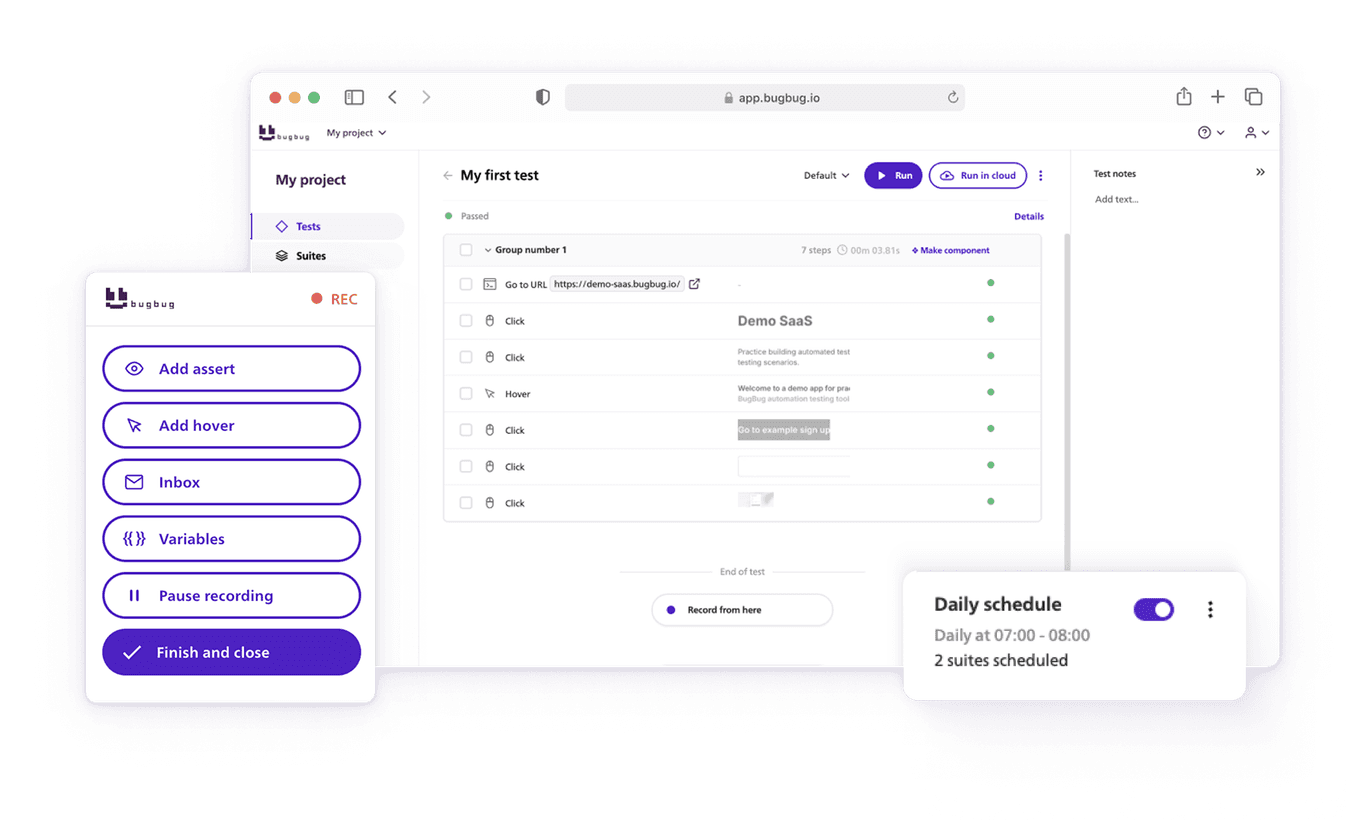
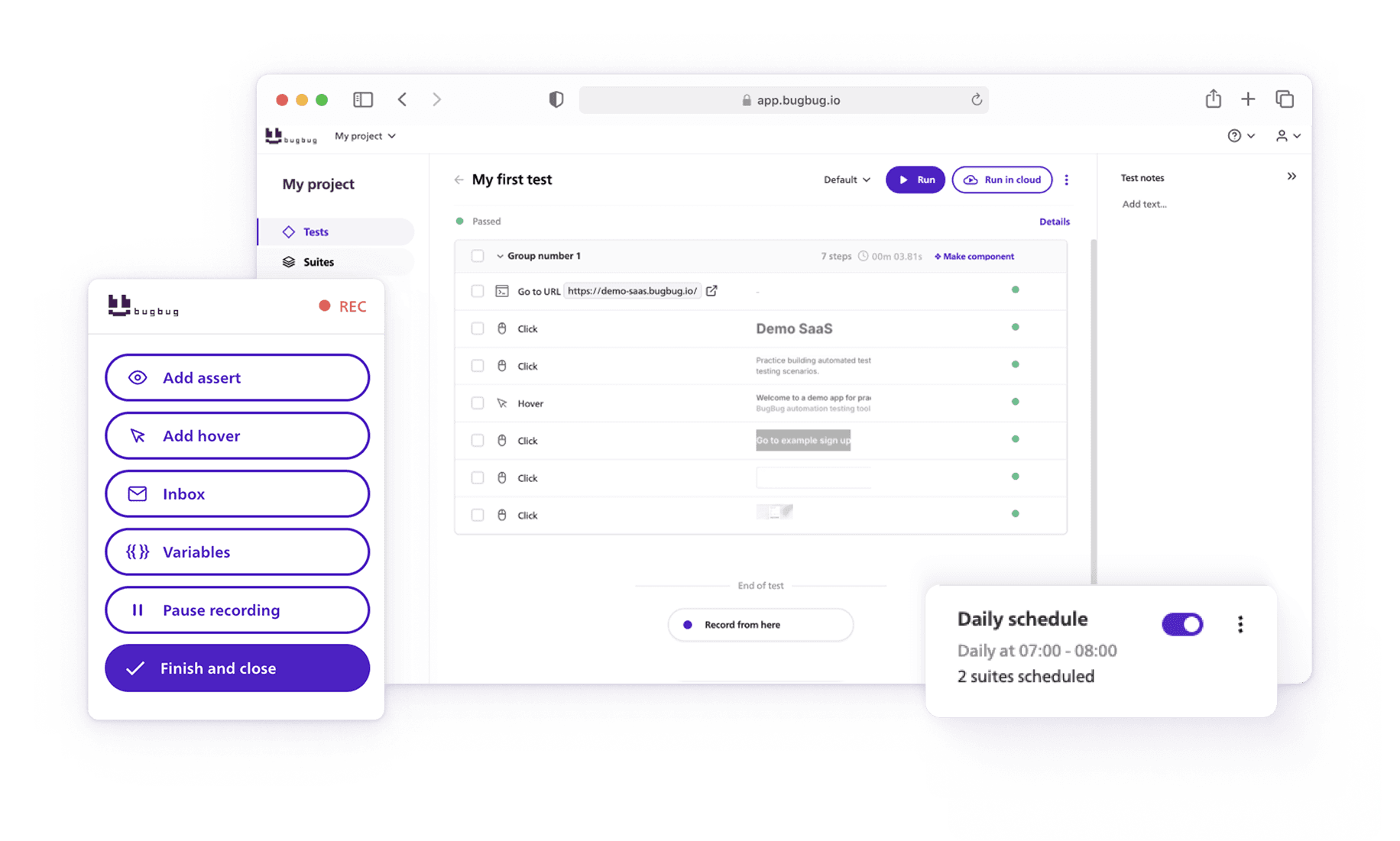
Speed up your entire testing process
Automate your web app testing 3x faster.

Dominik Szahidewicz is a technical writer with experience in data science and application consulting. He's skilled in using tools such as Figma, ServiceNow, ERP, Notepad++ and VM Oracle. His skills also include knowledge of English, French and SQL.
Outside of work, he is an active musician and pianist, playing in several bands of different genres, including jazz/hip-hop, neo-soul and organic dub.
Join thousands of QA experts. Subscribe to our newsletter.
Get more testing tips and product related content. Zero spam.
Let's dive into the best front-end testing frameworks, whether you need javascript driven platform or codeless solution with friendly user interface.
Discover the best practices for handling Stale Element Reference Exception in Selenium. Learn how to avoid it in your test automation code.
Learn how to build an effective QA strategy that aligns with your business goals. Discover best practices in quality assurance, test automation, and more!
Discover how to calculate ROI for test automation with easy formulas and practical examples. Learn to evaluate costs and track results effectively.
This article delves into the journey of becoming an Automated Test Engineer, offering insights into the essential skills, knowledge, and steps required to embark on this career path and increase your current salary.
Learn how to create a test plan for the testing process of your web application. Discover how to write a test plan with examples in the article.
Learn how you can use NotebookLM for you software testing needs. We prepared a comprehensive guide with tutorial so you can start right away!
This article delves into the significance of crafting comprehensive test cases for login pages, highlighting various scenarios.