Over-Automation: Why Teams Choose the Wrong Testing Stack
Dominik SzahidewiczFebruary 25, 2026
Over-automation slows startups down. The real cost isn’t tool pricing — it’s lost engineering focus, slower shipping, and runway burn.
Automation ≠ productivity. Complex frameworks and CI orchestration often create activity, not outcomes.
Most early-stage SaaS products need protection — not sophistication. Login, signup, checkout, billing, and core workflows are the real revenue-critical flows.
Heavy frameworks are often premature. They require infrastructure ownership, ongoing maintenance, and dedicated engineering time.
Complexity compounds. Flaky tests, slow CI pipelines, and “framework owners” are signs of automation overkill.
Right-sized automation creates leverage. It protects core browser flows, runs in the cloud, and requires minimal maintenance.
Early-stage SaaS teams don’t slow down because they lack automation.
They slow down because they overbuild it.
And the real cost isn’t tool licensing.
It’s runway.
It’s shipping speed.
It’s engineering focus.
Every hour spent maintaining a testing framework is an hour not spent building product.
That tradeoff matters when you’re under 30 engineers.
Also check:
Many businesses fall into the illusion that automation automatically equals productivity.
It doesn’t.
Tools and systems feel like progress. New dashboards, smarter workflows, AI-enhanced pipelines — they signal sophistication. But often, they quietly pull attention away from the core work that drives revenue: talking to customers, refining positioning, improving the product, shipping features.
Founders can end up tweaking CI pipelines instead of reviewing churn data. Engineering teams can optimize test orchestration instead of improving onboarding conversion.
Over-automation creates motion — not momentum.
The real leverage comes from simplification. Cutting unnecessary tooling. Focusing automation only where it directly protects revenue and release velocity.
Optimization should target outcomes, not activity.
There’s a subtle pressure in startups:
Serious companies use serious frameworks.
So you adopt:
It feels responsible. Scalable. Enterprise-ready.
But here’s the uncomfortable truth:
You don’t need enterprise infrastructure at 12 engineers.
You need protected revenue flows.
Let’s be honest about what breaks your business:
If those are stable, your risk profile drops dramatically.
These are deterministic browser flows.
They do not require:
They require reliability.
💡 See our curated list of the best Web Testing Tools.
In early SaaS teams, overkill usually looks like:
That’s not automation maturity.
That’s complexity tax.
And complexity compounds.
👉 Check out how to test website navigation
Automation should:
If it requires ongoing engineering ownership to stay alive, it’s not leverage.
It’s infrastructure.
And infrastructure has a cost.
There is a time for them.
If you:
Then sophisticated frameworks are justified.
But most startups under 30 engineers aren’t there yet.
For founders and CTOs building early SaaS, automation should:
If login, checkout, and billing are protected automatically, you’ve removed most release anxiety.
That’s the ROI.
Automation exists to protect velocity.
Not to impress other engineers.
Not to mirror enterprise architecture.
Not to future-proof for scale you don’t have yet.
Premature sophistication is as dangerous as premature optimization.
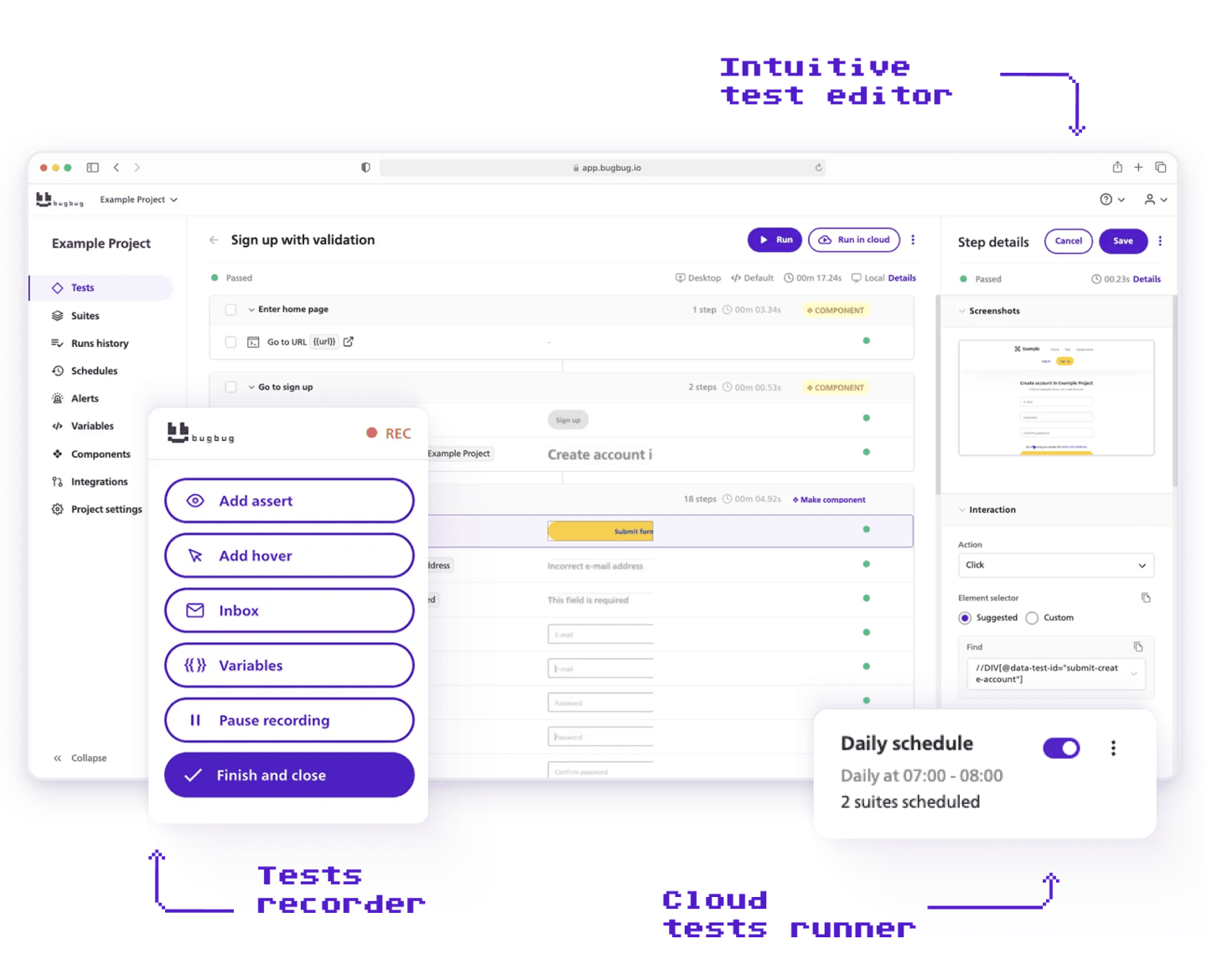
BugBug is intentionally narrow.
It focuses on:
You don’t manage drivers.
You don’t manage grids.
You don’t refactor framework architecture.
You protect the flows that generate revenue.
And your team keeps building.
Ask yourself:
If automation consumes more engineering time than it saves, it’s misaligned.
You don’t need less automation.
You need automation sized to your stage.
Protect your core browser flows in under 15 minutes — without owning testing infrastructure.
Free plan. No framework maintenance.
Start low-maintenance testing
Happy (automated) testing!
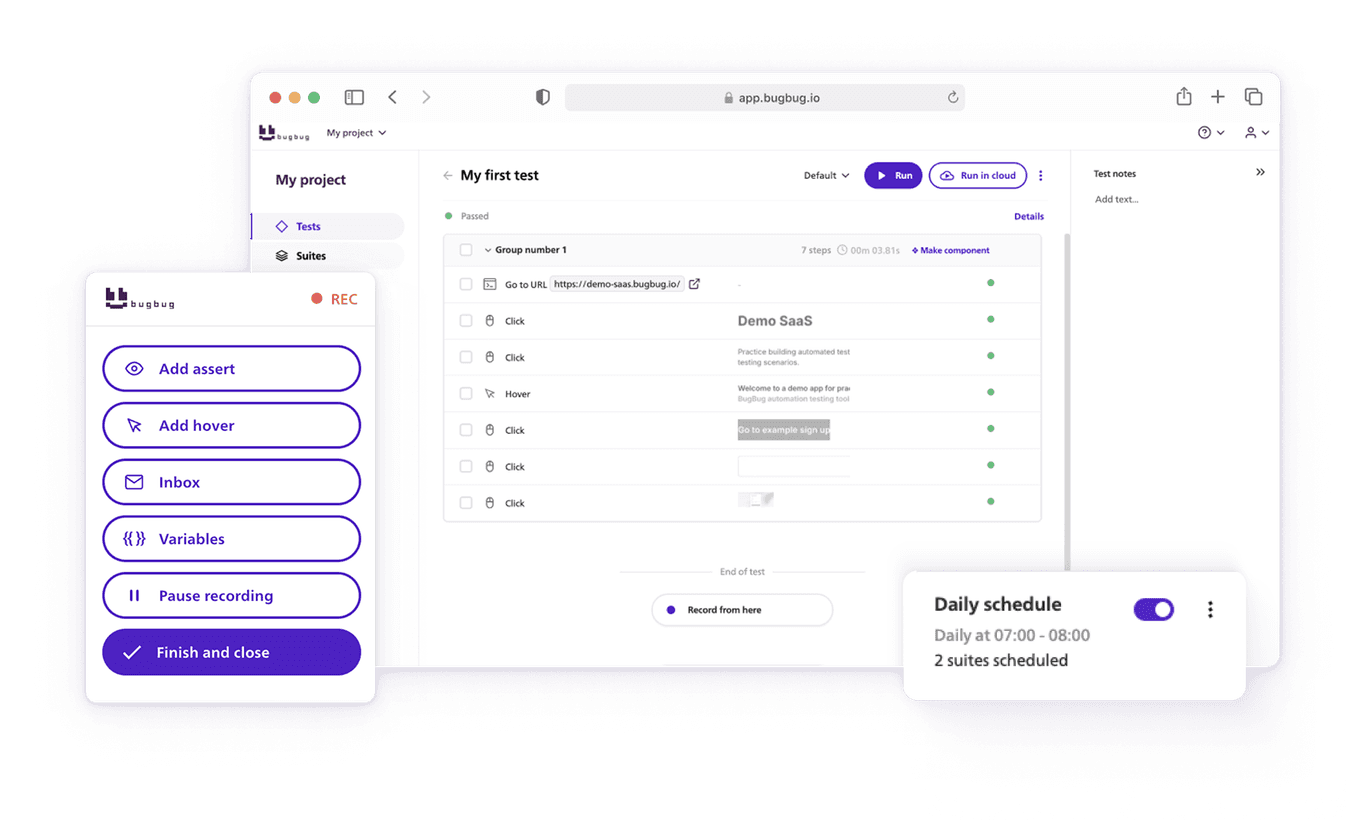
Speed up your entire testing process
Automate your web app testing 3x faster.

Dominik Szahidewicz is a technical writer with experience in data science and application consulting. He's skilled in using tools such as Figma, ServiceNow, ERP, Notepad++ and VM Oracle. His skills also include knowledge of English, French and SQL.
Outside of work, he is an active musician and pianist, playing in several bands of different genres, including jazz/hip-hop, neo-soul and organic dub.
Join thousands of QA experts. Subscribe to our newsletter.
Get more testing tips and product related content. Zero spam.
Build a CI/CD testing pipeline in 30 minutes with BugBug. Learn how to run reliable E2E smoke tests on every PR, block bad merges, and scale safely.
Discover essential accessibility testing tools and software in our guide. Learn how to make your applications accessible for everyone.
Are AI Testing Tools Worth the Hype? The integration of AI into software testing is transforming how we approach quality assurance.
Discover the best free test management tools that managers can use to maintain test suites and adopt agile test management best practices in 2026.
Discover the best API integration tools for 2025. We explore top platforms like IBM API Connect and Microsoft Azure.
Discover the best free and open-source automation tools of 2026! Explore testing tools and frameworks for each team type.
Learn exactly when to run regression tests—after features, fixes, updates, and on a schedule—plus tips to automate smoothly with minimal churn.
Discover how canary testing is a powerful method for safely deploying new software features by gradually releasing updates to a small user group.
Explore the test suite in software testing and understand its role in creating and executing test cases. Learn how to manage test suites effectively.