Perfecto Alternatives: 6 That Work
Written byDominik SzahidewiczReviewed byMariusz Wójcik


Updated: October 2, 2026View as Markdown
Most Perfecto alternatives lists hand you the same five device clouds and let you figure out the rest. That's useless, because the right replacement depends entirely on which part of Perfecto stopped working for you — and for a lot of teams, the device cloud was never the problem.
Renewal sticker shock is a different problem than device queue times. "Our manual QA team still isn't automating anything" is a different problem than both, and no amount of grid capacity fixes it.
So here's the shortlist, grouped by exit reason — with a verdict on each, and a clear note on who should skip it. If you're a QA lead, engineering manager, or founder at a 20–200 person company staring at a renewal, this is written for you.
We build a web testing tool, so be clear about our vantage point before you weigh anything below.
We have not run a 3,000-device mobile suite at enterprise scale, and we won't pretend otherwise. For anything involving real iOS or Android hardware, we've leaned on published pricing pages, G2 and TrustRadius reviews, and Gartner Peer Insights rather than benchmarks we didn't run.
What we do have is the other end of the funnel: the calls where teams explain why they're leaving an enterprise testing contract, and the deals we lose. Two numbers from our own data are worth putting on the table before you read further:
"No mobile" is our single most common lost-deal reason. Not price, not features — the app is mobile and we don't test it. If you're searching this keyword because of a mobile app, most of this list will serve you better than we will. Say so up front and you can trust the rest.
Roughly half of the teams that do fit us arrived with no working automated regression at all. Not a broken Perfecto setup - a manual checklist, a shared spreadsheet, and a lot of hope. That shapes which exit reason we actually understand well, which is the fifth one below.
Five reasons come up over and over in reviews, procurement threads, and migration calls. Find yours before you shortlist anything.
1. The contract math stopped working. Perfecto's published plans start at $83/month for Live, but subscriptions run on a 12-month minimum, and public cloud customers need 60 days' notice to cancel. Above the entry tier, pricing goes quote-based. Enterprise buyers make up roughly half of Perfecto's G2 review base — which tells you where the real price band sits. If you're a 40-person SaaS company that got quoted like a bank, that's your reason.
2. The cloud is slow, and slowness costs you minutes. Reviewers on TrustRadius describe sluggish device response and waiting for devices already checked out by another user — testing minutes burned on queueing. Gartner reviewers report intermittent failures where the same script passes, then fails on rerun with little diagnostic feedback. When your suite's trustworthiness drops, people stop reading the results.
3. You're still writing and maintaining Appium and Selenium by hand. Perfecto layers AI on top of execution, but for many teams the authoring layer never changed. You bought a platform and kept the scripting bill.
4. You're paying device-cloud prices for browser regression. This is the quiet one. Plenty of teams inherited Perfecto through a broader Perforce relationship, or bought it for one mobile app, and now run the bulk of their day-to-day browser regression on infrastructure built for 3,000 real devices. Mobile and web are different problems with different owners — bundling them into one contract is often why the renewal number looks the way it does.
5. Scriptless never stuck. Perfecto sells a scriptless authoring path, and plenty of teams bought it specifically so manual QA could finally automate. Then it didn't happen. The tests that exist were built by two engineers, QA still files tickets when something needs updating, and regression is still manual the week before release. That's not a device problem or a pricing problem — it's an ownership problem, and no amount of grid capacity fixes it.
Each reason points somewhere different. Here's where.
| Tool | Best for | Mobile / real devices | Authoring | Portable test output | Pricing published |
|---|---|---|---|---|---|
| BrowserStack | Swapping the grid, keeping your scripts | Yes | Bring your own | Yes — it's your code | Partly |
| Sauce Labs | Enterprise-scale parallel execution | Yes | Bring your own | Yes — it's your code | Yes — from $199/mo |
| TestMu AI (LambdaTest) | Grid plus an AI authoring agent | Yes | AI agent + frameworks | Yes — Selenium, Playwright, Cypress | Partly |
| Testsigma | Getting off hand-written Appium/Selenium | Yes | Natural language / low-code | Limited — check the export path | Partly |
| BugBug | The web slice — regression owned by QA or support | No — Chromium only | Visual recorder + AI agents | Yes — YAML export + MCP | Yes - from $99/mo |
| Playwright + MCP | Dev-led teams who only test browsers | Emulation only | Code (AI-assisted) | Yes — it's your repo | Free |
If real iOS and Android hardware is load-bearing for you, don't get creative. Replace infrastructure with infrastructure.
Best for: teams whose tests are healthy and whose complaint is purely cost, device availability, or contract terms.
Avoid if: your actual problem is maintenance. BrowserStack won't write or heal a single test for you — you'll arrive with the same flaky suite on nicer hardware.
BrowserStack is infrastructure, not a testing philosophy. Point your existing suite at it and most things work. Self-serve signup, no procurement cycle, real devices plus a browser grid.
Verdict: the lowest-friction migration if your Appium and Selenium scripts are fine and only the grid needs to change.

Best for: organizations where parallelism is the constraint and the security review is already a fact of life.
Avoid if: you're under 50 engineers. You'll pay enterprise prices for capacity you won't touch.
Sauce Labs publishes its Real Device Cloud entry at $199/month with unlimited testing minutes and unlimited users, scaling up through parallel-test tiers. Mature CI integrations, strong Appium and Selenium support, enterprise security posture.
Verdict: the right call above a few hundred parallel runs; overkill and overpriced below that.
Best for: teams replacing Perfecto who also want to stop hand-writing scripts, without stitching two vendors together.
Avoid if: you want a simple tool. The surface area is large, and the pricing is quote-driven above the self-serve tiers.
LambdaTest, now trading as TestMu AI, pairs a cross-browser and device grid with KaneAI, its GenAI test agent that generates tests from plain-language input and can export to Selenium, Playwright, or Cypress. That export path matters — it's one of the few AI platforms that doesn't trap your tests inside itself.
Verdict: the strongest single swap if you want to solve infrastructure and authoring in one purchase.
You don't need better hardware. You need to stop maintaining Appium.
Best for: mixed web and mobile teams with a manual QA function that should be automating but can't code.
Avoid if: you need Perfecto's device breadth. Testsigma's device coverage is real but not equivalent, and natural-language authoring means your test logic lives in their DSL — check the export path before you commit. We've written a fuller breakdown of that trade-off in our Testsigma alternatives piece.
Testsigma lets you write tests as plain English sentences across web and mobile, with self-healing on locator changes. If your Perfecto usage was 20% device coverage and 80% fighting your own scripts, this is the shape of the answer.
Verdict: the most direct fix for "our QA team can't write code and our devs won't maintain the tests."

Best for: dev-led teams with at least one engineer willing to own the suite.
Avoid if: nobody owns it. This is the failure mode we watch play out most often in migration calls, and it's remarkably consistent: one engineer builds the suite, it works, they move teams eighteen months later, and within two sprints nobody trusts the results enough to block a deploy on them. The repo is still there. Nobody reads it. Free tooling with no owner is more expensive than paid tooling with one — you just pay in production incidents instead of invoices.
Playwright is free, has won the framework war on developer mindshare, and its MCP server means an AI coding agent can drive the browser and generate tests directly. Codegen records interactions. UI Mode gives you trace-based time-travel debugging. "Playwright requires coding" is a much weaker objection in 2026 than it was in 2023.
Verdict: if you have engineers and only test the web, this is genuinely the best value in the category. It's also the most honest thing on this list.
You don't have to replace Perfecto with one thing. Keep a device cloud for the mobile app — BrowserStack or Sauce Labs cover that for a fraction of an enterprise line item — and move browser regression somewhere the people who actually know the workflows can own it.
That split is worth considering even if mobile stays in scope. It's usually where the money and the calendar time are.
Best for: a 5–100 person SaaS, customer portal, or transactional web platform where regression is owned by manual QA, support, or product, there's no dedicated automation engineer, and manual release checks are delaying deploys.
Avoid if: mobile or cross-browser coverage is load-bearing, or your compliance process requires formally validated tooling — that's genuinely Perfecto's territory, not ours.
We build BugBug, so read this with the appropriate skepticism, and read the scope boundary first.
Scope: Chromium and Chrome only. No mobile, no real devices, no Firefox or Safari, no desktop apps. This is not a Perfecto replacement. It replaces the web slice of one. If your critical flows have to pass on Safari or on real iOS hardware, keep your device cloud and skip this entry.
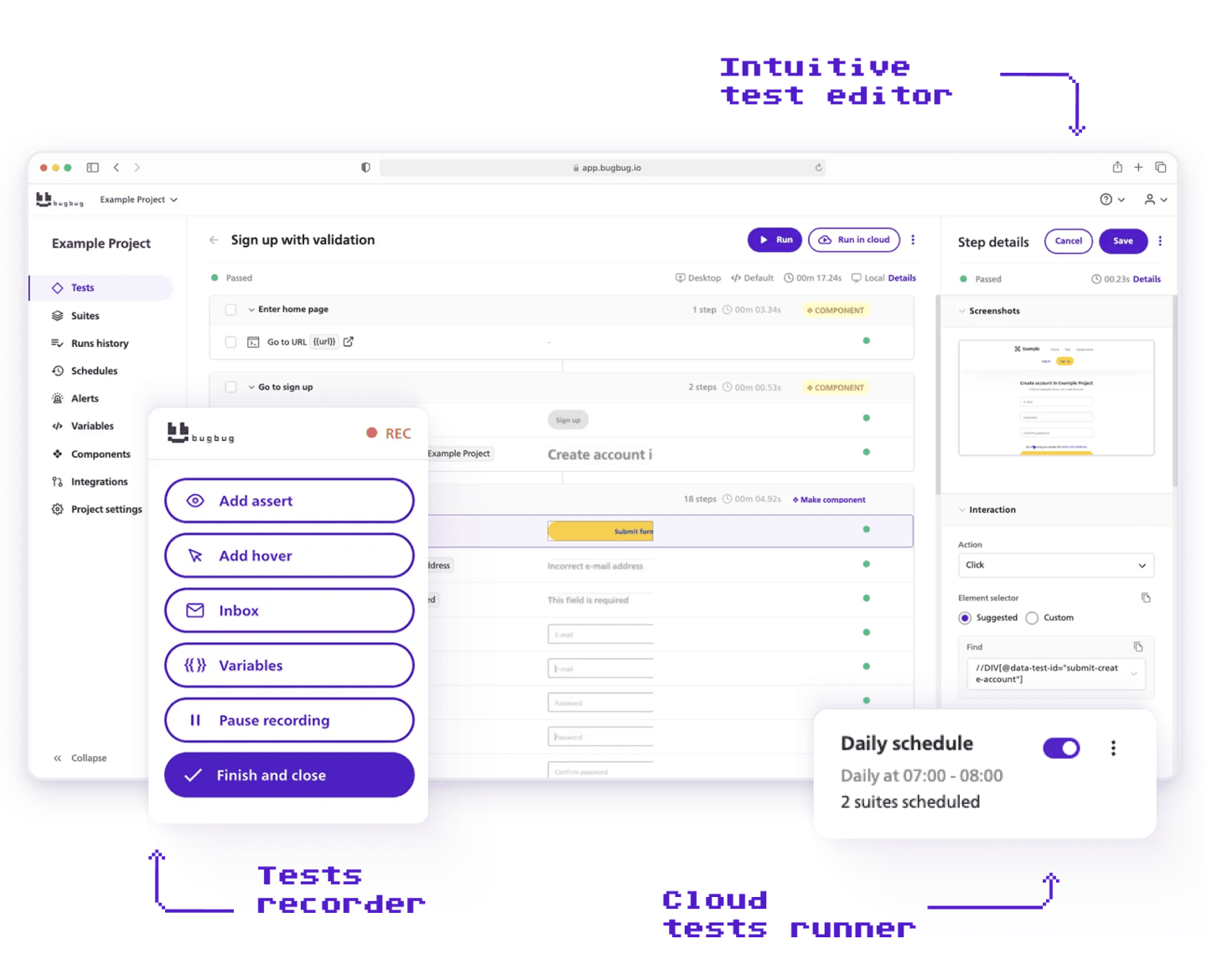
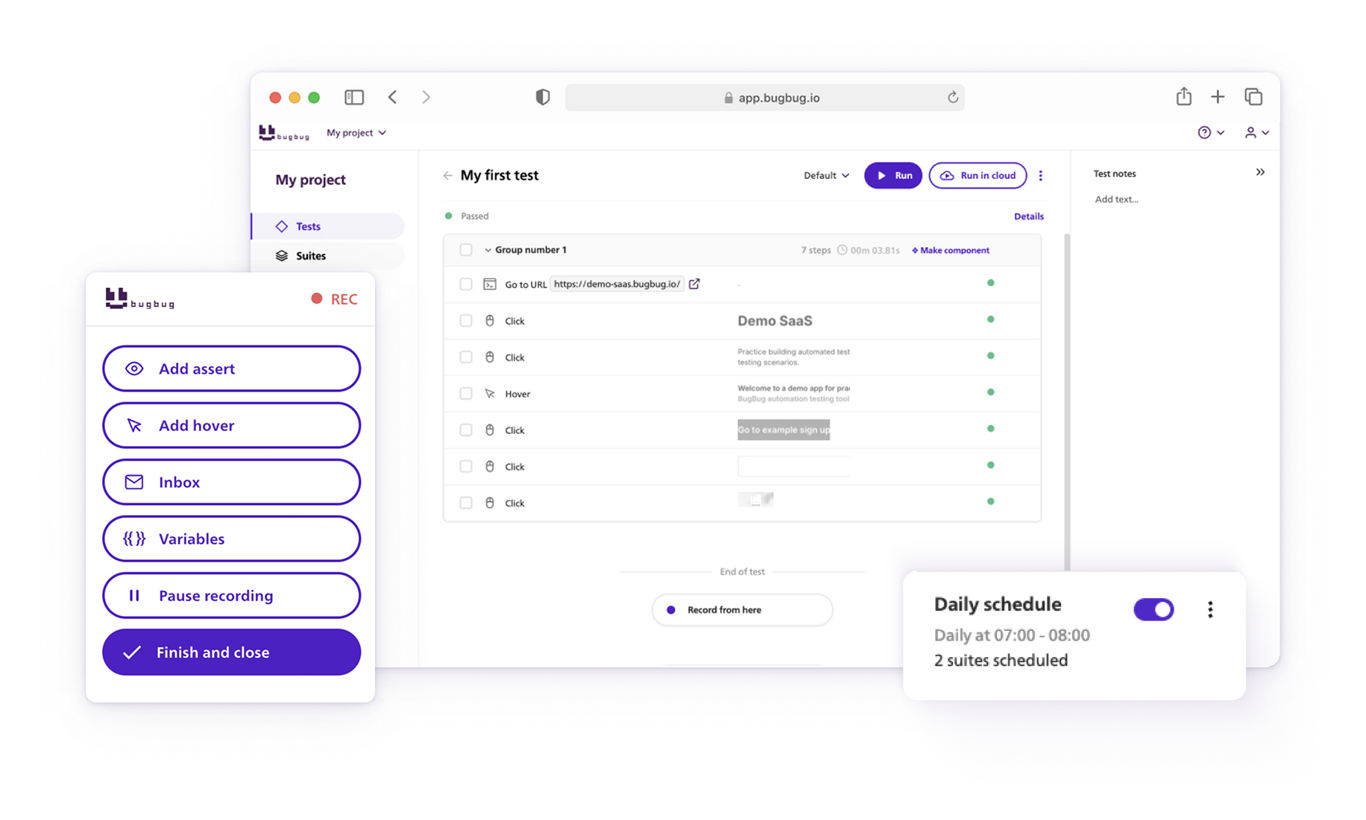
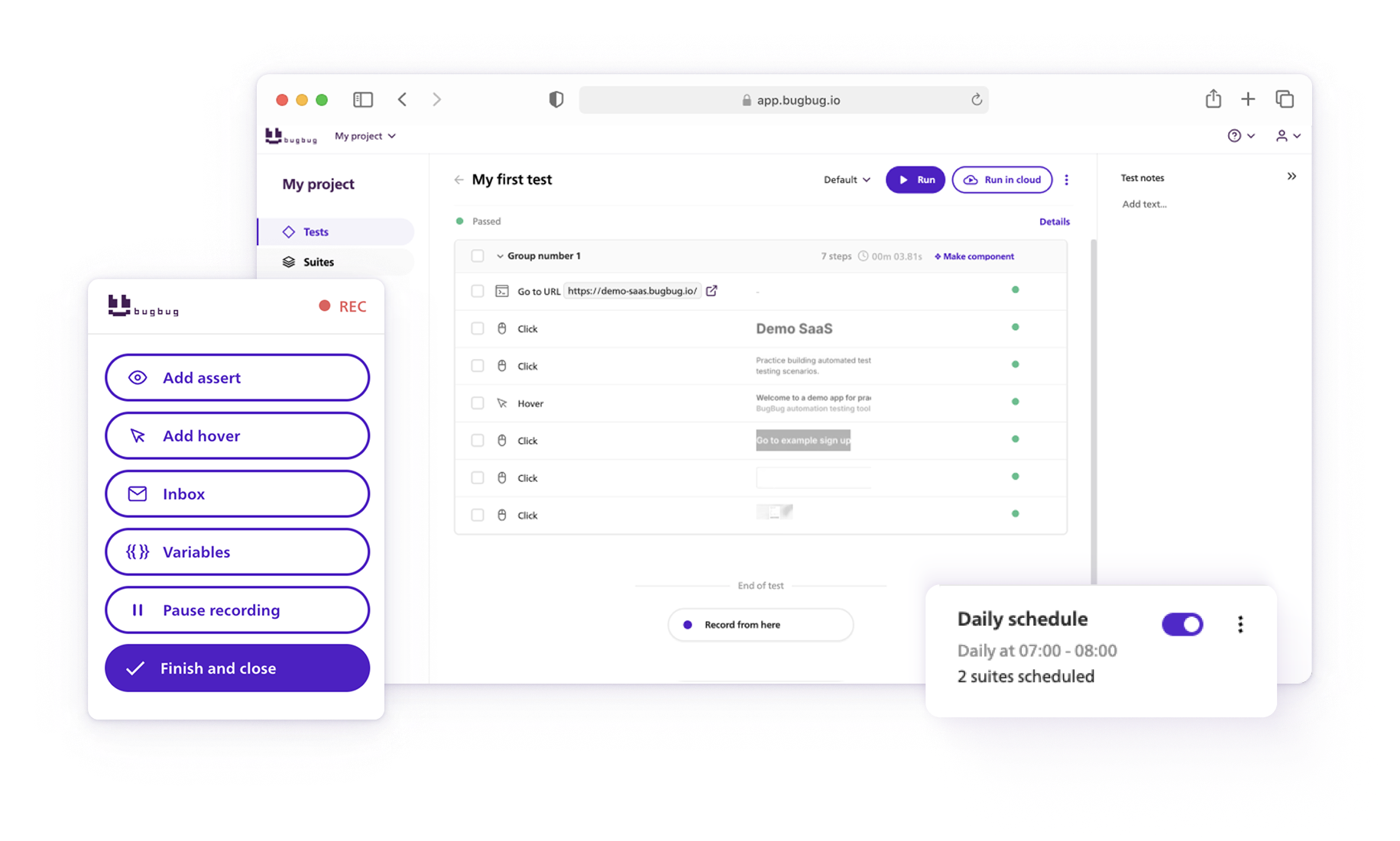
What it does inside that scope: you record a test by clicking through your app in a Chrome extension, and BugBug builds the steps automatically — real browser execution and real typing, not JavaScript simulation. That's the web test recorder model, and it's why a non-engineer can produce a working test at all. Edit & Rewind lets you insert a step in the middle of a 40-step checkout flow and rerun from that point instead of re-recording the whole thing. Built-in email testing via bugbug-inbox.com covers signup and password-reset flows, which is where most homegrown suites quietly stop. Tests run locally or in the cloud, so there's no grid, no Docker, and no VMs. Pricing is published, and paid plans include unlimited users — no seat meter.
Why it fits a Perfecto exit specifically: it's built for reason five. The manual tester who runs the same 30-step release checklist every sprint, and the support specialist who has reproduced the same billing bug four times, already know exactly what should be automated. In BugBug they can build and maintain those tests themselves — no ticket to engineering, no framework to learn, no runners to keep alive. A larger or cheaper device cloud does nothing about that.
And the tests don't stay locked in the recorder. This is usually where visual tools lose the engineering vote: someone asks "how do we review what QA built?" and there's no answer. BugBug exports tests to YAML — readable, diffable, reviewable in a pull request — and the BugBug MCP server lets an AI coding agent in Cursor or Claude Code discover and run your suites directly. The tester records it. The developer reads it in a diff. The agent runs it in CI. Same artifact, three hands.
Verdict: worth splitting out if your web regression is owned — or should be owned — by manual QA, support, or product, and nobody is going to build and maintain a Playwright stack.
Pcloudy and the other device-cloud switch pages are legitimate products but position almost identically to BrowserStack — including them would be padding, not curation. Katalon is worth a look if you want codeless and code in one IDE, but its per-user pricing gets awkward fast on a growing team. And the 40-tool roundups you'll find on this keyword aren't shortlists; they're inventories.
Match the tool to your exit reason, not to the feature grid:
One thing worth saying plainly: if you're leaving Perfecto because of slow device response or queue times, confirm that's a platform problem and not a plan problem before you migrate. Renegotiating device allocation is cheaper than a six-month tooling migration, and a fair number of teams discover the constraint follows them.
If you land in either of those last two buckets, BugBug's free plan gives you unlimited tests and unlimited users with no credit card. Pick the one browser flow your team checks by hand before every release, have the person who runs that check record it, and see whether it survives your next deploy. That's a shorter evaluation than a Perfecto renewal cycle — and it tests the thing that actually matters, which is whether the people who own quality can own the tests.
Happy (automated) testing!
Your next release. Properly tested.
Join 1,200+ QA teams that automated their regression coverage with BugBug.

Dominik Szahidewicz is a Software Quality Evangelist specialising in quality assurance, test automation, and modern software testing practices. He creates practical, research-driven content that helps QA professionals, developers, and product teams improve test coverage, automate repetitive testing, and release more reliable web applications.
Drawing on his experience in technical writing, data analysis, and application consulting, Dominik translates complex testing concepts into clear, actionable guidance. His areas of interest include end-to-end testing, no-code test automation, regression testing, and the use of AI in software quality assurance.

Senior software engineer at BugBug, where he's spent 6 years helping shape the product. He's a T-shaped developer skilled in frontend with React and TypeScript, browser extensions, backend work, and building AI agents and tooling. His strengths also include UX instincts, a product-minded approach, and process automation.
Join thousands of QA experts. Subscribe to our newsletter.
Get more testing tips and product related content. Zero spam.
MuukTest runs ~$7,000/mo. We compared 5 alternatives on price, portability and one question none of them want you to ask: who owns your tests?
Discover the essential QA tester skills for 2026! Learn the technical and soft skills required to excel as a QA Tester.
Learn how to automate regression testing without devs or QA. Discover a risk-based strategy and practical workflows.
Your tests can now move in and out of BugBug as YAML. Export a complete project as ZIP for backup. Import tests back into BugBug when you need them.
Discover essential business tools for startups. Read the article to find the right tools for your success.
Learn how to identify and fix test failures with this complete guide on what to do when your test fails.