- What Problem Did No-Code Platforms Actually Solve?
- What Is “Vibe Coding” and Why Is It So Compelling?
- The Case for AI Replacing No-Code
- What This Means for Software Testing
- Why AI Alone Breaks Down in Real Applications
- This Is Not About AI vs No-Code — It’s About Control
- The Emerging Middle Ground: AI-Enhanced No-Code
- What This Means for QA and Testing Workflows
- The Real Skill Shift: From Writing Code to Owning Systems
- So, Will AI Replace No-Code?
- Conclusion: Structured Speed Is the Endgame
With tools like Cursor, Claude, and Replit, you can describe an application in plain English and watch a working system appear in minutes. No UI builders. No workflows. Just prompts and output. Unsurprisingly, this has led to a loud conclusion: no-code is dead.
That conclusion mistakes speed for software.
The market for AI-powered no-code platforms is projected to experience rapid growth. AI has radically changed how fast applications can be generated, demonstrating AI's impact on software development processes by automating tasks and accelerating workflows. What it hasn’t changed is why no-code platforms existed in the first place. The original problem wasn’t syntax—it was ownership, iteration, and maintainability in teams that couldn’t afford uncontrolled complexity.
So the real question isn’t whether AI can build software without code. It can. The real question is whether AI can replace the structure, control, and shared understanding that no-code platforms were designed to provide.
To answer that, we need to revisit what no-code actually solved—before “vibe coding” entered the picture.
Check also:
What Problem Did No-Code Platforms Actually Solve?
No-code didn’t emerge because writing code was too hard.
It emerged because shipping software safely was too expensive, too slow, and too dependent on scarce engineering time. In startups and lean teams, the bottleneck was rarely ideas—it was the ability to turn those ideas into working systems and keep them alive.
No-code addressed this by introducing abstraction with structure. This created an abstraction layer that allowed both technical and non-technical users to build applications without dealing with low-level code, paving the way for more accessible software development.
Instead of bespoke codebases, teams got:
- Visual models of logic and data flow, enabling visual development through intuitive drag and drop components
- Opinionated building blocks with predictable behavior
- Constraints that made systems understandable beyond the original author
This wasn’t about avoiding code. It was about reducing accidental complexity—the kind that accumulates when every solution starts from scratch.
Just as importantly, no-code made software legible. A teammate could open an app and see how it worked. When something broke, the system wasn’t a black box—it was inspectable. That legibility is why no-code development and low code tools have become central to this evolution, spreading into operations, QA workflows, and internal tooling.
Speed mattered—but ownership mattered more.
What Is “Vibe Coding” and Why Is It So Compelling?
“Vibe coding” describes building software by describing intent in natural language and letting an AI generate the implementation.
Instead of assembling workflows or logic step by step, you explain what you want—“a dashboard showing recent signups with churn alerts”—and the AI produces something that works.
The appeal is obvious:
- No setup
- No learning curve
- Near-instant results
App builders play a key role here, enabling rapid prototyping and allowing users to quickly move from idea to working application. AI integrations in app builders further enhance user experiences by streamlining development, reducing repetitive manual tasks, and empowering non-developers to create more user-centric applications efficiently. For prototypes and experiments, it feels magical. People who openly say they “cannot code” are producing functional systems in minutes, often leveraging code based approaches where AI can write code for them automatically. To many, this feels like no-code—just faster and freer.
That’s why some argue no-code is obsolete. If AI can translate intent directly into software, why bother with visual builders?
The answer lies in what happens after the first demo.
Vibe coding optimizes for creation, not continuation. AI coding tools and code tools enable rapid prototyping and app creation, delivering results quickly. However, it rarely produces systems humans can reliably reason about later. There’s no shared model, no enforced structure, and often no durable representation of intent.
It feels like no-code—but behaves very differently once software has to evolve.
The Case for AI Replacing No-Code
From a distance, the replacement argument is persuasive.
Software history is a story of rising abstraction, from assembly to high-level languages, to visual programming, to no-code and low-code platforms. The key differences between AI powered development and traditional low code platforms lie in how advanced AI tools and AI features automate coding tasks, understand natural language, and enhance scalability and performance, rather than just simplifying interfaces. For example, Microsoft’s Power Platform is a code platform that integrates AI to accelerate development, accelerate app creation, and orchestrate AI agents for enterprise solutions.
AI-powered development not only speeds up processes but also leverages smart algorithms trained on large datasets to understand programming and provide helpful suggestions. Additionally, AI tools excel at automation, complex computation, and data analysis, further enhancing the capabilities of low-code and no-code platforms.
But the argument is also incomplete.
AI as the Next Layer of Abstraction
Software history is a story of rising abstraction: assembly to high-level languages, frameworks, visual builders. Natural language feels like the final step. Why learn tool-specific models when you can just explain what you want?
In this framing, no-code looks like an awkward middle layer. AI promises a universal interface—plain English—while visual builders still require users to learn constraints and metaphors.
Some argue traditional coding becomes a niche skill, reserved for edge cases and infrastructure, much like assembly today. Everyone else just defines outcomes.
Speed, Accessibility, and Radical Predictions
And the results are real. Non-technical founders are shipping tools. Designers are building real functionality. MVPs appear in days.
This has led to bold claims—most notably that no-code and low-code will disappear entirely, replaced by AI agents that take goals as input and output working systems.
For disposable software, that argument holds. If the application doesn’t need to live long, understanding is optional.
But most software doesn’t stay disposable.
What This Means for Software Testing
Software testing is where AI-first, prompt-only development tends to break first.
Tests must be deterministic, readable, and easy to fix when something changes. When a test fails, teams need to understand why—not renegotiate intent with an AI through another prompt.
AI can generate test scripts quickly, but without a clear, human-readable structure, those tests degrade fast. Small UI changes cause cascading failures. Flakiness appears. Debugging turns into guesswork because no one fully understands the generated logic.
That’s why structured test automation still matters.
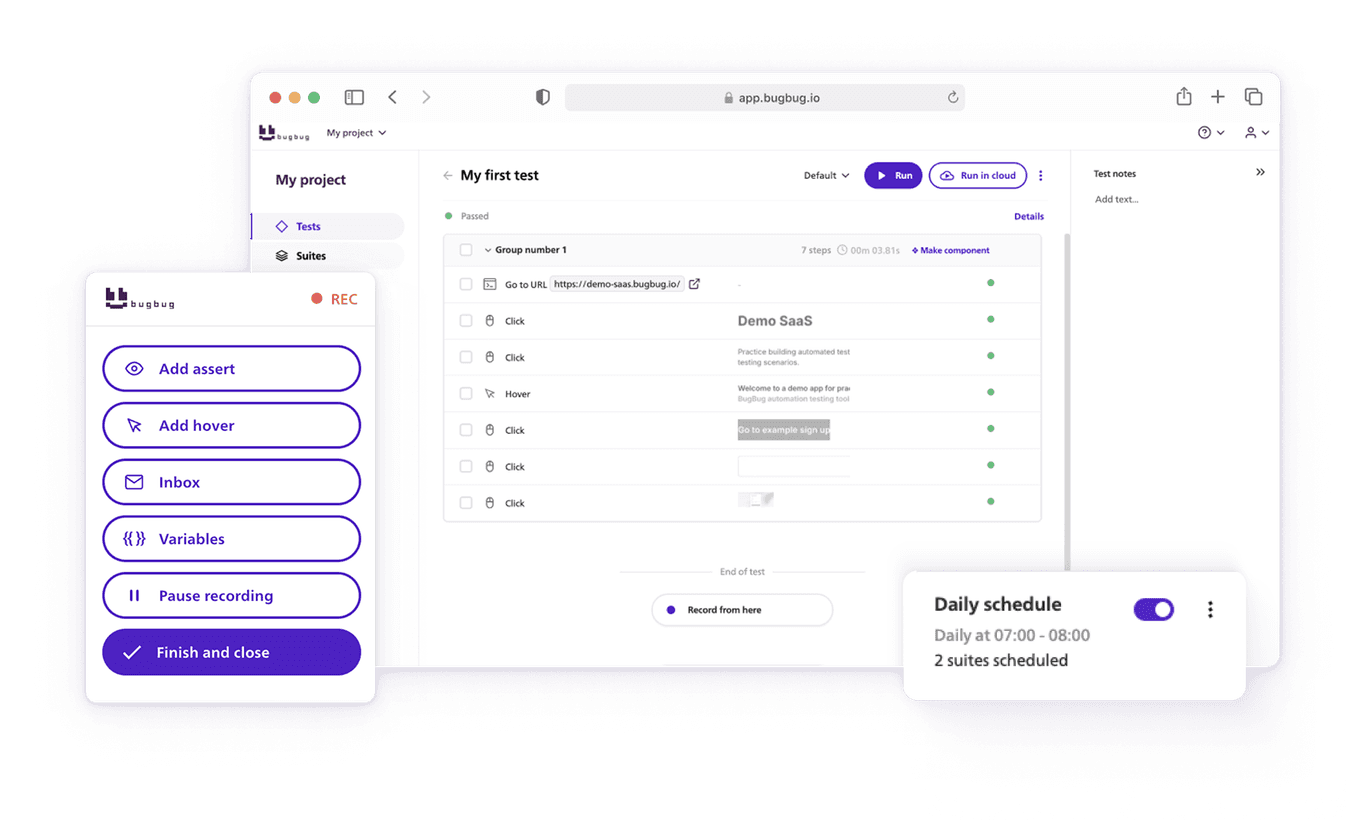
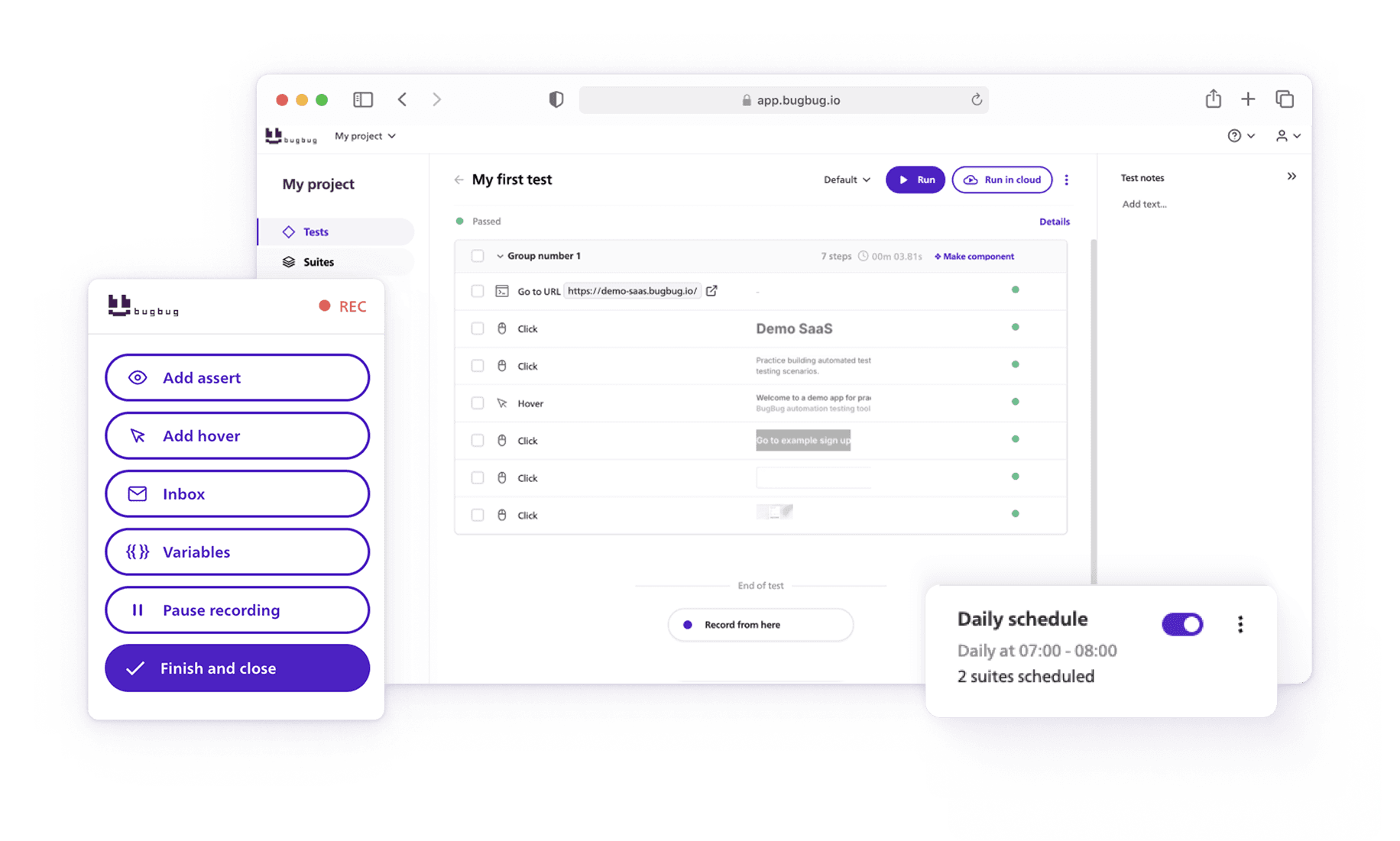
Tools like BugBug deliberately avoid hiding test logic behind opaque AI output. Test flows remain step-based and readable, so when something breaks, you can inspect the test, update a step, and move on. The system stays understandable to the whole team—not just to the AI that generated it.
AI still has a role in testing, but as an accelerator, not the owner. It can help with setup, selector suggestions, or generating initial steps. What it shouldn’t replace is the maintainable structure that QA teams rely on over time.
In testing especially, opacity isn’t innovation. It’s technical debt.
Why AI Alone Breaks Down in Real Applications
Building complex applications presents unique challenges, especially when it comes to maintaining app performance as user demands and data volumes grow. As organizations look to streamline app development, questions arise about whether AI will replace no-code platforms, particularly for projects that require advanced features and scalability.
5.1 Lack of Structure
Once software needs to survive real usage, AI-first development hits predictable limits. Without a clear structure, it becomes difficult to maintain, debug, and scale complex projects. This lack of structure can negatively impact developer productivity and improving developer productivity, as teams spend more time managing technical debt and less time on strategic tasks.
5.2 Long-Term Maintenance
AI-generated code may work for simple prototypes, but long-term app development requires robust architecture and the ability to add advanced features for complex projects. Relying solely on AI can increase development time when scaling or customizing solutions, especially for organizations that need to create custom apps tailored to specific workflows. For long-term success, the ability to build and maintain custom apps is crucial, as it ensures flexibility and adaptability as business needs evolve.
The “Immediate Orphan Code” Problem
Pure vibe coding often produces orphan code on day one.
The AI writes the system. The human who requested it cannot read or reason about it. When something breaks, the only option is to ask the AI again—without fully understanding what changed.
Over time, intent erodes. Each prompt subtly reinterprets requirements. The system works—until it doesn’t—and no one knows why.
Traditional no-code avoided this by making systems visible. Even without coding skills, users could see workflows, conditions, and data models. AI-generated code often removes that shared mental model entirely.
Production Reality: Bugs, Debt, and Fragility
AI-generated code also lacks judgment.
Models predict plausible solutions; they don’t design resilient ones. Edge cases, security, and long-term performance are afterthoughts unless explicitly—and expertly—guided.
For experienced engineers, this is manageable. AI becomes a fast pair programmer. For teams relying on AI instead of structure, technical debt compounds quickly. Each iteration makes the system harder to understand, not easier.
Speed turns into risk.
This Is Not About AI vs No-Code — It’s About Control
The debate isn’t really about tools. It’s about ownership.
Speed matters once. Control matters forever.
Teams need to answer questions like:
- Why does this behave this way?
- What breaks if we change this?
- Who can safely modify it?
AI and no-code platforms are allowing developers to focus on more strategic work, such as designing features and aligning applications with business goals, by automating repetitive tasks.
Opaque systems—no matter how fast they were created—fail these tests. This is why verbosity is often safer than elegance, and why enterprises care about governance, auditability, and explainability.
Technical expertise remains essential for building scalable, secure solutions and for effective collaboration between business users and software developers. The ongoing role of professional developers is critical, as these platforms are designed to complement—not replace—the skills and oversight that experienced software developers bring to complex projects.
No-code survived because it traded some freedom for shared understanding. AI challenges that trade-off—but doesn’t eliminate the need for it.
The Emerging Middle Ground: AI-Enhanced No-Code
AI is not replacing no-code; instead, it is being absorbed into no code tools and low code platforms, enhancing their capabilities and unlocking endless possibilities for users and businesses. Rather than making no-code obsolete, AI enhances these platforms by streamlining workflows, automating repetitive tasks, and making it easier for non-technical users to participate in software creation.
7.1 The Hybrid Model: AI-Enhanced No-Code
The future is a hybrid model where AI tools are integrated into no-code and low-code platforms, allowing for more efficient and scalable visual development. This combination leverages the strengths of both approaches, enabling users to automate complex processes while maintaining control and transparency.
7.2 Empowering Users, Not Replacing Them
App builders and no code solutions are empowering citizen developers to create apps and build apps without deep technical expertise. These platforms enable a broader range of users to participate in digital transformation, making it possible for anyone to contribute to innovation and business growth.
AI as a Feature, Not a Platform
The most durable pattern is AI generating structured artifacts, not raw software. Prompts accelerate creation, but the system itself remains the source of truth.
Humans can inspect, adjust, and evolve what the AI produces. Ownership is preserved.
Bubble’s “Vibe-Code Killer” Approach
Bubble exemplifies this hybrid model.
Its AI builds applications using productionized building blocks and expresses the result in Bubble’s visual language. Users can see what was created, understand it, and fix mistakes directly.
This avoids orphan code. The AI accelerates building, but the platform preserves control.
Governed Abstraction at Scale
Enterprise platforms follow the same logic. AI assists with modeling and requirements, but feeds into governed systems with permissions, audits, and constraints.
As AI grows more powerful, abstraction layers become more—not less—important.
What This Means for QA and Testing Workflows
Testing exposes AI’s weaknesses quickly.
Tests demand determinism and clarity. When a test fails, teams need to understand why—not renegotiate intent through prompts.
AI-generated test logic often works initially, then degrades. Small changes cause unexpected failures. Debugging becomes guesswork when no one understands the underlying structure.
This is why structured, visual automation still matters in QA. AI can help generate steps or selectors, but the final representation must be something humans can reason about. AI features and tool use can enhance app creation and app performance by improving scalability and efficiency, but maintaining clarity in test logic is essential for reliable QA workflows.
In testing, opacity isn’t innovation—it’s a liability.
The Real Skill Shift: From Writing Code to Owning Systems
Syntax is no longer the differentiator. Ownership is.
The valuable skills now are:
- Defining intent clearly
- Validating behavior
- Spotting incorrect assumptions
- Knowing what not to automate
With the rise of no-code and low-code developer tools, non technical users can now participate in code development without needing to require technical skills. These platforms make it possible for a broader audience to build and automate solutions, bridging the gap between technical and non-technical team members. However, relying solely on generic applications often leads to limitations, making tailored solutions through customizable platforms increasingly important.
Prompting without system thinking just produces faster confusion. The builders who thrive will blend product sense, technical literacy, and judgment—regardless of whether the tool is code, no-code, or AI-assisted.
So, Will AI Replace No-Code?
Survey data shows that nearly one third of tech leaders cite increased flexibility in creating custom apps as their primary reason for adopting low-code and no-code tools. The rise of ai apps is making it easier for non-technical users to create apps quickly, leveraging visual interfaces and AI-assisted tools. However, when choosing a no-code or AI platform, teams should be aware of the risk of vendor lock in, as some platforms restrict access to source code and make switching providers difficult.
AI wins for:
- Prototypes
- Experiments
- Disposable tools
AI-enhanced no-code wins for:
- Long-lived systems
- Team collaboration
- QA, governance, and maintenance
The future isn’t prompt-only development. It’s structured speed.
Conclusion: Structured Speed Is the Endgame
AI without structure creates chaos.
Structure without AI becomes slow.
The platforms that win will combine:
- AI-driven acceleration
- Clear, inspectable models
- Human ownership
No-code isn’t being replaced. It’s being forced to mature.
And that’s good news for anyone who has to live with the software after the first prompt succeeds.
Happy (automated) testing!