🤖 Summarize this article with AI:
💬 ChatGPT 🔍 Perplexity 💥 Claude 🐦 Grok 🔮 Google AI Mode
Outsourcing QA sounds like a fast solution. And for some teams, it is. But a lot of companies pay $30,000–$150,000 a year for an automation testing partner when what they actually needed was a clear process and the right internal tooling.
This article covers both: the software testing companies worth considering, and an honest framework for deciding whether outsourcing is the right call in the first place.
- Should You Outsource QA — or Own It?
- What Automation Testing Companies Actually Do
- How to Evaluate a Software Testing Company
- Quick Comparison: Top 7 Automation Testing Companies
- The 7 Companies Worth Considering
- 1. QualityLogic — Best for US Enterprises With Compliance or Accessibility Requirements
- 2. Testlio — Best for Teams That Need Surge Capacity and Real Device Coverage
- 3. QA Wolf — Best for SaaS Teams Who Want Guaranteed Coverage and Full Code Ownership
- 4. ImpactQA — Best for Healthcare, E-Commerce, and BFSI Teams Needing 24/7 Coverage
- 5. Testrig Technologies — Best for Product Teams With Specialized Technical Requirements
- 6. ScienceSoft — Best for Enterprises Bundling QA Into a Broader IT Transformation
- 7. QA Mentor — Best for Budget-Conscious Teams Needing Broad Service Coverage
- Which Testing Company — or Approach — Is Right for You?
- Honorable Mentions
Check also:
Should You Outsource QA — or Own It?
Before evaluating vendors, answer this: why are you outsourcing?
If the answer is "we don't have quality assurance expertise in-house and don't want to build it" — outsourcing makes sense. If the answer is "automation testing feels complicated and we don't know where to start" — you may be about to spend a lot of money solving a tooling problem.
Most SaaS teams don't need a software testing company. They need a way to protect their critical flows — login, checkout, onboarding — without building and maintaining complex automation frameworks from scratch. That's a different problem with a much cheaper solution.
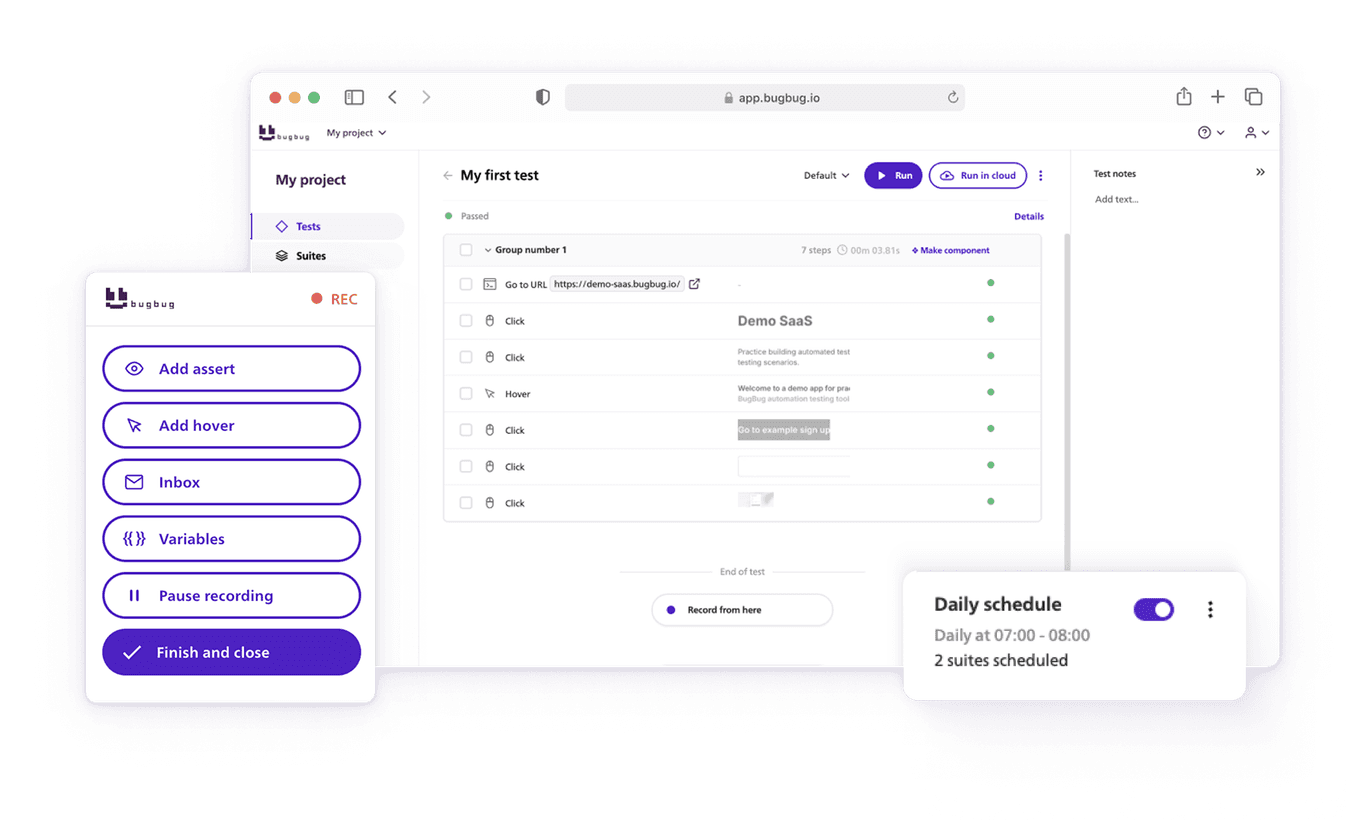
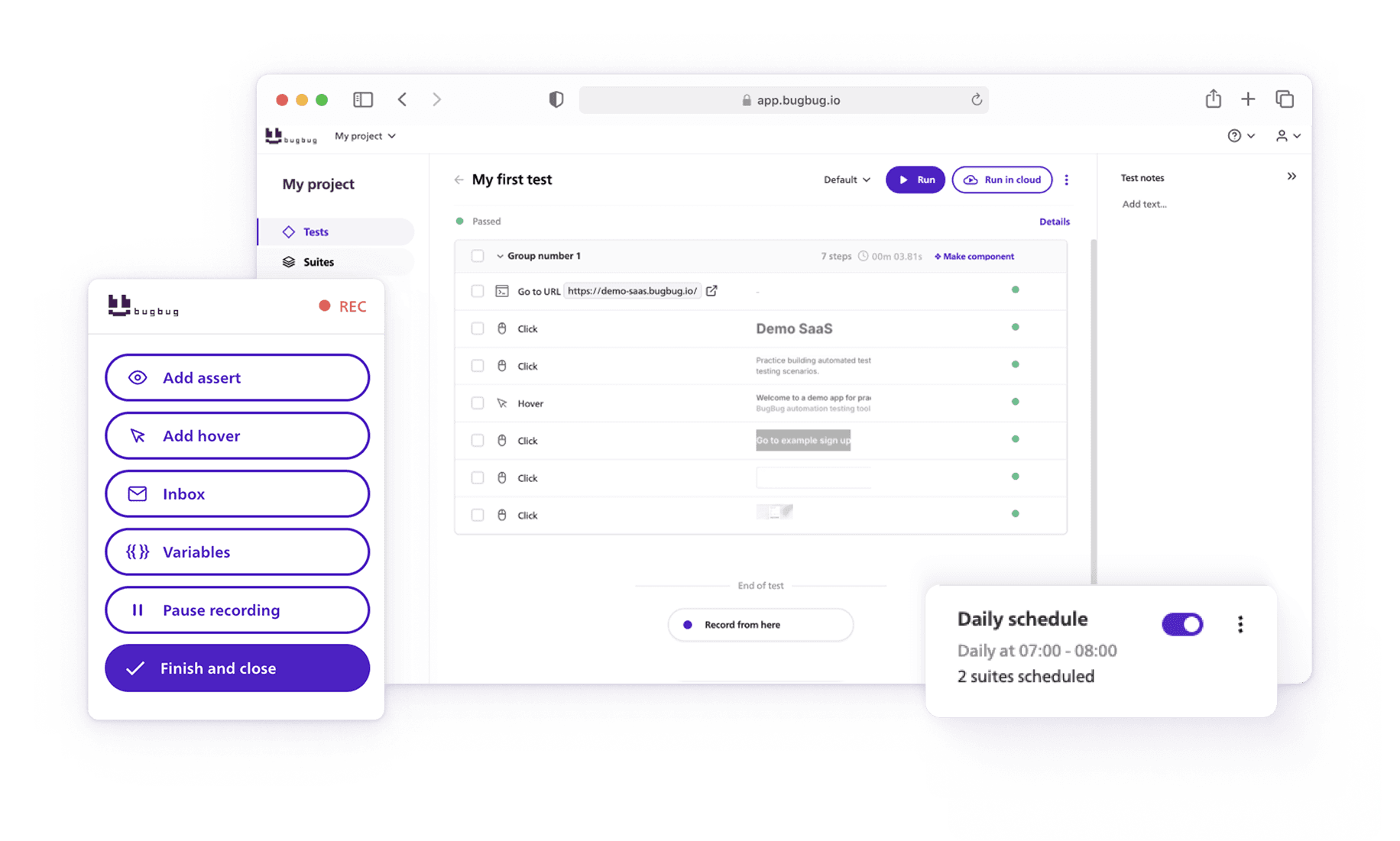
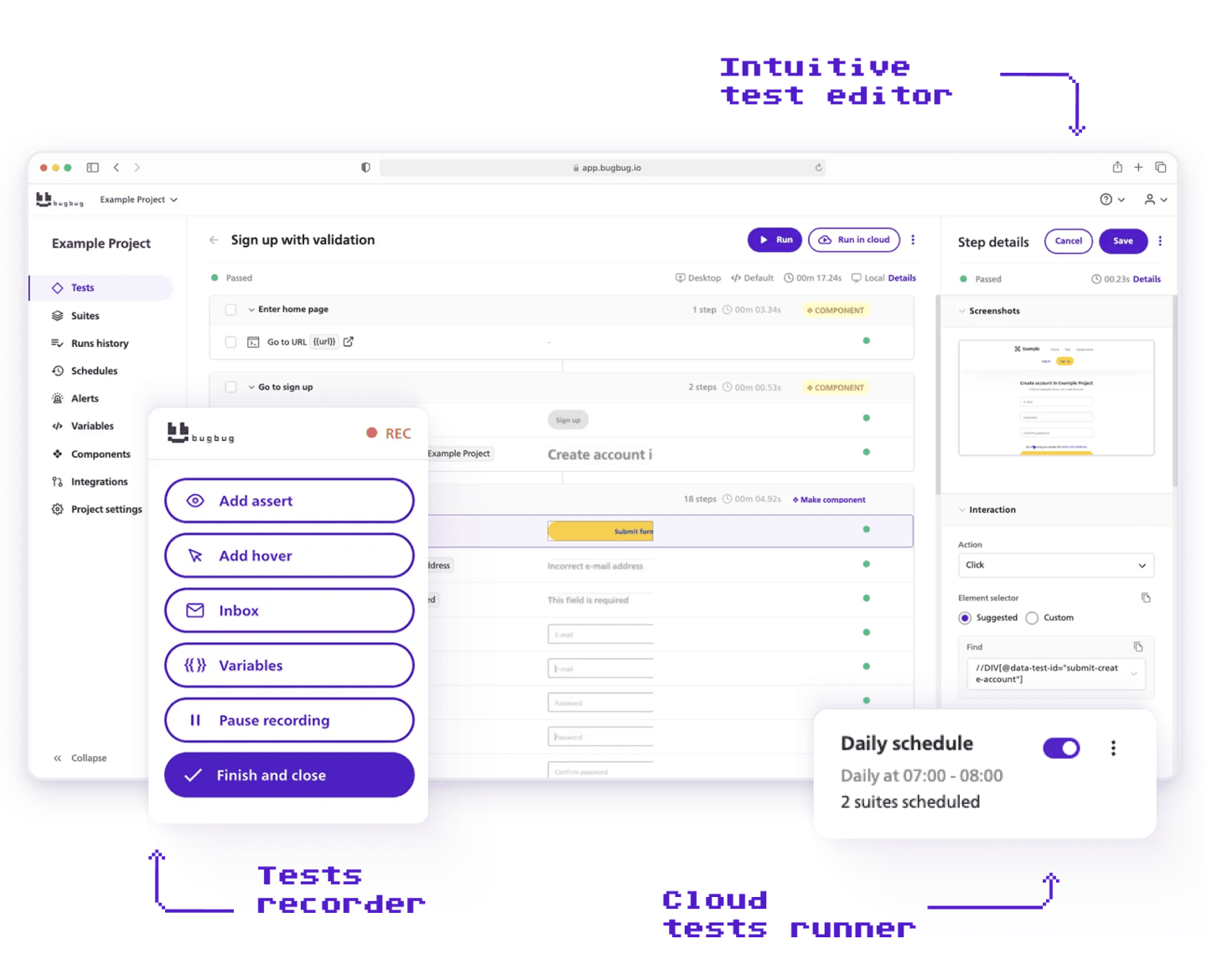
Tools like BugBug let non-technical QA testers and developers write tests and run tests against their web application without writing code, without infrastructure, and without an automation testing partner. The free plan gets your first automated functional testing suite running in under 10 minutes.
If you've evaluated that and still need a qa partner — because of scale, compliance requirements, cross device testing coverage, or specialized technical expertise — read on.
Automate tests with BugBug
Test easier than ever with BugBug test recorder. Faster than coding. Free forever.
Get started
What Automation Testing Companies Actually Do
Automation testing companies provide outsourced qa testing services: they build, run, and maintain automated tests on your software so your development team doesn't have to. They range from fully managed providers who own your entire testing process to staff augmentation firms who embed dedicated qa teams directly into your workflows.
The global test automation market now exceeds $50 billion annually, driven by intelligent automation and the increasing complexity of cloud-native applications. According to Gartner, 70% of enterprises outsource at least part of their qa automation — primarily to achieve faster time-to-market without expanding headcount.
The business case for outsourced automated testing services is real when:
- Your product requires compliance testing (HIPAA, PCI-DSS, SOC 2) demanding specialist knowledge your internal team doesn't have
- You need cross platform testing and cross device testing coverage across thousands of device and OS combinations for mobile applications
- You're scaling faster than your internal qa testers can keep pace with
- You need surge capacity around major releases or seasonal traffic spikes that would overwhelm a small in-house team
The case is weaker when your primary need is functional testing and regression coverage on a web application — and you haven't found the right automation testing tools yet.
How to Evaluate a Software Testing Company
Not all qa testing services are equal. Before comparing names, define what you're actually buying.
Technical expertise and technology stack compatibility: Do they have genuine depth in your stack — not just checkbox familiarity? Selenium is still the most common of the automation frameworks at 65% industry adoption, but Playwright has grown to 25% for cross-browser reliability. Ask specifically how they'd approach your application testing services requirements and what technical capabilities they bring to your stack.
Industry and domain knowledge: Teams in regulated industries need a right automation testing partner with compliance frameworks already built. A generalist software testing company can take months to develop domain knowledge that a specialist already has — and in healthcare or fintech, that gap costs real money.
Pricing model and test management clarity: Fixed-price works for well-defined test cases and stable applications. Time-and-materials suits exploratory testing or rapidly evolving products. Pay-per-cycle models offer flexibility for unpredictable volume. Get total cost of ownership — not just hourly rates — and confirm how test data and test management are handled throughout the engagement.
Code and asset ownership: Will you own the test cases and automation frameworks at the end? A vendor who holds your automated testing system hostage creates long-term lock-in that's expensive to exit.
Integration into your development process: The right automation testing partner integrates with your existing continuous integration setup — GitHub Actions, Jenkins, GitLab — without creating new bottlenecks in your software development cycle.
Quick Comparison: Top 7 Automation Testing Companies
| Company | Best For | Pricing | Key Differentiator |
|---|---|---|---|
| QualityLogic | US enterprise, accessibility | $100–150/hr | US-only delivery, WCAG expertise |
| Testlio | Crowdsourced, device coverage | $0.50/test min | 20,000+ testers, 5,000+ real devices |
| QA Wolf | Coverage guarantee, code ownership | $10k–50k setup | 80% coverage guarantee, Playwright-native |
| ImpactQA | Healthcare, e-commerce, 24/7 | $35–100/hr | Compliance expertise, global redundancy |
| Testrig Technologies | Custom frameworks, emerging tech | Custom | AI/ML and blockchain testing |
| ScienceSoft | IT consulting + QA bundled | $50–80/hr | Cybersecurity focus, 30+ years experience |
| QA Mentor | Budget-conscious, broad coverage | $30–50/hr | 30+ service types, offshore model |
The 7 Companies Worth Considering
1. QualityLogic — Best for US Enterprises With Compliance or Accessibility Requirements
Best for: US-based organizations in energy, media, or tech that require domestic delivery, data sovereignty, and deep accessibility expertise in their quality assurance programs.
QualityLogic's main differentiator is its TestNitro managed automated testing system — a cloud-based platform with AI flake detection that achieves 99% pass rates on retries. For software testing programs where failed tests and test failures create noise that erodes trust in the entire qa automation setup, that reliability matters.
Their WCAG 2.2 accessibility testing expertise is among the strongest in the market — relevant given that non-compliance fines average $75,000 per violation. If accessibility is a hard compliance requirement rather than a nice-to-have, this technical expertise is a meaningful differentiator.
Strengths: Fully US-based delivery with no offshore data handling concerns. Deep WCAG expertise spanning automated and manual testing. Proven track record across 8,000+ completed projects, with documented 60% reductions in post-release bugs for retail clients.
Limitations: Priced accordingly — $100–150/hour is 20–30% above offshore alternatives. Better suited to $100k+ annual software testing budgets. Overkill for teams whose qa testing needs are straightforward web application regression coverage.
2. Testlio — Best for Teams That Need Surge Capacity and Real Device Coverage
Best for: Commerce and media companies with unpredictable qa testing volumes or major release events requiring rapid scale-up across web and mobile applications.
Testlio's crowdsourced model — 20,000+ vetted qa testers across 150 countries — provides something no in-house dedicated qa team can easily match: cross device testing and cross platform testing coverage across 5,000+ real devices, with the ability to scale to 1 million test cycles per month. Their intelligent automation triage reduces bug duplication by 70%, which matters significantly when managing high-volume input from distributed manual testers.
The model is particularly strong for mobile app testing and mobile applications where device fragmentation makes emulator-only testing insufficient. Real users on real hardware catch test failures that automated device farms miss — especially for complex user journeys in mobile app environments.
Strengths: Unmatched cross device testing and geographic coverage. Flexible pay-per-cycle pricing. Strong track record handling traffic spikes — documented 500% surge handling without downtime. 4.9/5 on GoodFirms from Fortune 500 clients.
Limitations: Less control over individual qa tester selection — algorithms handle matching. Communication complexity across 24 time zones. Better suited for exploratory and usability testing than highly specialized technical qa automation.
3. QA Wolf — Best for SaaS Teams Who Want Guaranteed Coverage and Full Code Ownership
Best for: Mid-market SaaS companies on modern technology stacks that need rapid E2E automated functional testing coverage and want to avoid vendor lock-in.
QA Wolf's methodology uses Playwright to deliver 80%+ automated software testing coverage within weeks — backed by a money-back guarantee. More importantly, you own the test cases and automation frameworks outright. When you leave, your entire automated testing system leaves with you.
Teams using QA Wolf have reported 90% reductions in qa testing time. Their self-healing scripts maintain 98% flakiness-free runs via machine learning, directly addressing the test failures and failed tests that cause continuous testing programs to collapse quietly after launch. Their approach to managing test data and visual regression testing within the same platform also reduces the number of separate tools your team needs to maintain.
Strengths: Coverage guarantees with financial accountability. Full code ownership prevents lock-in on automation frameworks. Playwright expertise delivering significantly faster execution than Selenium-based approaches. Client-reported 5x engineering velocity gains. Strong visual testing and api testing capabilities.
Limitations: $10,000–50,000 setup fees for mid-sized suites. Rigid Playwright focus limits options for teams on Java-heavy legacy systems. Guarantees require clear scope definition before software development work begins.
4. ImpactQA — Best for Healthcare, E-Commerce, and BFSI Teams Needing 24/7 Coverage
Best for: Regulated industries requiring round-the-clock automated testing services with HIPAA, GDPR, or PCI-DSS compliance expertise already built in.
ImpactQA's global delivery across US, India, and Europe delivers genuine 24/7 continuous testing operations — not just a support ticket queue. Their intelligent automation anomaly detection identifies issues 3x faster than traditional monitoring, and their compliance frameworks reduce audit times by 50% for healthcare and financial services clients.
Pre-built industry-specific test cases — including e-commerce checkout testing workflows covering 200+ scenarios — mean you're not paying for automation framework development that already exists elsewhere. That accelerates time-to-coverage significantly compared to starting from scratch with a generalist software testing company.
Strengths: Round-the-clock availability with redundant global presence. Deep compliance expertise in HIPAA, GDPR, and PCI-DSS. Pre-built quality assurance scenarios reduce time-to-coverage. Scalable to 500+ resources for large application testing services engagements. Strong performance testing and integration testing capabilities.
Limitations: Primarily offshore model — not suitable for teams with data sovereignty requirements. Complex pricing structure with tiered rates. Multi-timezone project management adds coordination overhead.
5. Testrig Technologies — Best for Product Teams With Specialized Technical Requirements
Best for: Development teams working in AI/ML, blockchain, or other areas where generalist qa testing services lack the technical capabilities to test effectively.
Testrig's custom automation framework approach — their "TestRig Orchestrator" integrates Selenium and Appium with continuous integration pipelines for 85% coverage across web and mobile applications — is built for technical teams who need qa automation adapted to their specific technology stack, not forced into a templated system.
Having tested 50+ DeFi protocols with deep AI/ML application testing expertise, they fill a gap that traditional software testing companies consistently fail to address. Their security testing and api testing coverage alongside functional testing means fewer vendors to coordinate across your testing workflows.
Strengths: Genuinely customized automation frameworks rather than templated approaches. Clear test management reporting via Jira dashboards. Documented 60% defect reduction rates. Covers security, penetration testing, and OWASP compliance alongside automated functional testing. Strong technical expertise in cross platform testing for mobile app environments.
Limitations: Less brand recognition than larger incumbents. Smaller team size limits capacity for massive parallel testing engagements. Occasional 4–6 hour response delays from Indian delivery teams.
6. ScienceSoft — Best for Enterprises Bundling QA Into a Broader IT Transformation
Best for: Organizations where software testing is one workstream inside a larger IT modernization or ERP migration initiative — and want a single vendor with consistent technical expertise across all of it.
ScienceSoft's 30+ years and 4,000+ completed projects give them institutional depth across healthcare and financial services software development. Their security focus — ISTQB-certified teams detecting 95% of vulnerabilities pre-production — makes them a strong quality testing partner when automated software testing requirements include security assessment alongside functional and performance testing coverage.
Strengths: Holistic IT consulting beyond standalone qa testing services. Strong cybersecurity specialization that complements functional testing programs. 700+ experts available for large engagements. Hybrid onshore-offshore delivery at $50–80/hour. Documented 40% cost savings on compliance quality assurance initiatives.
Limitations: Software testing is not their primary focus — they are IT consultants first. May lack the automation testing tools depth of pure-play testing firms. Better suited to bundled engagements than teams sourcing standalone qa testing services.
7. QA Mentor — Best for Budget-Conscious Teams Needing Broad Service Coverage
Best for: Startups and mid-sized companies that need access to multiple quality testing types — performance testing, security testing, automated software testing, qa audits — at offshore pricing without committing to a premium automation testing partner.
QA Mentor's 30+ service types, 300+ resources across six countries, and $30–50/hour pricing deliver genuine breadth at competitive cost. For teams that need test management process improvement alongside test execution, their consulting capability covers both without requiring a second vendor. Their parallel testing capabilities across multiple environments also help development teams run tests faster without scaling internal infrastructure.
Strengths: Over 30 distinct qa testing services under one roof. Cost-effective offshore delivery model. Comprehensive quality assurance audits improving mean time to recovery by 50%. Multi-country delivery blending US oversight with offshore execution.
Limitations: Service quality varies across delivery locations per some client reviews. Less specialization in cutting-edge automation testing tools including AI self-healing. The cost advantage involves trade-offs in premium service depth and dedicated qa team consistency.
Which Testing Company — or Approach — Is Right for You?
Choose QualityLogic if you need premium US-based automated testing services, have a $100k+ annual quality assurance budget, and accessibility compliance is a hard requirement for your software development cycle.
Choose Testlio if you have unpredictable qa testing volumes, need real-device cross platform testing at scale across mobile applications, or face major release events where surge capacity matters.
Choose QA Wolf if your technology stack is modern, you want guaranteed automated software testing coverage fast, and code ownership of your automation frameworks matters more than the lowest hourly rate.
Choose ImpactQA if you operate in healthcare, BFSI, or e-commerce and need 24/7 continuous testing coverage with compliance quality assurance frameworks already in place.
Choose Testrig Technologies if your software development sits in AI, blockchain, or another area where specialist technical capabilities are the deciding factor over general qa testing services.
Choose ScienceSoft if software testing is one workstream in a broader IT transformation and a single quality assurance vendor across initiatives makes operational sense.
Choose QA Mentor if cost is your primary constraint and you need broad qa testing services access — including performance testing and integration testing — without premium pricing.
Consider owning it internally first if your core need is protecting web application flows — login, checkout, onboarding — and your team hasn't yet tried building that qa automation in-house. BugBug lets QA testers and developers record tests and run tests against web applications without code, without infrastructure, and without a monthly service contract. It eliminates human error from manual testing, integrates with your continuous integration pipeline, and gets your first automated functional testing suite running within a day. For small teams, it typically reduces outsourcing costs by 30% while keeping quality assurance expertise in-house where it compounds over time. Free plan, no credit card required.
Honorable Mentions
Accenture — An enterprise consulting giant with an AI-led quality engineering practice serving over 1,000 global clients. If you're already inside the Accenture ecosystem for broader transformation work, their QA capability is worth evaluating. Not a realistic option for teams outside large enterprise engagements.
Cigniti Technologies — Known for its proprietary AI-driven platform BlueSwan, which predicts defects and optimizes test coverage before failures surface in production. A strong option for data-heavy enterprises that want predictive quality assurance, not just reactive test execution.
Infosys — A global technology consulting firm headquartered in Bangalore offering end-to-end testing services alongside its broader IT practice. Similar to ScienceSoft in positioning: best when testing is one part of a larger engagement, not a standalone requirement.
TestingXperts — A multinational quality engineering firm with AI-driven QA solutions and automation-first delivery. Solid mid-market option for teams that want a dedicated automation focus without enterprise-scale pricing.
Parasoft — Primarily known for its automated testing tools rather than services, with strong coverage across continuous quality management, performance testing, and API testing. Worth evaluating if you want tooling and advisory support from the same vendor.
SmartBear Software — Based in Massachusetts, SmartBear offers automation testing tools and services focused on API testing and automated functional testing. Better known as a tooling provider than a services firm — most relevant if you're already in their ecosystem via tools like ReadyAPI or TestComplete.
KiwiQA — A multinational QA firm with a significant US presence, focused on scalable automation testing solutions. A practical mid-tier option for teams that need flexible engagement models without committing to a top-tier provider.
TestFort — A US-headquartered QA and software testing firm offering end-to-end QA support and automation strategy. Suitable for teams that need strategic QA guidance alongside execution, particularly during early automation program setup.
ThinkSys — Delivers cost-effective automation testing for web, mobile, and API applications with a focus on regression testing and functional automation. A budget-conscious alternative to the main list for teams with straightforward automation requirements.
Mindful QA — A Los Angeles-based firm offering manual testing, automated testing, API testing, and performance testing. A practical choice for US-based teams that prefer working with a smaller, accessible partner over a large offshore operation.
Appsiera — A US automation testing and QA services firm focused on full-cycle automation for web and mobile applications. Worth considering for product teams that want US-based delivery at a scale below the premium providers on the main list.
Happy (automated) testing!