# 5 MuukTest Alternatives, Honestly Ranked
Written by Paweł Bylina
Reviewed by Mariusz Wójcik
Published: 2026-08-27
Updated: 2026-08-31
\[TABLE\_OF\_CONTENTS\]
## Outsourced QA Is Still QA Nobody Owns: 5 MuukTest Alternatives, Honestly Ranked
I hired four marketing agencies and three freelancers for BugBug. All of them failed.
The problem wasn't their skills. It was that I didn't own the thing I was paying them to do. I couldn't tell them who our customer was, I hadn't nailed our positioning, and I had no idea which channel was worth scaling. So I bought hours instead of results, three times in a row, before I finally hired someone onto the team and marketing started working.
I now watch companies do the same thing with quality.
They get burned by a bad release, someone says "we need test automation," and instead of deciding who owns it internally, they buy a service. Twelve months and $84,000 later they have a test suite they can't read, maintained by people who don't work there, protecting flows nobody on the team can explain.
That's not always a mistake. Sometimes buying is genuinely right — I'll be specific about when. But if you're on this page because MuukTest quoted you around $7,000 a month and you're looking for something cheaper, cheaper isn't your question. Ownership is.
## What MuukTest Actually Gets Right
Let me be fair, because I compete in this market and it would be easy not to be.
MuukTest is a done-for-you service: their AI agents plus QA engineers build your end-to-end suite and maintain it, targeting broad coverage in roughly 8–12 weeks. Two things genuinely stand out. It exports to multiple frameworks — Selenium, Playwright, Appium, Postman — and it covers native mobile. Most alternatives on this page do neither.
If your honest situation is "we need a large suite across web, mobile and API, and nobody here is going to build it," MuukTest is a real answer and you should keep it.
The rest of this article is for everyone else.
## The Pattern I've Seen in 100+ Demo Calls
Here's the timeline I hear over and over, almost word for word:
Something breaks in production. Usually checkout, usually on a Friday. Someone says "this can't happen again, we need to automate regression." The team gets fired up and builds tests. Lots of them.
A month later: "we're safe now."
Next release, three tests fail. Nobody fixes them, because nobody was ever made responsible for fixing them. Next release, ten fail. Six weeks later the suite is red, everyone ignores it, and production breaks again.
Test automation without an owner is expensive decoration. I've said this for years and I've never seen an exception.
Buying a managed service looks like it solves this. It doesn't — it relocates it. The vendor owns test maintenance, which is real value. But someone at your company still has to own the answer to "is this test still checking the right business outcome?" And that question doesn't survive a vendor change, a contract end, or the departure of the one person who ran the relationship.
The teams that succeed with a managed service have named that owner internally. The ones who fail bought the service instead of naming them.
## The Two Questions Worth Asking Before You Look at Prices
**1\. Do the people who understand your critical flows already work here?**
Not "do we have a QA team." Do you have a support lead who can recite the ten workflows customers complain about most? A product owner who knows exactly what breaks when someone edits a subscription mid-cycle? That person is the most valuable QA asset you own, and no vendor can replace them — they can only work around them.
**2\. What happens at renewal?**
Ask every vendor on this list one thing: if we stop paying next March, what do we still have? Not "can we export the code" — of course they'll say yes. Ask who on your team will be able to read it, run it, and fix it when it breaks in April.
I had a customer ask me the reverse of this during a sales call — "will BugBug still exist in three years?" It's a fair question to ask a smaller vendor and I respect it. It's an even fairer question to ask a service you're about to make responsible for your entire regression suite.
## At a Glance
| Option | Model | Published entry price | Who maintains tests | What you keep if you leave | Native mobile |
| --- | --- | --- | --- | --- | --- |
| **MuukTest** (baseline) | Managed service | Not published (~$7,000/mo, ~500 tests) | Vendor, capped hours on base plan | Multi-framework export | Yes |
| **QA Wolf** | Managed service | ~$8,000/mo min, ~200 tests | Vendor | Playwright TypeScript | Yes (Appium) |
| **QA Guardian** | Managed service | From $3,500/mo | Vendor, uncapped under 24h SLA | Playwright export | No |
| **Bug0** | Managed service | $2,500/mo flat, to 500 flows | Vendor | Partial — exports still need their package | Not stated |
| **Rainforest QA** | No-code platform | Est. $1,500–12,000+/mo | Your team, in their editor | Nothing — no export confirmed | No |
| **BugBug** | Team-owned platform, managed execution | Free plan; flat published pricing | Your team (we run the infrastructure) | Your suite, run via CLI/API | No — Chromium only |
## QA Wolf: The One I'd Pick If I Were Buying
`{"name":"dotted-frame","children":[{"name":"dotted-frame-details","children":[{"name":"paragraph","children":[{"attributes":{"bold":true},"data":"Best for:"},{"data":" you want the service model, reliability beats price, and your suite stays under ~300 tests. "}]},{"name":"paragraph","children":[{"attributes":{"bold":true},"data":"Avoid if:"},{"data":" your coverage is going to double next year."}]},{"name":"paragraph"}]}]} **Best for:** you want the service model, reliability beats price, and your suite stays under ~300 tests. **Avoid if:** your coverage is going to double next year. `
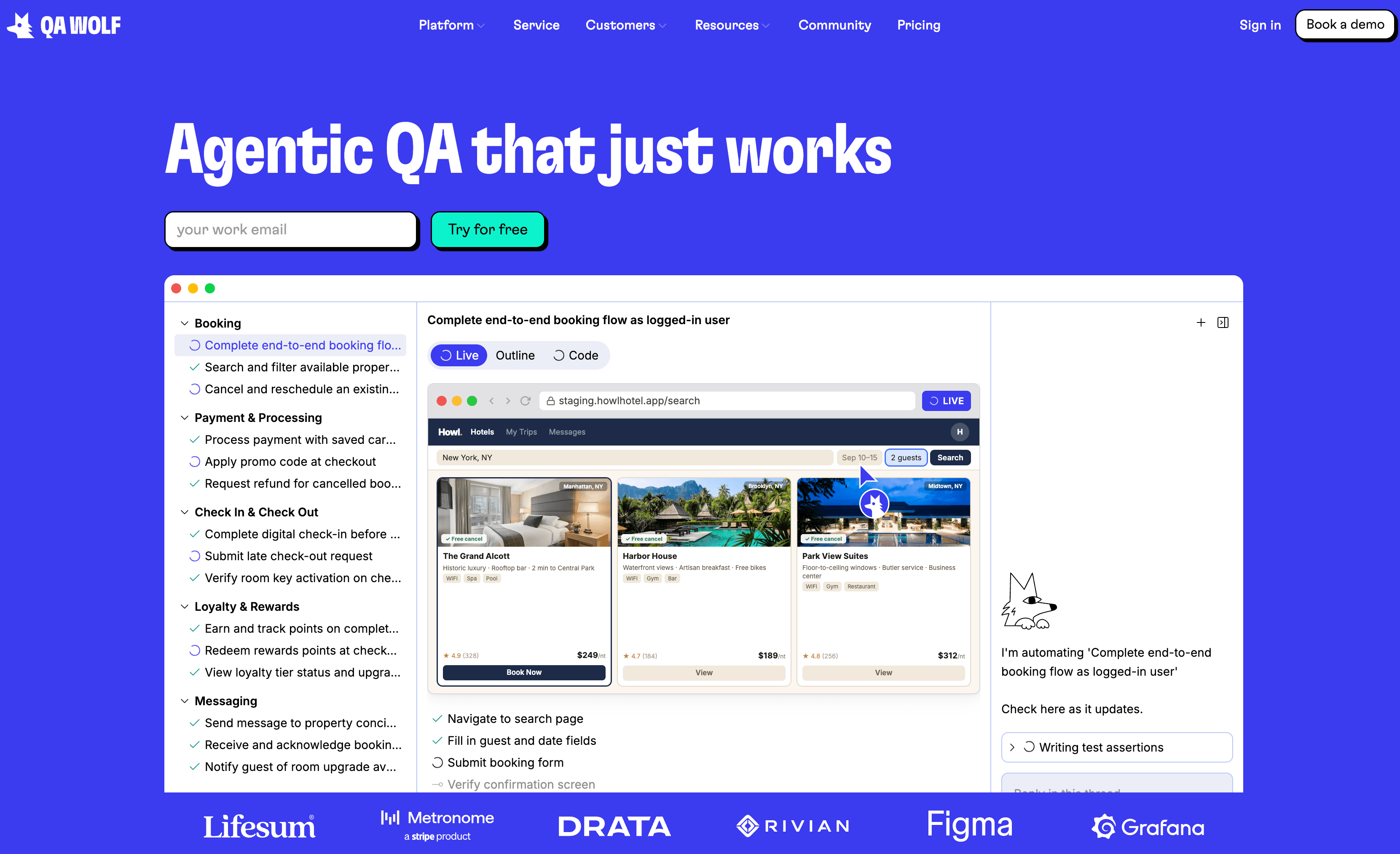
If I had budget and no intention of owning testing internally, this is where I'd go. 180+ G2 reviews at 4.8, 24/7 Slack, a zero-flake guarantee they actually staff against, and everything written in standard Playwright TypeScript — so what you're buying is portable code, not platform artefacts.
The catch is arithmetic, not quality. Roughly $8,000/mo for ~200 tests, scaling close to linearly at about $40 per test under management. Get to 500 tests and you're paying multiples of MuukTest for the same count. Their own marketing says ~80% coverage in about four months, which is slower than MuukTest's 8–12 weeks.
**Verdict:** the safest managed choice and the most expensive at scale. Buy it if you're never going to own this internally and you'd rather pay once for something that works.
## QA Guardian: Published Prices, Fewer and Bigger Tests
`{"name":"dotted-frame","children":[{"name":"dotted-frame-details","children":[{"name":"paragraph","children":[{"attributes":{"bold":true},"data":"Best for:"},{"data":" web-only teams leaving MuukTest specifically over pricing opacity. "}]},{"name":"paragraph","children":[{"attributes":{"bold":true},"data":"Avoid if:"},{"data":" you need mobile, or Selenium/Postman export."}]},{"name":"paragraph"}]}]} **Best for:** web-only teams leaving MuukTest specifically over pricing opacity. **Avoid if:** you need mobile, or Selenium/Postman export. `
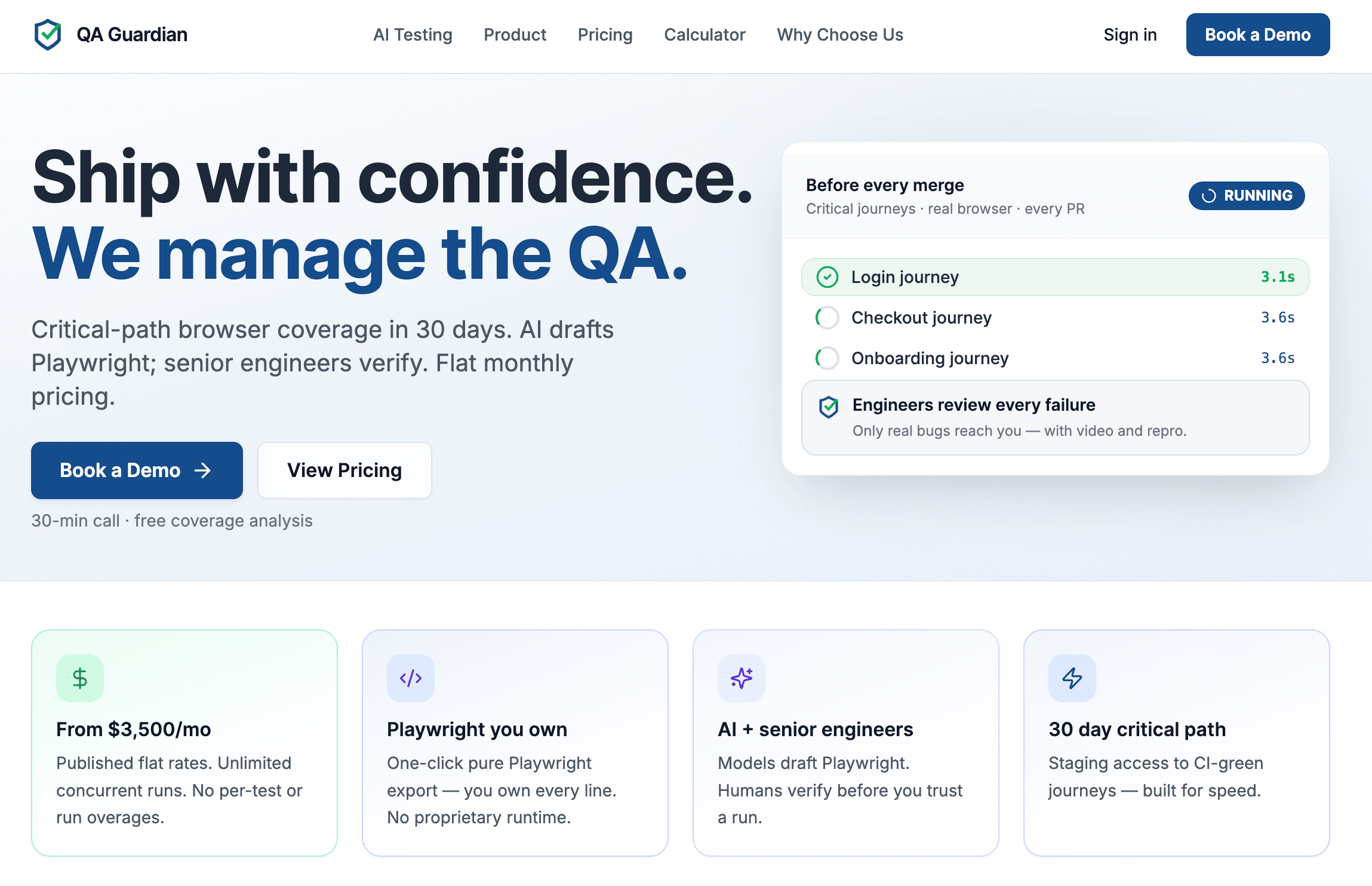
Their entire pitch attacks the per-test model: they write whole user-journey flows in Playwright and argue one flow replaces five to twelve atomic MuukTest tests. From $3,500/mo, published on the site, critical flows in CI within 30 days, uncapped maintenance under a 24-hour SLA.
Two things to know. Their scope is narrower than MuukTest's — web and Playwright only. And they're the source of most competitor pricing floating around this keyword, so read their tables knowing who wrote them.
**Verdict:** the best answer if your complaint is "I couldn't even find out what it costs" and your product runs in a browser.
## Bug0: Cheapest Way to Stay Managed, With One Gap

`{"name":"dotted-frame","children":[{"name":"dotted-frame-details","children":[{"name":"paragraph","children":[{"attributes":{"bold":true},"data":"Best for:"},{"data":" suites that fit comfortably under 500 flows. "}]},{"name":"paragraph","children":[{"attributes":{"bold":true},"data":"Avoid if:"},{"data":" you're near that cap, or you want more than one engineer on the account."}]},{"name":"paragraph"}]}]} **Best for:** suites that fit comfortably under 500 flows. **Avoid if:** you're near that cap, or you want more than one engineer on the account. `
$2,500/mo flat for up to 500 flows is the lowest published number in this category by a distance. Passmark, their test library, is [open source](https://bugbug.io/blog/test-automation-tools/open-source-automation-tools/). Cross-browser through Playwright — Chromium, Firefox, WebKit — plus SOC 2 and a HIPAA BAA.
But the entry tier gives you a single forward-deployed engineer, and the rate beyond 500 flows isn't published. Which puts you right back in the pricing uncertainty you left MuukTest to escape. Exported tests also still import their package to run, so "portable" has an asterisk on it.
**Verdict:** best price per managed flow in the category — get the over-500 rate in writing before you sign, or you've solved nothing.
## BugBug: Team-Owned Regression
`{"name":"dotted-frame","children":[{"name":"dotted-frame-details","children":[{"name":"paragraph","children":[{"attributes":{"bold":true},"data":"Best for:"},{"data":" browser-based products where regression is owned by manual QA, support or product, and there's no automation engineer to hire. "}]},{"name":"paragraph","children":[{"attributes":{"bold":true},"data":"Avoid if:"},{"data":" you need mobile or cross-browser, or you want someone else to build the suite."}]},{"name":"paragraph"}]}]} **Best for:** browser-based products where regression is owned by manual QA, support or product, and there's no automation engineer to hire. **Avoid if:** you need mobile or cross-browser, or you want someone else to build the suite. `
I built this one, so read it with suspicion.
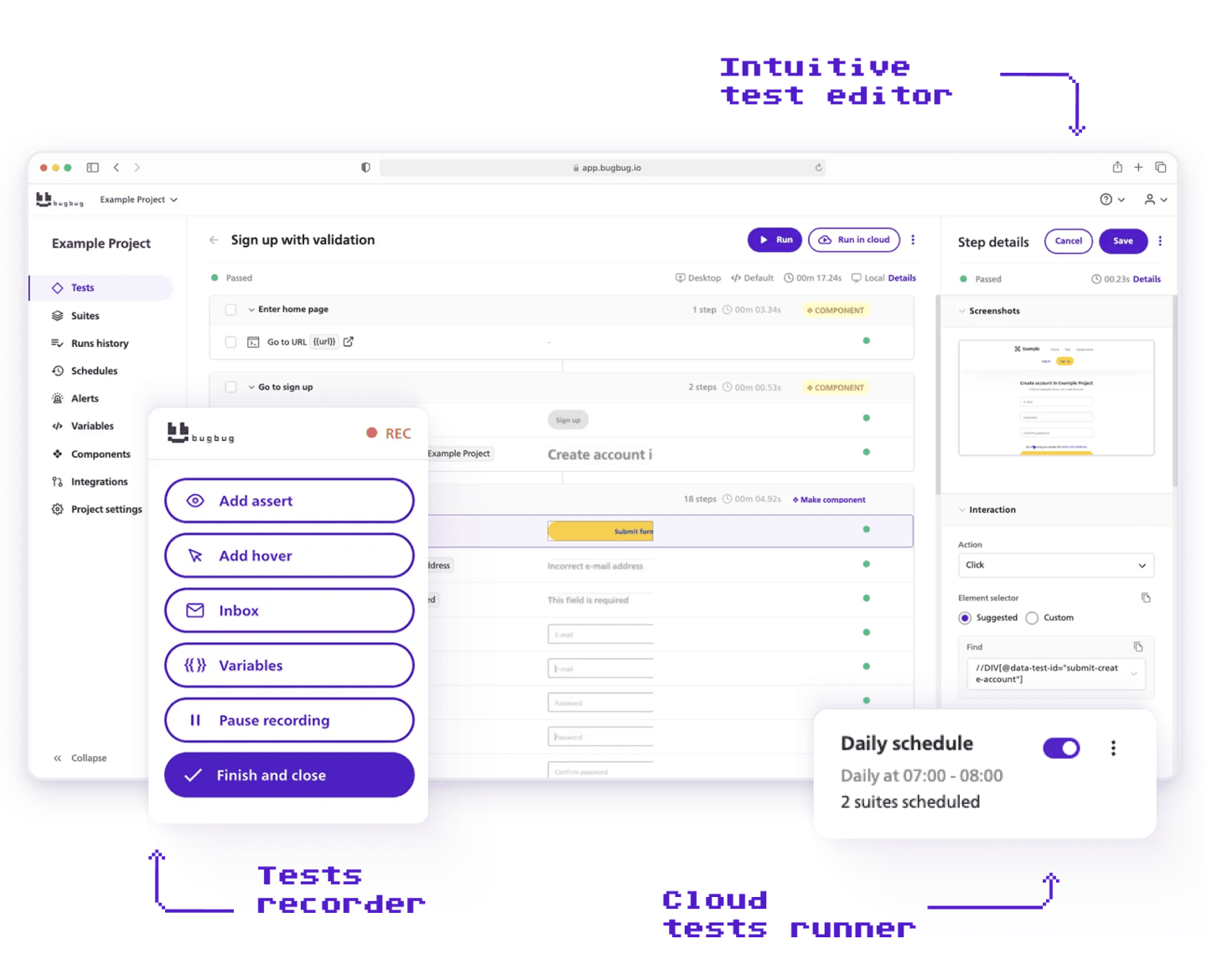
The people who understand your critical workflows record them by clicking through the app in Chrome — manual QA, a support lead, a product owner, not necessarily a developer. That's the [record-and-replay](https://bugbug.io/blog/test-automation-tools/record-and-play-automation-tools/) model, and it's the whole reason a non-engineer can produce a test at all. When a test breaks, Edit & Rewind inserts a step mid-journey and re-runs from that point instead of re-recording the whole thing, which is where visual-tool maintenance time actually goes. Signup and password-reset flows test end to end through a built-in email inbox. Reusable components mean one change propagates instead of forty.
And you can take the tests with you. Every test exports as readable YAML — steps, settings, components — on every plan including the free one, with a whole project exportable as a ZIP that carries suites, profiles and visual baselines. One caveat, stated plainly: that YAML describes what a test does, it isn't standalone Playwright or Cypress code, and it won't run outside BugBug. What it will do is give your team — or an AI assistant — a full, readable description of the flow to rebuild from, rather than a blank file and someone's memory.
A concrete example, because I'd rather show you one than describe the category. [Brand24](https://bugbug.io/case-study/brand24/) is a 100+ person SaaS with clients in 110 countries and no QA team. Their Product Owner, Krzysztof Studniarek, set up hourly monitoring of the production site himself — no IT involvement, no engineers assigned. Since April 2021 those tests have run more than 100,000 times and caught five business-critical issues, including users being unable to log in after a bad release and the pricing page rendering blank. Eight people get alerted, none of whom had to learn a framework.
Now the limits.
Chromium and Chrome only. No Firefox, no Safari, no native mobile, no desktop apps. Mobile is the most common reason we lose deals, and when a prospect needs it I tell them to go elsewhere.
Nobody builds the suite for you. A managed service sells you engineers. We don't. If your real constraint is that no one internally has three days for this, buy the service.
And I won't tell you that writing tests in code is hard. Playwright records interactions, debugs with time travel, and now ships agents that plan, generate and repair tests. If your team wants to own a Playwright stack, own it — we're the wrong tool for you. What AI keeps making cheaper is generating tests. What it doesn't touch is who's accountable for the checkout flow, whether an auto-repaired test still checks the outcome it was written for, and who reads the result at 9am with a release waiting. That gap is the product.
Pricing is published on the site. The free plan covers unlimited users, tests and local runs — unlimited users because per-seat pricing would punish exactly the cross-team ownership the tool exists to enable.
**Verdict:** the option where regression stays owned by the people who understand your product, without them becoming automation engineers or you becoming a platform team. Right when your product runs in a browser and that knowledge is already in the building. Wrong when it isn't.
If that's you: record the three flows that break most often on the free plan this week. No credit card, no call. You'll know within an afternoon whether this is an $84,000-a-year problem or one your own team can own.
## So What Should You Actually Do?
**Web, mobile and API, and nobody internal will ever own this.** Stay with MuukTest, or look at DeviQA if you'd rather have a dedicated pod than a platform — 16 years of track record, native iOS and Android, broad compliance, roughly $6,000–8,000/mo. Both are honest answers and I'd tell you the same on a call.
**You want a service and reliability outranks cost.** QA Wolf. Budget for linear growth.
**You're leaving over pricing opacity and you're web-only.** QA Guardian.
**You need the lowest managed number and your suite is small.** Bug0 — with the over-500 rate in writing.
**Regression is owned by manual QA, support or product, and you don't want to run a testing platform.** BugBug, if Chromium-only works for you. [Rainforest](https://bugbug.io/blog/test-automation-tools/rainforest-qa-alternatives/) if you need its editor and accept that leaving means starting over.
One last thing. Whichever of these you choose, write down the name of the person at your company who owns regression coverage. Not the vendor. The person.
If you can't fill in that name, no amount of money on this page will fix your quality problem. I learned that lesson with marketing, three agencies in. It cost me about a year.
Happy (automated) testing!