# Agentic Test Automation: What AI Test Agents Actually Do
Written by Dominik Szahidewicz
Reviewed by Mariusz Wójcik
Published: 2026-09-18
Updated: 2026-09-18
\[TABLE\_OF\_CONTENTS\]
Two people post in the same QA Slack channel this week. Both say they're "looking into agentic testing."
One means an agent that can read a Jira ticket and write a Playwright test from it. The other means checking whether their company's new AI chatbot hallucinates pricing information to customers.
Same phrase.
Two completely different problems, two different tool categories, two different buyers and right now, Google mostly can't tell them apart either.
That confusion is baked into the term itself. Agentic test automation is a real, fast-moving category: Testsigma, Tricentis, and mabl are all building it hard right now, and it's also, confusingly, two different categories wearing the same name.
This article is about the first one: AI agents that plan, write, run, or maintain tests for _your application_. If you're here for the second - evaluating whether an AI product behaves safely - you want agent evals, not test automation, and you should bounce now and save yourself 2,000 words.
For everyone else: here's what "agentic" actually means in a test suite, what today's tools can really do, and more importantly what they still can't.
`{"name":"purple-tip","children":[{"name":"purple-tip-title","children":[{"name":"paragraph","children":[{"attributes":{"bold":true},"data":"AI test agent ≠ testing an AI agent."},{"data":" "}]}]},{"name":"purple-tip-details","children":[{"name":"paragraph","children":[{"data":"An AI test agent is software that plans, writes, runs, or maintains tests for your application. Testing an AI agent is evaluating whether the AI agent itself behaves correctly: accuracy, hallucination, safety. This article is about the first one."}]}]}]} **AI test agent ≠ testing an AI agent.** An AI test agent is software that plans, writes, runs, or maintains tests for your application. Testing an AI agent is evaluating whether the AI agent itself behaves correctly: accuracy, hallucination, safety. This article is about the first one. `
## What "Agentic" Actually Means Here (and Why It's Not Just GenAI)
"Agentic" gets slapped on a lot of features that are really just GenAI with better copy. The distinction matters, so here's the short version.
[Generative AI](https://bugbug.io/blog/software-testing/generative-ai-in-software-testing/) answers one prompt and stops. You ask, it responds, the interaction ends. An agent does more than respond, it plans a sequence of steps toward a goal, takes action without a new prompt at every step, and adjusts when what it finds doesn't match what it expected. In testing terms: a GenAI feature turns "test the login flow" into one test case.
An agentic system plans the scenario, generates the steps, runs them, notices the button moved, and updates the test, without you writing a new prompt for each of those stages.
That's the theory. In practice, almost every agentic testing tool shipping in 2026 still keeps a human approval gate somewhere in the loop: reviewing a generated test before it runs in CI, or confirming a self-healed selector before it merges.
That's not a weakness worth hiding. It's the honest maturity level of the category right now, and any vendor claiming otherwise is describing a roadmap, not a product.
## The Two Different Things People Call "AI Test Agents"
Worth spelling out, because the confusion in the callout box above isn't hypothetical - it shows up in the actual search results for this topic.
**Agents that test your app.** This is the category BugBug and most of the vendors you've heard of sit in: Testsigma's Atto, the agentic layer inside Tricentis Tosca, mabl. These agents plan test coverage, [generate test cases](https://bugbug.io/blog/software-testing/ai-test-case-generation/) from requirements or recordings, execute them, and adapt when the UI changes. The goal is regression and functional coverage for software you built.
**Agents that evaluate AI products.** A separate, younger discipline: testing whether an AI feature - a chatbot, a copilot, an agent your own product ships - gives accurate answers, avoids hallucination, and stays within guardrails. Different metrics (accuracy, safety, drift), different vendors, different buyers. It's a real and growing field. It's just not this one.
If you searched "agentic testing tools" and landed here trying to solve the second problem, you now know which term to search instead. Everyone else, keep reading.
`{"name":"purple-tip","children":[{"name":"purple-tip-title","children":[{"name":"paragraph","children":[{"attributes":{"bold":true},"data":"💡 "},{"attributes":{"bold":true,"linkHref":"https://bugbug.io/blog/test-automation-tools/ai-tools-for-testing/"},"data":"Check a list of best AI tools for testing in 2026"}]}]},{"name":"purple-tip-details","children":[{"name":"paragraph"},{"name":"paragraph"}]}]} **💡** [**Check a list of best AI tools for testing in 2026**](https://bugbug.io/blog/test-automation-tools/ai-tools-for-testing/) `
## What Agents Actually Do Today (Mapped, Not Marketed)
Strip the adjectives off the vendor homepages and the real capability set in current agentic AI software testing is narrower, and more useful than "AI writes your tests." Here's what's actually shipping:
| Capability | What it looks like in practice | Where you'll see it |
| --- | --- | --- |
| Test generation from source material | Turns a Jira ticket, a Figma file, a screen recording, or a plain-English description into a runnable test | Tricentis Tosca generates test cases directly from natural-language prompts; Testsigma's Atto does the same from Jira stories, PRDs, and journey videos |
| Self-healing execution | When a button moves or a selector breaks, the AI agents adapt to UI changes without predefined scripts by updating the selector instead of failing the run | Testsigma's Healer agent; mabl's auto-heal |
| Autonomous scheduling and execution | Uses intelligent agents to autonomously execute tests, then runs and re-runs suites without a human triggering each run | Standard across most agentic platforms once a suite exists |
| Failure triage | Groups failures, suggests likely causes, sometimes drafts the bug report | Testsigma's Analyzer/Bug Reporter agents |
| Coverage and risk prioritization | Flags what changed in the last commit and uses real-time decision-making to choose the most relevant tests for test execution after a change, instead of running everything every time | Increasingly common in enterprise agentic suites |
That's a real, useful set of capabilities.
The goal is regression and functional coverage, with clear value for regression testing and catching hidden application crashes. These agents can also explore web and mobile applications for edge-case scenarios, helping with expanding test coverage and improving software testing and software quality.
It's also not "hands-off testing."
`{"name":"dotted-frame","children":[{"name":"dotted-frame-details","children":[{"name":"paragraph","children":[{"data":"The World Quality Report 2025–26 found that while "},{"attributes":{"bold":true},"data":"89% of organizations are piloting or already running GenAI "},{"data":"somewhere in quality engineering, only 15% have gotten it to enterprise scale and 60% of respondents named hallucination and reliability as a top concern about using it at all. "}]},{"name":"paragraph","children":[{"data":"Flaky test rates, meanwhile, have "},{"attributes":{"bold":true},"data":"gone up"},{"data":", not down, since AI-generated code started shipping faster than test coverage could keep pace with - from roughly 10% of teams reporting flakiness in 2022 to 26% in 2025."}]}]}]} The World Quality Report 2025–26 found that while **89% of organizations are piloting or already running GenAI** somewhere in quality engineering, only 15% have gotten it to enterprise scale and 60% of respondents named hallucination and reliability as a top concern about using it at all. Flaky test rates, meanwhile, have **gone up**, not down, since AI-generated code started shipping faster than test coverage could keep pace with - from roughly 10% of teams reporting flakiness in 2022 to 26% in 2025. `
None of that means agentic testing doesn't work. It means "agentic" describes a capability level, not a finished state, and that teams still need quality assurance guardrails even as optimize tests workflows and autonomous test execution promise faster feedback loops on each code commit despite current reliability limits.
Treat any [demo](https://bugbug.io/demo/) that shows zero human involvement as a demo, not a workflow you'll actually run on Monday.
## What Agentic Testing Still Doesn't Solve
Here's the part vendor pages skip, because it's not a feature you can put on a pricing table.
Unlike traditional automation, an agent can write a test faster than a person can as part of the testing process. It can't decide who's accountable when that test is wrong, or when it stops failing for the wrong reason.
Four things stay a human, and an organizational problem no matter how capable the agent gets, so the near-term model is more ai assisted than fully autonomous, with human expertise still required across the [testing lifecycle](https://bugbug.io/blog/software-testing/bug-life-cycle/):
* **Ownership.** Someone has to own each test after the agent creates it. "The agent wrote it" isn't an answer when a release ships broken anyway.
* **Governance.** Permissions, audit history, and who approved what. An agent that can silently edit a test suite without a record of the change is a liability, not a feature, especially when continuous monitoring raises privacy and data security concerns and still calls for human oversight.
* **Test intent.** A self-healed test that stops failing might just be testing the wrong thing now. Fixing the selector isn't the same as confirming the test still validates the outcome it was written to check.
* **Cross-team operation.** Schedules, environments, escalation paths, who gets paged when something breaks. No agent decides your team's incident process for you, even if execution runs with minimal human oversight.
**This is the honest ceiling on "autonomous" testing in 2026:** agents are getting very good at the mechanics of test creation and maintenance. The practical future is blending AI agents with human expertise, not replacing people with agent-only ownership of quality.
## Where BugBug Fits (and Where It Doesn't)
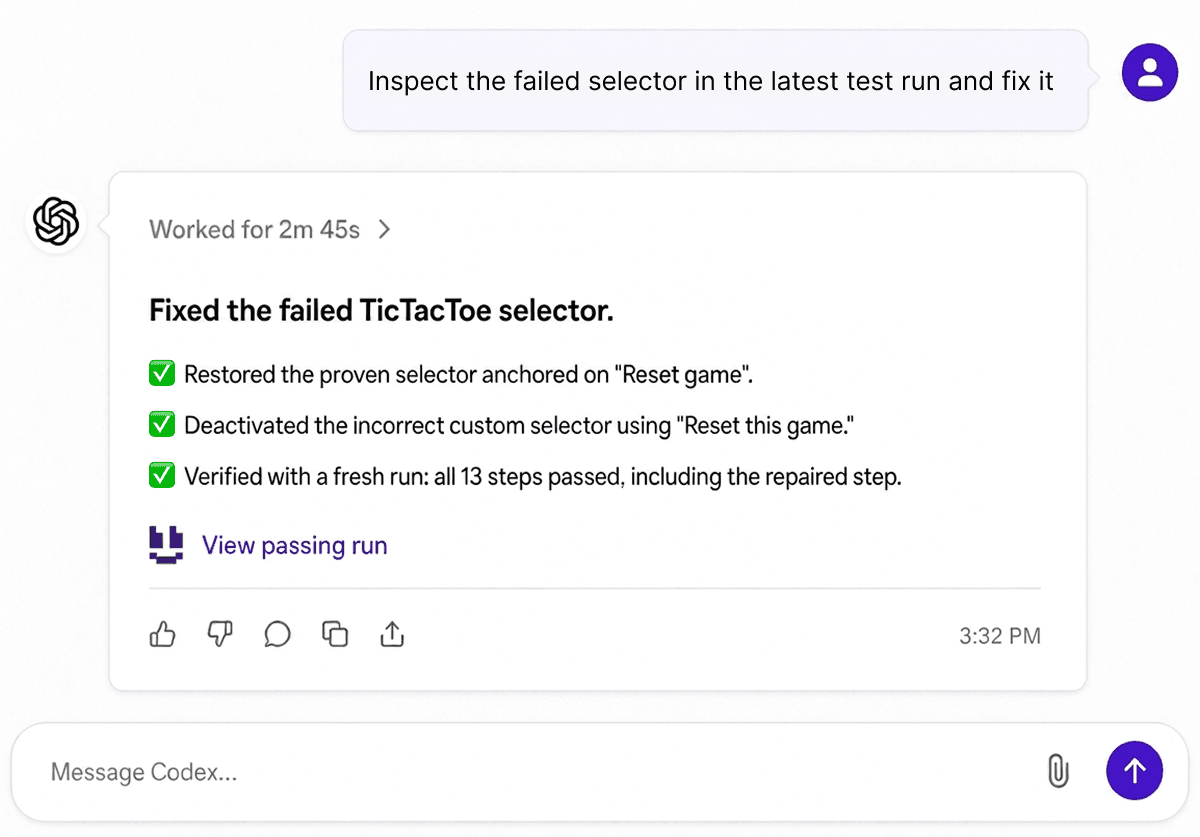
Worth being direct about this, because BugBug isn't chasing the same bet as the biggest names in this space.
Testsigma and Tricentis are building toward full-lifecycle, multi-agent orchestration: planning, generating, executing, healing, and optimizing tests across web, mobile, API, and enterprise systems like SAP and Salesforce, usually with enterprise pricing and infrastructure to match.
That's a real, serious play, and it's not BugBug's. They also move beyond traditional test automation, where fixed scripts struggle with changes and create more broken tests as applications evolve.
BugBug's bet is narrower and more specific: **a visual web test recorder** that a product manager, support lead, or manual tester can use without writing code, so non-technical users can contribute to quality assurance, producing tests structured enough (in [**YAML**](https://bugbug.io/test-import-export/)) that a developer can review and edit them, and reachable by an AI coding agent through [**MCP**](https://bugbug.io/blog/software-testing/how-to-use-mcp-for-test-automation/), so the test suite stays one shared, governed asset instead of a black box only the recorder-user understands.
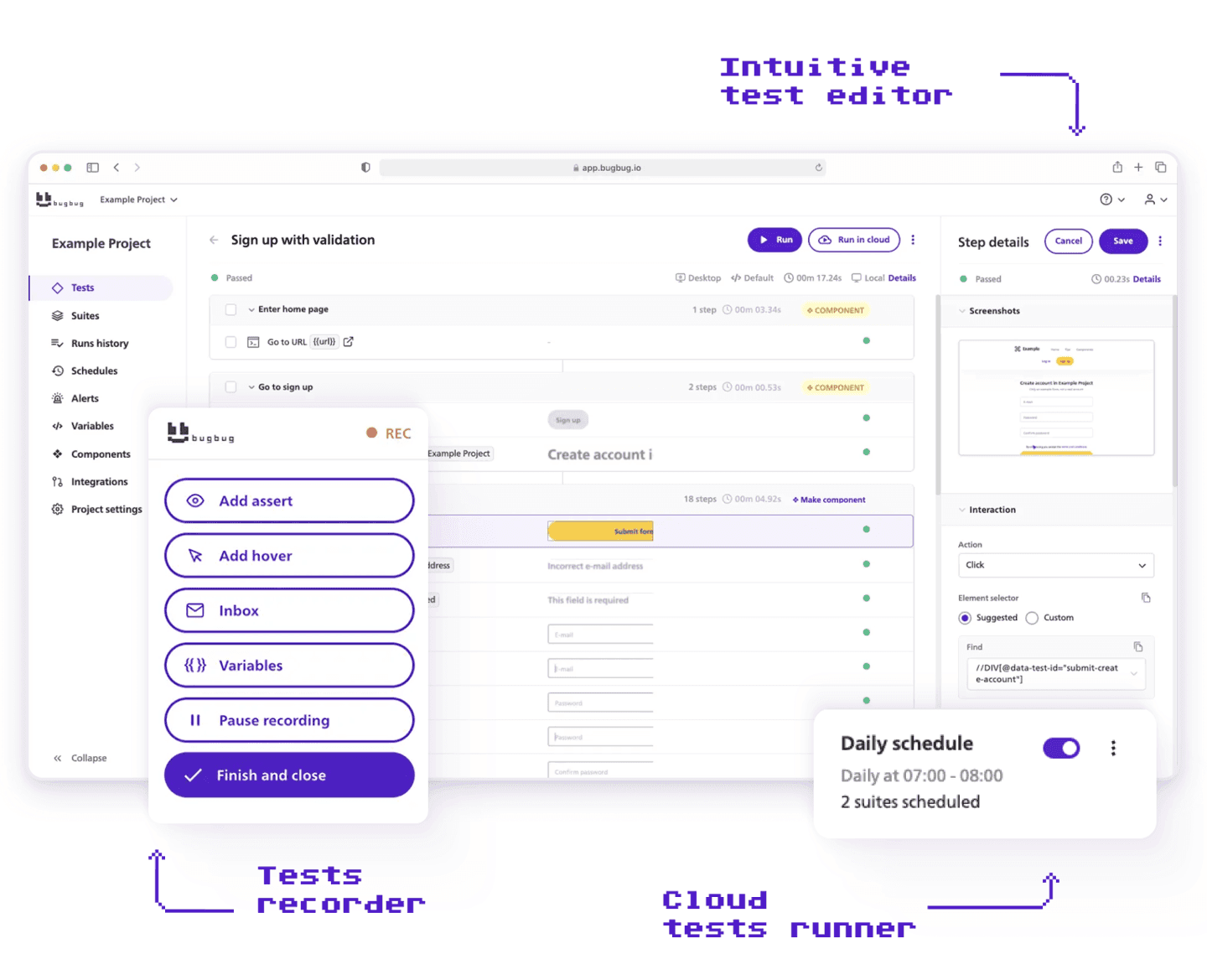
That makes it practical for QA teams and lean testing teams working inside fast-moving software development environments, where manual testing still has a place but repetitive regression work does not need to stay manual. It's Chromium/Chrome only, and it's not trying to out-orchestrate a platform built for SAP regression at enterprise scale.
If your team's problem is "we need [regression coverage](https://bugbug.io/automated-regression-testing/) a non-engineer can own, that a developer or an AI coding agent can still work with" without standing up an agent orchestration platform to get there - that's the specific gap BugBug is built for, and the lighter model can reduce test maintenance overhead by up to 90% when UI changes are frequent.
[BugBug's free plan](https://bugbug.io/pricing/) is the fastest way to see whether that model fits your team before you commit to anything bigger.
`{"name":"cta-card","children":[{"name":"cta-card-title","children":[{"name":"paragraph","children":[{"attributes":{"bold":true},"data":"Automate your tests with BugBug"}]},{"name":"paragraph"}]},{"name":"cta-card-details","children":[{"name":"paragraph","children":[{"data":"BugBug's free plan is the fastest way to see whether that model fits your team before you commit to anything bigger."}]}]},{"name":"cta-card-cta","children":[{"name":"paragraph","children":[{"attributes":{"bold":true},"data":"Start testing. It's free."}]},{"name":"paragraph"}]}]} **Automate your tests with BugBug** BugBug's free plan is the fastest way to see whether that model fits your team before you commit to anything bigger. **Start testing. It's free.** `
## How to Evaluate an "Agentic Testing" Claim
Every vendor in this space says "agentic" now. Here's what to actually ask in a demo before the word means anything on a pricing page:
1. **What does the agent decide on its own, and what does it just execute?**
"Agentic" and "automated" get used interchangeably in sales decks. They're not the same thing. Also ask how agentic testing works in practice: is the system intent-driven through natural language understanding, or just replaying rigid scripted steps?
2. **Can a human see and approve a change before it ships, or does it happen silently?**
If you can't find the approval step in the demo, ask where it is.
3. **What does it need to work?**
Jira, Figma, a mature CI pipeline - or does it work from what's already sitting in the browser? Ask whether test scenarios can be defined in plain English and executed immediately from that description, because agentic AI executes based on intent rather than rigid steps. That answer tells you how much setup you're actually signing up for.
4. **Who owns the test after the agent creates it specifically, in your organization?**
If the answer is "the tool," that's not an answer.
5. **What happens when it's wrong?**
Every agent will eventually generate a bad test or heal the wrong selector. Ask what happens when a test fails, whether the platform can explain the failure, recover from broken tests, and how much maintenance overhead still falls on your team, especially if it claims to reduce repetitive tasks or cut upkeep by up to 90%.
`{"name":"yellow-tip","children":[{"name":"yellow-tip-title","children":[{"name":"paragraph","children":[{"attributes":{"bold":true},"data":"💡 TIP"}]}]},{"name":"yellow-tip-details","children":[{"name":"paragraph","children":[{"data":"Ask about scale, too: can the platform handle ai testing workloads by running hundreds of tests simultaneously, and do its testing strategies actually support common agentic testing at enterprise volume?"}]}]}]} **💡 TIP** Ask about scale, too: can the platform handle ai testing workloads by running hundreds of tests simultaneously, and do its testing strategies actually support common agentic testing at enterprise volume? `
Ask those five questions before "agentic" means anything on anyone's pricing page - BugBug's included.
Happy (automated) testing!